
Repair Hub · Phoenix Metro
Ceiling Crack Repair That Stays Closed Through Summer and Winter
Straight seam cracks, wall-line gaps, and settling cracks overhead, read correctly, taped with setting compound, and re-textured so the ceiling stops keeping score.
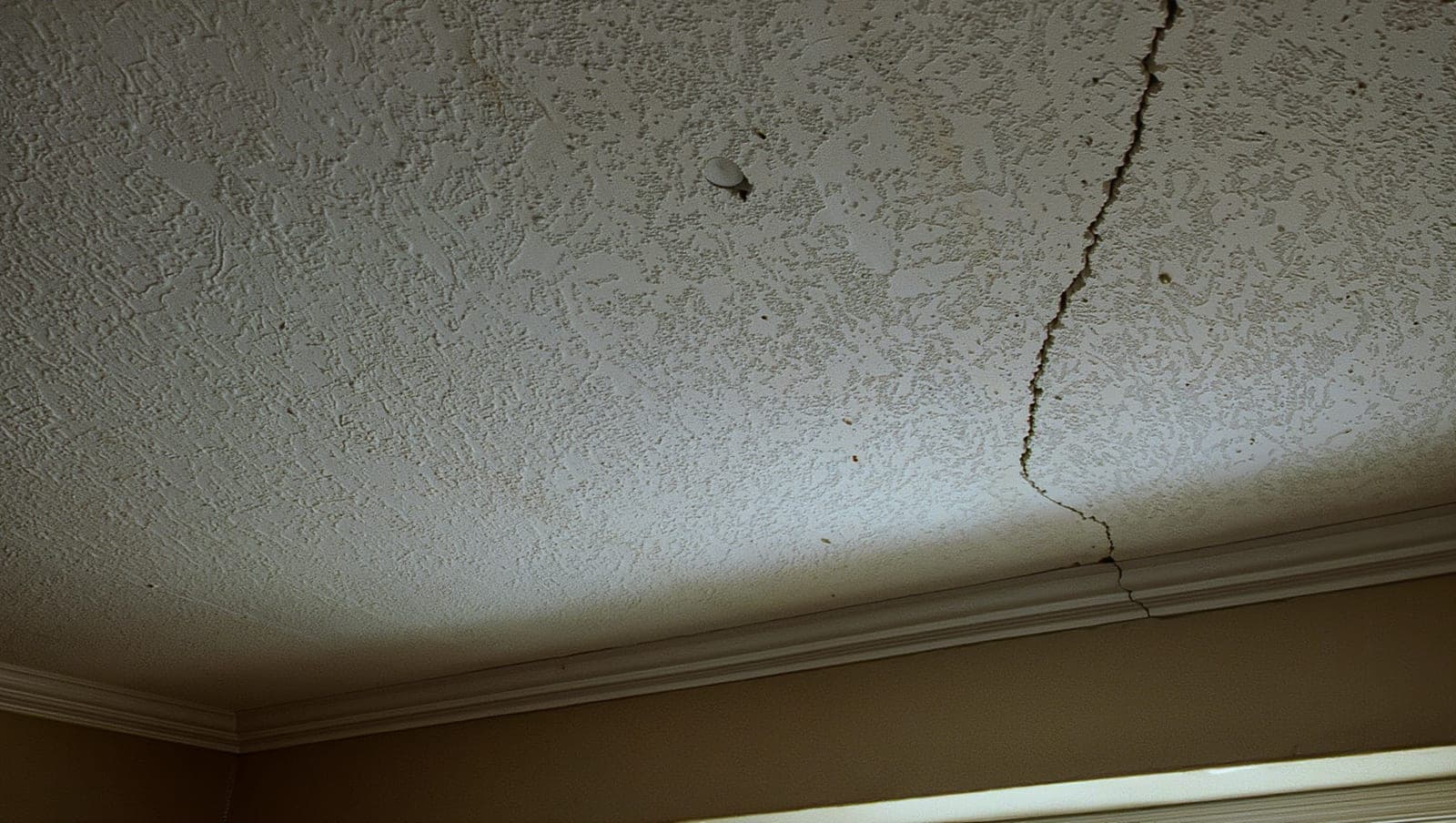
A ceiling crack is a line where the drywall gave up trying to hold two moving things together. Ceilings in Phoenix are screwed to the bottom chords of roof trusses, and trusses are not still. In a slab-on-grade house with an attic that runs far hotter than the air outside, the top chords and the bottom chord live in different climates. The top chords take on moisture from monsoon humidity and cooler nights while the bottom chord, buried in insulation, stays dry, and the difference bows the truss upward by a fraction of an inch. The ceiling drywall near the interior walls lifts with it, and the joint between ceiling and wall opens. When the attic dries out, the truss relaxes and the gap closes. The paint records every cycle as a crack. That is truss uplift, the most common ceiling crack in the Valley and the most misunderstood.
The other cracks have their own signatures. A hairline that runs dead straight across the room, often four feet from a wall or dividing the ceiling in halves, is a tape joint that has let go, usually a butt joint with too little compound over it. A crack that starts at the corner of a skylight, a ceiling register, or a can light and runs a foot or two at an angle is stress concentrating at the opening. A web of fine cracks that stay in the paint and texture and do not go through the board is a finish problem, often texture sprayed too heavy or paint applied over dusty compound. A crack that arrives together with a sag between trusses, or with a stain, is not a crack problem at all. The board is failing or wet, and that is a different repair.
Bleuwave Handyman reads the crack before touching it, then matches the repair to the cause. Seam cracks are opened into a shallow V, the failed tape is cut out, and the joint is re-taped with paper tape bedded in setting-type compound and feathered with twelve-inch knives so the repair is a slope, not a ridge. Truss uplift at the wall line is not filled and forgotten. Where the gap opens every year, we float the ceiling edge by removing the fasteners nearest the wall so the drywall can flex, or we install crown molding fastened to the ceiling only, which lets the joint move behind it. A crack that is just texture and paint is scraped, skimmed, and re-textured. Everything is primed and painted to a corner, because a ceiling repainted in a square is a ceiling with a square on it.
Ceilings hold their cracks up to the light for everyone to see, and they end up on inspection reports, on tenant move-in photos, and in every real estate listing where a buyer looks up. Property managers see the same crack in the same spot across a floor plan, because the trusses came from the same plant and were hung by the same crew. We can identify which cracks in a building are truss movement and which are failed joints, and fix each the way it needs, on a schedule that fits turns.
A ceiling crack that has been painted twice is a crack that has been misdiagnosed twice. The estimate is free, we will tell you what the crack is, and the repair will be built to outlast the next monsoon rather than the next coat of paint.
Signs you need ceiling cracks
- A gap or crack where the ceiling meets an interior wall, wider in some months than others, often near the center of the house.
- A ruler-straight hairline crossing the ceiling, frequently four feet from a wall or at the room's midpoint.
- A short angled crack running from the corner of a skylight, register, can light, or attic hatch.
- Paint and texture cracked in a fine web that does not go through the board, often on ceilings with heavy knockdown.
- A crack that has been filled and painted and has reopened in the same place.
- A crack accompanied by a stain, a bow between trusses, or texture falling, which points to board or water rather than a simple seam.
Not sure this is your problem?
Start with a diagnosis. These questions end at this repair:
How the repair is done
- 1
Read the crack, and check the attic when it matters
A low-angle light and a straightedge across the crack tell us whether the board is flat or sagging on one side. A moisture meter runs along its length. For wall-line gaps and any crack under a bathroom, air handler, or roof penetration, we go into the attic and look at the trusses, the insulation, and whatever is running above the crack, since a sweating condensate line over a bedroom changes the plan entirely.
- 2
Open seam cracks and re-tape them
The crack is cut into a shallow V with a utility knife and the failed tape is removed back to sound bond. Loose board along the seam is refastened to the truss with drywall screws. The joint is prefilled with 45-minute setting-type compound, paper tape is embedded and skimmed, and two more coats follow with ten- and twelve-inch knives, feathered a foot to each side so the ceiling reads flat in raking light.
- 3
Detail truss uplift as movement, not damage
Where the ceiling lifts at an interior wall each season, the ceiling screws within about sixteen inches of the wall are removed so the board can float and flex with the truss, with the edge supported by the wall board and clips or blocking where needed. Where the homeowner prefers, crown molding is installed and nailed to the ceiling only, so the joint moves behind it out of sight. Flexible caulk is a supplement to these details, never the fix.
- 4
Fix finish-only cracks at the surface
When the crack lives in the texture and paint and the board beneath is sound, the loose texture is scraped back, the area is skimmed with topping compound, sanded, and re-textured. It is quicker than a seam repair and it is the wrong repair for anything that goes through the board, which is why we check first.
- 5
Texture, prime, and paint the whole ceiling
Knockdown or orange peel is sprayed from a hopper gun after a test pass on cardboard, and knocked down on the same timing the original had. Popcorn is patched with acoustic texture. The repair is primed with PVA and the ceiling is painted corner to corner, with floors and furniture covered and the dust vacuumed out before we leave.
What it costs in Phoenix
In the Phoenix market, a single straight seam crack on a ceiling, re-taped, textured, and primed, typically lands in the low hundreds, and painting the ceiling corner to corner, which most ceiling repairs need to disappear, adds to that. A room with several cracks or a truss-uplift detail at the wall line, whether a floated edge or crown molding, more often runs into the mid hundreds and can go higher on large or vaulted ceilings. Cracks that turn out to be a sagging or wet panel are priced as that repair. These are ranges for orientation. The free estimate will say which kind of crack you have and what the specific fix costs.
Do it yourself, or call someone?
A hairline that stays in the paint is a fair weekend job: scrape, skim, sand, spot texture, paint the ceiling. A seam crack can be done by a patient homeowner who is willing to tape rather than fill, and to work overhead with a mud pan for two days. Where we would step in is truss uplift, because filling the gap makes the crack worse next season, and the fix involves fasteners and framing rather than compound. Also any crack with a companion: a stain, a bow, texture dropping, or a length that has grown since you first noticed it. Those call for someone who can get into the attic and tell you what is going on above the board, and that visit is free.
Can a handyman repair drywall? The honest answerWhat is included
- Straight seam and butt-joint cracks re-taped with paper tape and setting compound
- Truss uplift at the wall line handled with floated edges or crown molding
- Stress cracks at skylights, registers, can lights, and attic hatches
- Finish-only cracks scraped, skimmed, and re-textured
- Attic-side inspection of trusses, insulation, and anything leaking above the crack
- Knockdown, orange peel, and popcorn ceiling texture matched
- Primer and corner-to-corner ceiling paint so the repair has no edge
- Floor and furniture protection, dust control, and cleanup
Why Phoenix calls Bleuwave
- We diagnose before we mud. A truss-uplift crack and a failed seam look alike from the floor and need opposite repairs.
- Movement cracks get a detail that moves. Caulk in a wall-line gap is a promise the ceiling will break every fall.
- Paper tape in setting compound on every seam, feathered wide, so the ceiling reads flat in raking light.
- We look above the crack. A condensate line or a roof penetration over the repair changes the whole plan, and the Bleuwave family includes licensed HVAC and plumbing companies when it does.
- Floor-plan-wide crack surveys for property managers, so one walk tells you what the whole building needs.
- Licensed, insured, and bonded, Veteran Owned & Operated since 2022, with free estimates and same-day or next-day scheduling within 35 miles of Phoenix.
Questions Phoenix homeowners ask
When should I worry about a ceiling crack?
Worry about the company it keeps. A straight hairline or a seasonal gap at the wall is cosmetic. A crack paired with a visible sag, a stain, texture coming down, or a width that grows week to week means the board is failing or something above it is wet, and it should be looked at soon. A wide crack that appears suddenly after a storm, or one accompanied by doors that stop closing, calls for a same-day visit.
What is truss uplift, and can it be fixed?
Truss uplift is the seasonal bowing of roof trusses caused by the top and bottom chords holding different amounts of moisture. It lifts the ceiling at interior walls and opens a gap along the joint. It cannot be stopped, but the ceiling can be detailed so it no longer shows: float the ceiling drywall near the wall so it flexes with the truss, or install crown molding attached to the ceiling only. Both hide the movement for good.
Is a crack in the ceiling a sign of roof or foundation problems?
Rarely on its own. Roof trouble shows up as stains before cracks, and foundation movement shows up first at doors, windows, and the slab. A ceiling crack that runs continuously down a wall to a door corner deserves a closer look. Most ceiling cracks in the Valley are truss movement or failed joints, and we will tell you plainly if yours looks like more.
Why does my ceiling crack in the same place every year?
Because it is moving every year in the same place and has only ever been filled. Compound and paint are rigid. If the crack is a tape failure, the joint needs to be re-taped so it has strength. If it is truss uplift, no filler will hold, and the joint needs to be allowed to move behind a floated edge or molding.
Can you repair a ceiling crack without repainting the whole ceiling?
On a recently painted ceiling with matching paint on hand, sometimes. On most ceilings, touch-up over a repair shows as a rectangle of slightly different sheen once the sun moves across it. We price the ceiling corner to corner by default and will tell you if a blend is realistic.
How long does a ceiling crack repair take?
Typically two visits over two or three days. Tape and setting compound go in on the first visit, the finish coats and texture follow once they cure, and paint comes last. A floated edge or crown molding for truss uplift adds carpentry but not usually extra days.
Related repairs
Guides worth ten minutes
Guide · 8 min read
Repair vs. Replace Damaged Drywall
Most drywall damage can be patched. Some of it should not be. Here is a framework, a decision table, and the water-damage rule of thumb that settles most arguments.
Guide · 8 min read
How Much Does Drywall Repair Cost in Phoenix?
The same doorknob hole can draw three different prices from three honest people. Here is what each of them counted, what the Phoenix ballparks look like, and how to get a number you can hold someone to.
Elsewhere on the site
Related services, nearby city pages, and reading that pairs with this repair.
Looking for the service page? See how we handle this as a scheduled service, or browse all services.
Stop repainting the same line. Get a free estimate on your ceiling.
Licensed, insured & bonded · Veteran Owned & Operated since 2022 · Serving 35 miles around Phoenix.