
Repair Hub · Phoenix Metro
Orange Peel Texture Repair Matched Spatter for Spatter
The Valley's default wall finish, sprayed to the same droplet size and density as the original so the patch has no outline.
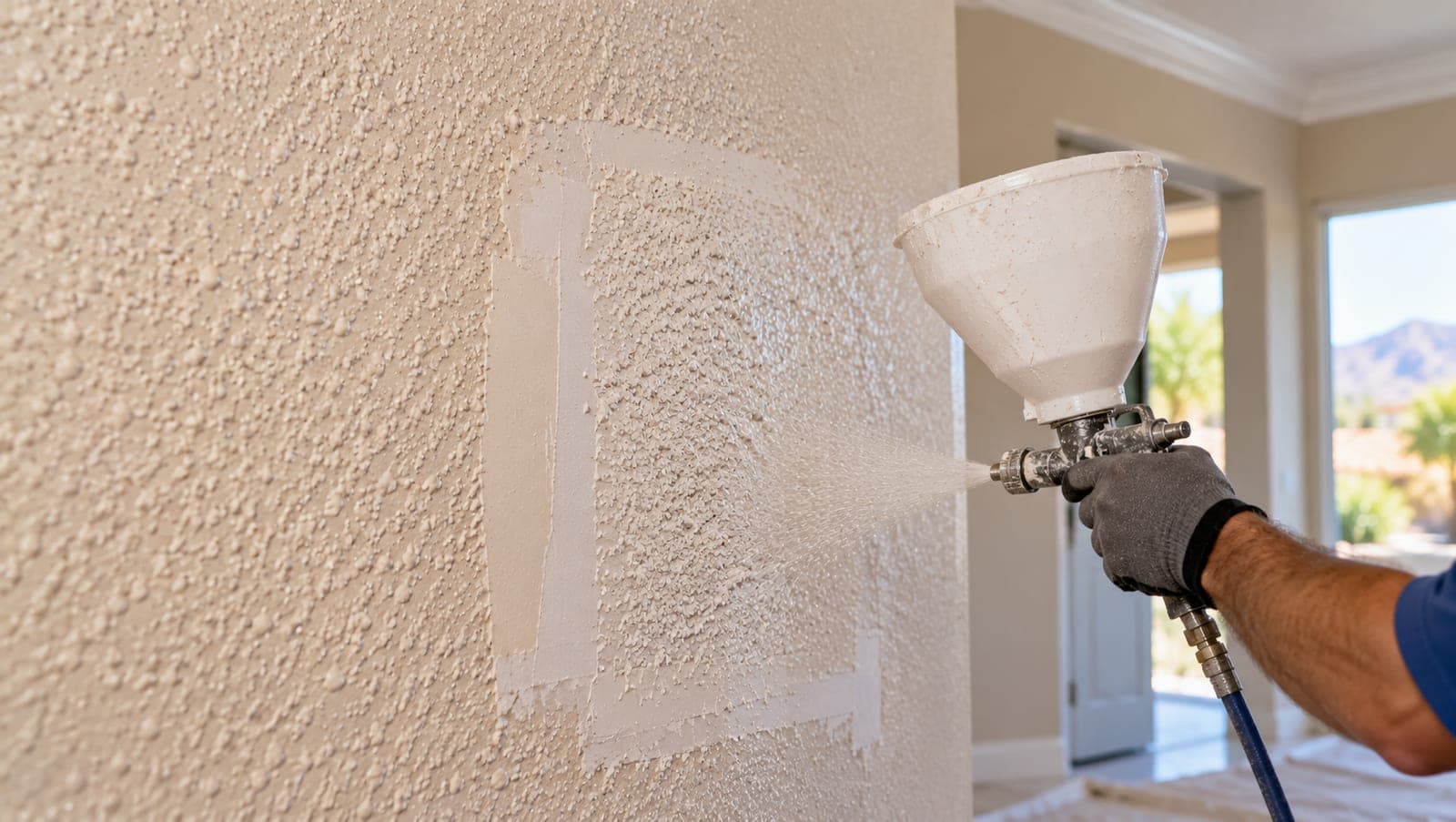
Orange peel is the texture on most walls in the Phoenix metro, and it is there for reasons that had little to do with beauty. It is fast. A hopper gun and a compressor can texture a whole house in a day, and the fine spatter hides taped seams, screw dimples, and the small waves in a wall that would otherwise show under the low desert sun. Builders in the Valley adopted it wholesale, and it is the finish in the great majority of production homes from the 1970s onward, in apartments, and in nearly every commercial suite with drywall partitions. The pattern is thinned joint compound sprayed as fine droplets that land and slump slightly before they dry, leaving a surface with the soft dimpling of the fruit it is named for. It comes in fine, medium, and heavy, and no two houses, and sometimes no two rooms, were sprayed at quite the same setting.
That variety is the whole difficulty of repairing it. Orange peel is a statistical surface. The eye does not see individual droplets; it sees the average size, the spacing, and the way shadows fall across thousands of them at once. Change the average even slightly, spray droplets that are a bit finer or a bit farther apart, and the patch reads as a different fabric sewn into the wall. It does not matter that it is flat, that it is primed, that the paint came from the same can. Aerosol texture cans, the tool of most quick repairs, produce a droplet that is smaller and rounder than a hopper's and a pattern that sits in a tight circle with a hard edge. That is why a rental hallway so often looks as though it was patched by four different people, which it usually was.
Bleuwave Handyman matches orange peel with the tool that made it. Once the patch is flat and primed, we thin all-purpose compound to the consistency of the original, load a hopper gun, and set the orifice and the compressor pressure on a test board beside the wall until the droplets are the same size and the coverage the same density as the surrounding surface. Then we spray past the edges of the repair with a lighter hand toward the outside, so the new spatter thins into the old across several inches instead of stopping at a line. Once dry, the texture is primed so it takes paint like the rest of the wall, and the wall is painted corner to corner.
For property managers, orange peel is the texture on almost every unit, and the mismatch is what makes a turned unit look patched rather than fresh. We texture consistently across a whole unit, correct old aerosol repairs that stand out, and re-spray entire walls when a wall has collected enough patches that matching them one at a time no longer makes sense. The hopper works at scale. A hallway with thirty patches gets the same setting on every one.
If you are looking at a patch that is smooth where the wall is dimpled, or dimpled where the wall is smoother, the fix is a texture pass and a coat of paint, not another patch. It is a short visit. Estimates are free.
Signs you need orange peel
- A repaired spot that is smoother than the surrounding wall and reads as a flat patch when sun comes through the window at an angle.
- A tight circle of fine mist from an aerosol texture can, with a visible edge where the spray stopped.
- Texture that is heavier over an old repair because new spatter was sprayed on top of the original instead of blended into it.
- Bare compound left untextured after an electrician, plumber, or cable installer closed an access hole.
- Orange peel sanded flat around a crack or seam repair, leaving a smooth stripe along the joint.
- A wall with so many mismatched patches that it looks quilted, common in rentals after several turns.
How the repair is done
- 1
Read the original and get the patch flat
We find an unpainted or lightly painted spot, inside a closet or behind a switch plate, to see the texture as it was sprayed and judge it fine, medium, or heavy. The patch itself is finished with setting-type compound, feathered with a 12-inch knife, sanded with a fine sanding sponge, and checked under a straightedge. Orange peel hides a dimple. It does not hide a hump, and it does not hide a patch that drinks the texture because it was never primed.
- 2
Mix and thin the compound
All-purpose joint compound is thinned with water and mixed with a paddle until it flows like thin pancake batter, then adjusted from there, because consistency is the single biggest control on droplet size. Thicker mix throws larger, heavier spatter. Thinner throws a fine mist. In July we mix small batches and keep the hopper covered, since compound skins over quickly in dry heat.
- 3
Dial in the hopper on a test board
The hopper gun takes interchangeable orifices, and the compressor regulator sets the air. A smaller orifice at higher pressure makes finer spatter; a larger orifice at lower pressure makes heavier. Most orange peel lands somewhere in the twenties to forties of pounds per square inch, depending on the mix. We spray scrap drywall or cardboard held against the wall, compare under the same light, and adjust until the test board disappears against the original.
- 4
Spray the patch and feather the edges
Floors, trim, and adjacent surfaces are masked. The patch is sprayed from a steady distance, then the gun moves outward in quicker, lighter passes so coverage thins across several inches of the old texture. That overspray zone is where the blend happens. We avoid double-covering the patch itself, which is how a repair ends up heavier than the wall around it.
- 5
Prime the texture and paint to the corners
New spatter is raw compound and absorbs paint differently from painted texture, so it is primed before finish paint. Then the wall is painted corner to corner, and a ceiling end to end, so there is no sheen change to give the repair away. Eggshell and satin walls are least forgiving of a spot paint, and we say so before the estimate is signed.
What it costs in Phoenix
A single orange peel patch in the Phoenix market, texture included, generally lands in the low hundreds, with the texture pass a small share of that and the wall paint a larger one. Correcting a handful of old aerosol repairs on one wall costs little more than one, because the hopper is already set up. Re-spraying a whole wall or a room's ceiling is priced by the square foot and runs into the hundreds. Those are ballparks with the usual caveats about access, ceiling height, and paint. The specific number is a free estimate, and we give it in writing.
Do it yourself, or call someone?
Orange peel is the friendliest texture to attempt at home. For a patch the size of a coaster, a water-based aerosol texture can sprayed onto a primed patch from the distance on the label will get you close, provided you practice on cardboard first and paint the whole wall afterward. Push the can much past that size and the small, round droplets and the hard circular edge start to show. Renting a hopper gun and compressor is the real answer, and it is a genuine learning curve, because the mix consistency, the pressure, and the distance from the wall all change the pattern at once. If your patch is bigger than a hand, on a ceiling, in a bright room, or one of several in a unit that has to pass an inspection, hire it out and keep the Saturday.
Can a handyman repair drywall? The honest answerWhat is included
- Orange peel texture matching on walls and ceilings in fine, medium, and heavy
- Hopper gun and compressor texture, never an aerosol can on anything larger than a coin
- Test-board matching of droplet size and density before the wall is sprayed
- Feathered overspray so the new pattern thins into the original with no edge
- Correction of previous aerosol and over-heavy texture repairs
- Texture over closed access holes, crack repairs, and patched seams
- Full-wall and full-ceiling re-spray when a surface has too many patches to blend
- Primer over new texture and corner-to-corner paint
Why Phoenix calls Bleuwave
- We match on cardboard beside the wall, under the same light, and we do not spray the wall until the test board disappears against it.
- Compound is thinned and mixed for the job. Consistency is the biggest lever on droplet size, and a batch mixed for knockdown does not make orange peel.
- The patch under the texture is flat and primed first. Orange peel hides a dimple; it does not hide a hump or a thirsty patch.
- Overspray is feathered, not cut off. The blend zone around the repair is where an invisible patch is made or lost.
- Consistent texture across whole units and suites for turns and work orders, scheduled around occupancy within 35 miles of Phoenix.
- Licensed, insured, and bonded, Veteran Owned & Operated since 2022, with free estimates on every repair.
Questions Phoenix homeowners ask
How is orange peel texture applied?
Joint compound is thinned with water and sprayed through a hopper gun driven by an air compressor. The droplets land on primed drywall, slump slightly, and dry in place. Droplet size is controlled by the mix consistency, the nozzle orifice, and the air pressure, and coverage density by how fast the gun moves. Unlike knockdown, nothing touches it after it is sprayed.
Why does spray-can orange peel never quite match the wall?
A can atomizes the compound differently from a hopper. The droplets are smaller and rounder, the pattern is denser in the middle of the spray and thin at the rim, and the spray stops in a circle instead of feathering out. On a spot the size of a coin nobody notices. On a spot the size of a hand, the circle shows in afternoon light no matter how well it is painted.
Why does the repaired area look heavier than the rest of the wall?
Usually because new texture was sprayed over the old rather than into it, so the patch carries two layers of spatter. Sometimes the mix was too thick, or the patch was sprayed twice to cover a thin spot. The fix is to knock the heavy area down with a sanding sponge, skim it lightly if needed, and re-spray at the right mix with feathered edges.
Does the texture go on before or after painting?
Before. The order is patch, prime the patch, texture, prime the texture, then paint. Skipping either primer is a common shortcut and a common reason a patch shows as a dull or shiny square. Texture sprayed over glossy paint without primer also adheres poorly and can flake later.
Can you texture over the smooth spot a plumber or electrician left?
Yes, and it is one of the most common calls we get. Trades close their access holes with compound and leave the texture and paint for someone else. We check that the patch is flat and taped, prime it, spray orange peel to match, prime again, and paint the wall. It is a short visit unless the patch underneath needs redoing.
Can orange peel be repaired on a ceiling?
Yes. The process is the same, with more masking below and a lighter mix so the spatter does not sag before it dries. Ceilings show mismatches more than walls because light crosses them sideways from the windows, so the test board matters even more and the whole ceiling gets painted in flat afterward.
Related repairs
Guides worth ten minutes
Guide · 8 min read
Can a Handyman Repair Drywall?
Drywall repair is the job handymen do most and do best. The better question is where the line falls, and how to know whether the person you hired is on the right side of it.
Guide · 7 min read
How Long Does Drywall Patching Take?
A small patch is a same-day job. A proper mid-size repair is two visits, and the gap between them is not idleness. Here is the realistic timeline, and what Phoenix heat does to it.
Elsewhere on the site
Related services, nearby city pages, and reading that pairs with this repair.
Looking for the service page? See how we handle this as a scheduled service, or browse all services.
The wall should look like nothing ever happened. Get a free estimate on your orange peel repair.
Licensed, insured & bonded · Veteran Owned & Operated since 2022 · Serving 35 miles around Phoenix.