
Repair Hub · Phoenix Metro
Drywall Hole Repair, From Doorknob Dents to Fist-Sized Damage
Holes in walls and ceilings across the Phoenix metro, backed, patched, textured, and painted so the room looks like nothing ever happened.
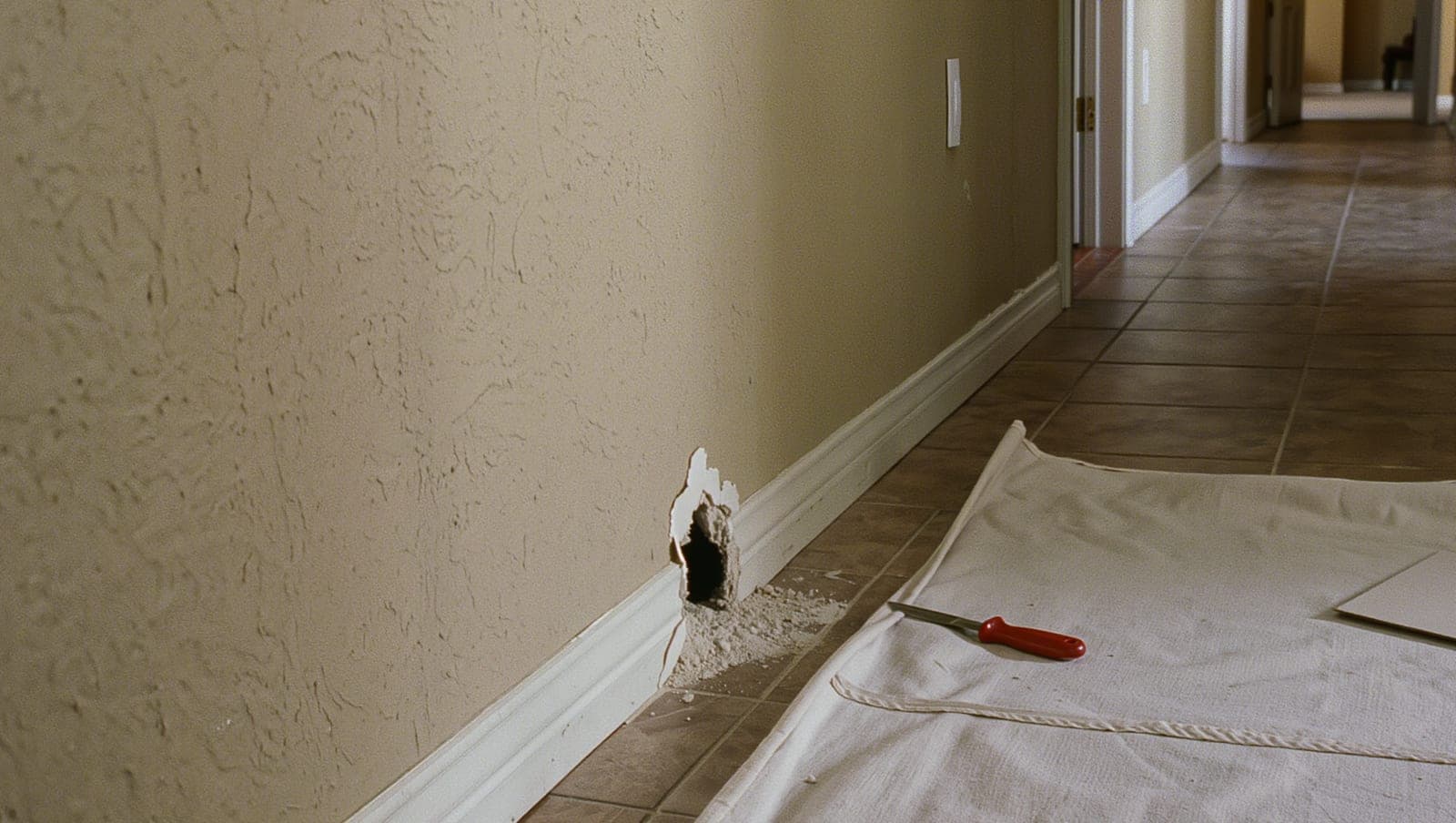
A hole in drywall is a failure of the gypsum core, not just the paper. Half-inch board resists slow pressure well and sudden pressure poorly, which is why a shoulder leaning on a wall does nothing and a doorknob swung by a draft does a two-inch crater. Once the core is crushed, the paper face has nothing behind it and tears outward, and the hole grows with every touch. In Phoenix homes the causes are ordinary and repetitive: interior doors flung open by the pressure change when a monsoon gust hits an open window, missing or broken door stops, furniture moved through hallways sized for smaller furniture, TV mounts and shelves torn out at move-out, and the access holes cut by trades who needed to reach a valve or a wire and closed nothing. The garage gets its share from bikes and bumpers. Kids and the occasional frustrated adult account for the rest.
The size of the hole decides the repair, and the repair decides whether the hole comes back. A dent with crushed paper can be cut clean and filled. A doorknob hole needs new board, not just compound, because compound has no strength across an open span and will crack and fall in. A fist-sized or larger hole needs backing screwed inside the wall so the plug has something to hold, and a hole that runs into a stud, a corner, or an outlet box is a small piece of carpentry before it is a drywall job. Skipping the structure is the common shortcut. A mesh sticker over a doorknob hole holds paint for a season and then a fingertip goes through it, and the second repair costs what the first one should have.
Bleuwave Handyman repairs holes with the structure first and the cosmetics second. We square the opening, check for wires and pipes, back it with wood, set a plug of matching thickness, tape the seams in setting compound, and build out in thin feathered coats. Texture is tested and matched, whether the wall is orange peel, knockdown, or a hand texture from the 1980s, and the repair is primed and painted so it does not flash. Then we install the door stop that would have prevented the hole in the first place, which is the cheapest part of the job and the most often skipped. The result is a wall you can lean on, not a scab you learn to walk around.
For property managers and maintenance teams, holes are the most common line on a turn sheet and the most common reason a unit misses its ready date. We batch holes across a unit or a building, work them by drying stage, and finish with paint so the deposit reconciliation has a clean number behind it. Same-day and next-day scheduling is usually available, after-hours visits are an option for occupied offices, and we are licensed, insured, and bonded, Veteran Owned & Operated since 2022, working everything within 35 miles of Phoenix.
A hole in the wall is the household equivalent of a chipped tooth: not dangerous, impossible to stop noticing. Get a free estimate. We will tell you exactly what the repair involves, how many visits it takes, and what it costs, and then the wall goes back to being a wall.
Signs you need hole repair
- A crater behind a door at knob height, often with an older dent beside it where the last strike landed.
- Torn paper with white gypsum dust at the edges, and a hole that gets bigger when anyone brushes it.
- A ragged opening the size of a fist or a foot, usually low on a hallway wall or in a garage.
- A rectangular access hole with a cover plate or a piece of cardboard taped over it.
- A cluster of anchor holes and torn paper where a mount, shelf, or grab bar was pulled out.
- A hole near an outlet or switch where the box has been exposed, which needs the power checked before the repair starts.
How the repair is done
- 1
Look inside before cutting
A flashlight and inspection mirror go in first. Interior walls in Phoenix homes carry electrical runs, plumbing supply and drain lines, low-voltage cable, and, near an air handler closet, the condensate drain. Anything found is noted and protected. If a hole exposes a box or a cable, the circuit is confirmed off before a blade goes near it.
- 2
Cut the opening square
Ragged holes are cut back to a clean rectangle with a utility knife and jab saw, wide enough to remove all the crushed core. The edges are beveled slightly so the compound has a shoulder to grip. Holes that run into a stud are cut to the stud center so the plug can be screwed straight to framing on that side.
- 3
Back the opening and set the plug
Furring strips or half-inch plywood scraps go inside the wall along each edge, held with 1-1/4 inch coarse-thread screws sunk just below the paper. A plug is cut from board of the same thickness, half-inch on most walls, five-eighths on ceilings and many garage walls, and screwed to the backing so it sits flush or a hair below the surface. For openings over about two feet, we move to a stud-to-stud section instead.
- 4
Tape, bed, and build out
Seams are taped with paper tape bedded in setting compound, then built up in two or three thin coats of all-purpose or topping compound with ten- and twelve-inch knives. Each coat feathers wider than the last. Screw heads get their own coats. Everything dries fully between coats and is sanded with a fine sponge and a vacuum-attached sander.
- 5
Texture, prime, paint, and prevent
The texture is matched by test pass on cardboard, applied by hopper or aerosol and knocked down where the wall calls for it. The repair is primed with PVA, or a stain-blocking primer if the hole came with a water mark, and painted to a blend or a corner. On doorknob holes, a hinge-pin or baseboard door stop goes in before we leave.
What it costs in Phoenix
A single doorknob-sized hole, backed, textured, and painted, typically lands in the low hundreds in the Phoenix market, and the same hole with the door stop installed adds very little. A fist-sized hole or a large access opening usually runs somewhat higher, and several holes in one property done together cost noticeably less per hole than the first one alone. Holes into corners, around electrical boxes, or through ceilings take more labor and more visits, and a hole that reveals wet insulation or a chewed cable changes the job into something else. These are ballpark figures, not a price list, and paint area is the swing factor. Your free estimate will name the number for your wall and your texture.
Do it yourself, or call someone?
If you are handy and patient, a doorknob hole is a reasonable first project, provided you skip the stick-on mesh kit and do it properly: cut it square, add a wood backer, set a plug, tape, and feather. The kit is where most homeowner repairs go wrong, because it puts the patch on top of the wall instead of in it, and the hump that results is permanent. Feathering compound out eight inches on every side takes a wide knife and a light hand, and it is learned by doing it badly a few times. Texture is the harder problem. Aerosol orange peel and knockdown can come close, but matching the density and spatter of your specific wall takes test passes and timing, and a near miss is more visible than the hole was. Ceilings add a ladder, compound overhead, and grit in your eyes. Sanding dust rides the AC through the whole house. Try a hole in a closet or a garage first. If the wall is in the living room and the in-laws land Saturday, the estimate is free.
Can a handyman repair drywall? The honest answerWhat is included
- Doorknob holes backed, plugged, and finished, with a door stop installed
- Fist-sized and foot-sized holes cut square and rebuilt on wood backing
- Access openings from plumbing, HVAC, and electrical work closed properly
- Holes around outlets, switches, and corner bead handled with the wiring protected
- Ceiling holes, including old fixture and vent openings
- Torn-out anchor and mount damage repaired as one clean field
- Texture matched: orange peel, knockdown, skip trowel, smooth
- Primed and painted so the repair does not flash
Why Phoenix calls Bleuwave
- Every hole larger than a coin gets real backing. Compound alone across an open hole is a repair on a timer.
- We check inside the wall before we cut, because Phoenix interior walls are full of things that do not like saws.
- Door stops installed as part of the job, so the same hole is not on next year's list.
- Texture matched by test pass, not guessed from the can, and feathered past the patch.
- Turn-sheet friendly: batched holes, one invoice per unit, ready dates you can promise a leasing agent.
- Licensed, insured, and bonded, Veteran Owned & Operated since 2022, with free estimates and same-day or next-day scheduling across a 35-mile radius of Phoenix.
Questions Phoenix homeowners ask
How big a hole can be patched before the drywall needs replacing?
Up to about two feet across, a backed plug is as strong as original wall and finishes invisibly. Past that, or when a hole crosses more than one stud bay, we cut back to stud centers and hang a new section, which is faster and cleaner. Multiple holes in one wall sometimes make a single new sheet the smarter answer.
Can a hole in drywall be fixed the same day?
A small hole can be structurally repaired and rough-coated in one visit, and with setting compound for every coat it can be textured the same day. The paint and the final invisibility usually want a second short visit after everything has dried. We will tell you honestly which timeline your hole allows.
Will the repair hold if the door hits it again?
A backed plug is as strong as the surrounding wall, so it holds up the way the original did, which is to say a doorknob will dent it again. That is why we install a door stop as part of the repair. It costs less than a cup of coffee and ends the cycle.
Does homeowners insurance cover holes in drywall?
Almost never for ordinary impact damage, which falls under maintenance. It may apply when the hole is part of a covered event, such as a break-in or a burst pipe that required opening the wall. For rentals, tenant-caused holes are typically a deposit matter, and a clear itemized estimate helps that conversation stay short.
What if there are wires or pipes behind the hole?
We look before we cut and work around them. Damaged wiring or a nicked pipe is handled before the wall is closed, either by us where it is within handyman scope or by the licensed electrical and plumbing companies in the Bleuwave family where it is not. Closing a wall over a damaged cable is not a service we offer.
Do you fix holes in ceilings too?
Yes. Ceiling holes from old fixtures, vents, or a foot through the attic floor are repaired with the same backing and plug method, on five-eighths board where the ceiling uses it, with the texture matched overhead. Ceiling work takes ladders, containment, and more drying care, and we plan for that.
Related repairs
Guides worth ten minutes
Guide · 7 min read
How Long Does Drywall Patching Take?
A small patch is a same-day job. A proper mid-size repair is two visits, and the gap between them is not idleness. Here is the realistic timeline, and what Phoenix heat does to it.
Guide · 8 min read
Can a Handyman Repair Drywall?
Drywall repair is the job handymen do most and do best. The better question is where the line falls, and how to know whether the person you hired is on the right side of it.
Elsewhere on the site
Related services, nearby city pages, and reading that pairs with this repair.
Looking for the service page? See how we handle this as a scheduled service, or browse all services.
Fill the hole for good. Get a free estimate today.
Licensed, insured & bonded · Veteran Owned & Operated since 2022 · Serving 35 miles around Phoenix.