
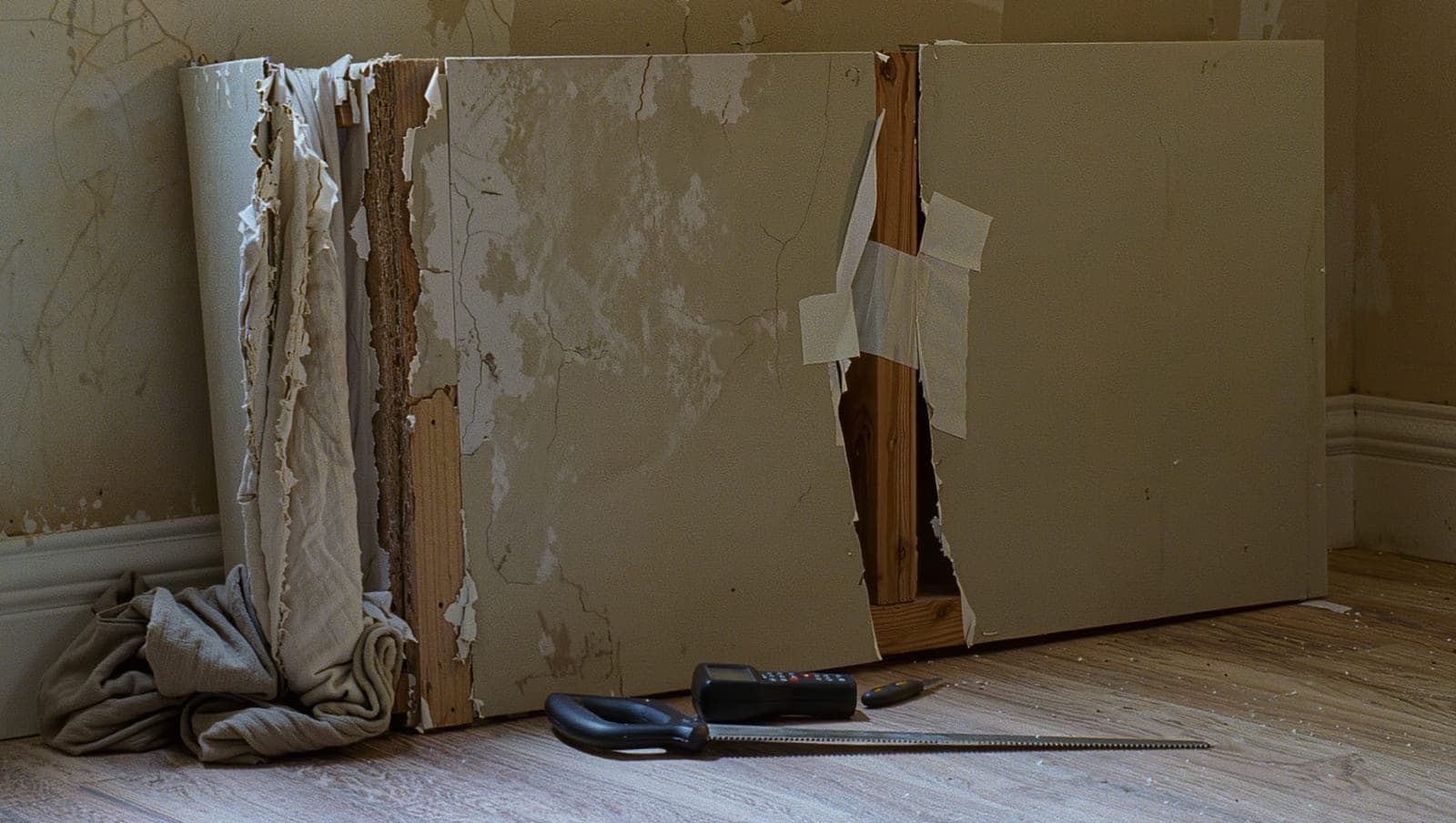
Almost any drywall damage can be patched. The question is whether it should be. A patch is cheaper today and, done well, invisible. Replacement costs more today and settles the matter. The wrong choice in either direction is expensive: patch what should have been replaced and you pay twice; replace what should have been patched and you pay for a wall you did not need.
Here is the framework we use on estimates, followed by the decision table, the water-damage rule that resolves most of the hard cases, and the arithmetic on when replacement is actually the cheaper path.
Five questions that decide it
1. How big is the damage, really?
Not the hole. The affected area. A doorknob hole is three inches across. The compound feathered around a good repair of it is closer to eighteen. A two-foot cut-out becomes a four-foot repair by the time the last coat is skimmed. When the feathered area starts to approach the size of the wall, you are patching a whole wall the slow way. Replace it.
2. Is the board itself still sound?
Drywall is gypsum between two sheets of paper. It is sound when the gypsum is hard and the paper is bonded to it. Press on the board around the damage. If it is firm, the damage is local and a patch will hold. If it gives, crumbles, or the paper face slides under your thumb, the board is finished no matter how small the visible damage looks.
3. What caused it, and is the cause gone?
A hole from a doorknob has a cause that is not coming back, unless the door stop is still missing. A crack from slab settling has a cause that may keep moving. A stain from a roof leak has a cause that will return every monsoon until the roof is fixed. Patching damage whose cause is still active is not a repair. It is a subscription. Fix the cause first, then decide.
4. How many times has this spot been fixed?
Once is a repair. Twice is a pattern. Three times is a wall telling you it wants to be replaced. Every patch over a previous patch adds compound, adds thickness, and makes the texture harder to match. There is a point where the section is more patch than wall.
5. What does the finish require?
A patch has to disappear into its surroundings. On a flat wall with a common orange peel, that is routine. On a hand-troweled texture, a glossy paint, or a ceiling lit from the side by a west window at five in the afternoon, the bar is higher. When an invisible patch is not achievable, a replaced section that gets a fresh corner-to-corner texture and paint may look better and cost about the same.
The decision table
| Damage | Usual call | Notes |
|---|---|---|
| Nail pops, dents, scuffs | Repair | Minimum service call, several at once |
| Hairline cracks over doors and windows | Repair | Tape, not just fill; see drywall crack repair |
| Diagonal settling crack, first time | Repair | Tape and feather; watch it through one season |
| Same crack, third time | Evaluate the slab, then replace the section | The wall is not the problem |
| Doorknob or fist-sized hole | Repair | Backed patch; see drywall hole repair |
| Hole larger than a dinner plate | Repair by section | Cut to studs, new board, finish |
| Multiple holes in one wall | Replace the wall | Faster and cleaner than a dozen patches |
| Water stain, board firm, dried, source fixed | Repair | Stain-blocking primer, texture, paint |
| Water stain, board soft or sagging | Replace the section | Beyond the stain by a foot or more |
| Water stain that came back | Replace, after the source is fixed | Second stain means the first fix missed |
| Any visible mold | Replace, with the cavity inspected | Cut-and-bag if small; remediation if not |
| Popcorn ceiling, one bad spot | Repair | Texture match; see ceiling texture repair |
| Popcorn ceiling, many stains and sags | Replace or re-skin the ceiling | Test for asbestos first on pre-1980s ceilings |
| Termite or rodent damage | Replace, after pest control | The board is not the point; the cavity is |
| Fire, smoke, or soot | Replace | Odor lives in the gypsum |
| Old patches with visible ridges | Replace the section | You cannot skim your way out of a bad patch |
The water-damage rule of thumb
Water is where most repair-or-replace mistakes happen, because a water stain looks like a paint problem and behaves like a structural one. Phoenix supplies water damage in three main flavors: AC condensate lines that clog and overflow in the attic, roof penetrations that leak when the monsoon arrives sideways, and supply or drain lines inside walls. All three deliver water to the back of the drywall, where you cannot see it.
The rule has four parts. If any one of them is true, replace.
Soft. Press around the stain with your palm. Sound drywall does not give. If it does, the gypsum has absorbed water and lost its bond with the paper. It will not recover when it dries, and it will not hold compound or texture.
Sagging. A ceiling that has bellied downward, even slightly, has been wet enough to lose its strength between joists. It will not go back up. It is also holding whatever water is still above it, which is why sagging ceilings sometimes come down in one piece.
Stained more than once. A stain that reappears after being primed and painted means water is still arriving. Even if the board is firm, it has been wet twice, and the insulation and framing behind it have too. Open it, dry it, replace it, and fix the source before you close it.
Mold. Any visible mold on the face or, when you cut in, on the back of the board means the board is done. Small areas can be cut out and bagged. Large areas or mold that continues into the framing call for a remediation company. Do not paint over it. Paint is not a fungicide.
If none of the four is true, if the board is firm and dry, the source is fixed, and this is the first stain, then it is a repair: stain-blocking primer, texture, paint. A fair number of AC condensate stains fall into this category if they are caught early, which is one more reason to look at your ceilings before the monsoon starts rather than after it ends. Our monsoon prep checklist covers what to check, and water-damaged drywall repair covers what happens next when the test fails.
Cost and time: what each path actually costs you
Repairs and replacements are priced differently, and the difference is not only the number on the invoice.
| Patch or section repair | Replace the wall or ceiling | |
|---|---|---|
| Upfront cost | Lower | Higher |
| Visits | One to two | Two to three |
| Dust and disruption | Contained to the patch area | The whole room, for the duration |
| Texture match | Blended into existing texture; skill-dependent | Fresh texture edge to edge; no blending |
| Paint | Touch-up if the paint is available; otherwise the wall | The whole wall or ceiling, always |
| Risk of recurrence | Depends on the cause and the board | Low, if the cause is fixed |
| Best for | Local damage, sound board, cause resolved | Widespread damage, soft board, repeated failure |
The trap is in the recurrence row. A patch that fails costs the patch, plus the paint, plus the second patch, plus a second paint, and the wall still carries every layer. Two patches often cost more than one replacement, and three always do.
When replacing is the cheaper option
The wall has more than three or four significant patches. Each patch is priced individually. A wall is priced once. At some count, and it is not a high one, the wall wins.
The crack keeps coming back. Slab-on-grade houses across the Valley settle, and settling cracks reopen along the same line. The first repair should be taped properly. If it returns after that, have the slab and the framing looked at, then replace the section with a control joint or a floating corner detail so the next movement has somewhere to go. See interior wall repair for the stucco-to-drywall and framing side of that.
The texture cannot be matched. Some hand-applied textures were done once by one person with one trowel and cannot be reproduced credibly. Replacing the section and re-texturing corner to corner gives you a consistent wall for roughly what three attempts at a match would cost.
The ceiling is popcorn and has several problems. Popcorn is the hardest texture to patch invisibly, and old popcorn may need testing before anyone touches it. When there are multiple stains, sags, or previous bad repairs, re-skinning or replacing the ceiling is often cheaper than a series of patches that each look slightly wrong. Details at drywall replacement.
For property managers and maintenance teams
Your version of this decision has one more variable: the next tenant. A patch that is good enough for a move-out inspection may not be good enough three tenants from now, when the same wall has collected four more. On high-turn walls (behind entry doors, hallway corners, the wall the couch goes against), replacing a section during a turn and getting a clean texture is often cheaper across a five-year horizon than patching on every turn. Ask your vendor to flag walls that are approaching that point, and to price both options on the same estimate. Our drywall repair cost guide has the per-turn framing, and the full Repair Hub covers the rest.
Have someone make the call with you
Bleuwave Handyman is licensed, insured, and bonded, Veteran Owned & Operated since 2022, serving everything within 35 miles of Phoenix with same-day, next-day, and after-hours availability. When the answer is replace, we say so, and when the answer is patch, we do not sell you a wall. Estimates are free.
Schedule Now, or call (480) 863-5975. Press on the wall before we get there. If it gives, tell us. That changes what we bring.