
Repair Hub · Phoenix Metro
Texture Matching That Makes the Repair Impossible to Find
Orange peel, knockdown, skip trowel, popcorn, and smooth, blended so the wall keeps your secret.
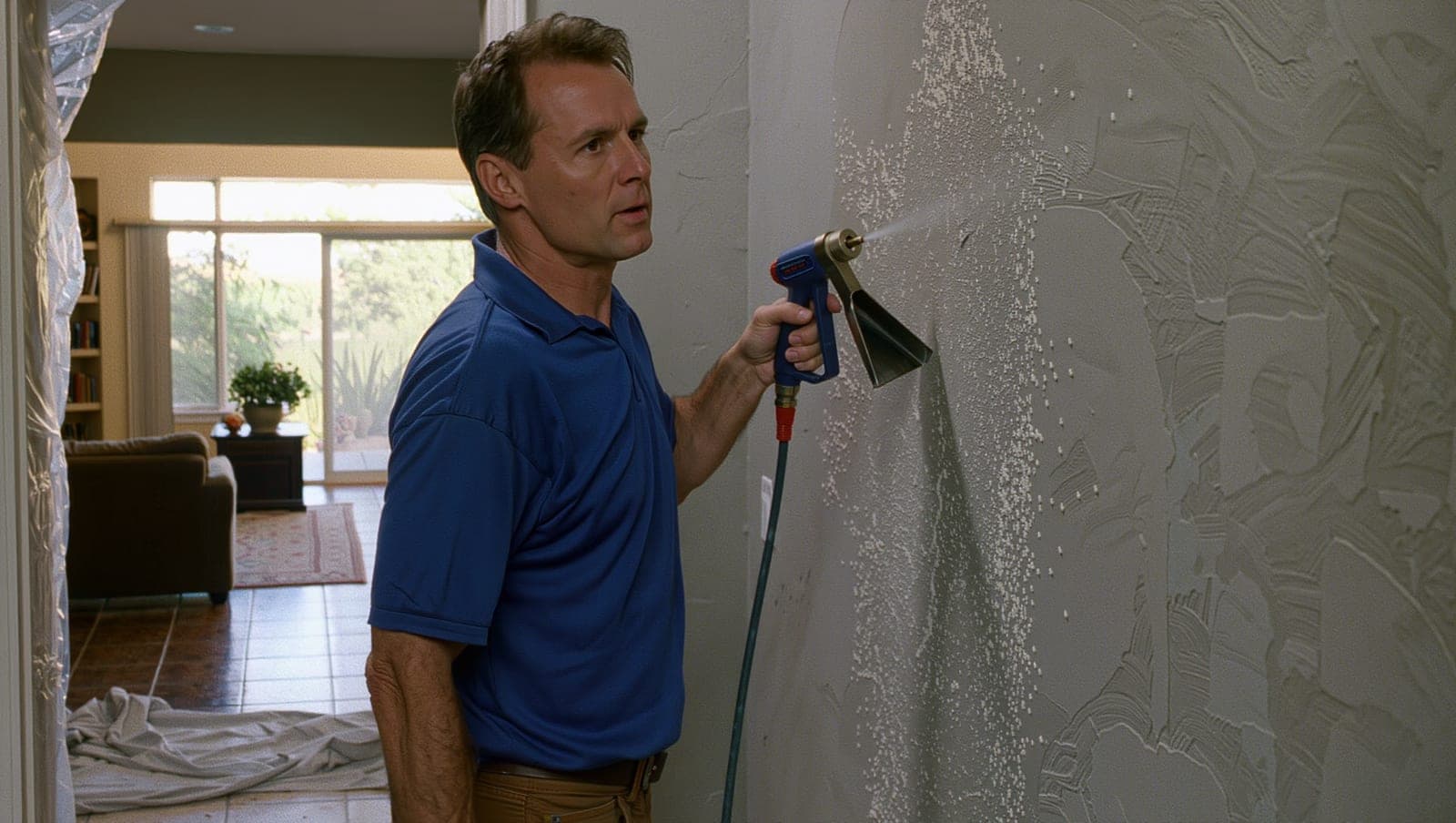
Wall texture is thinned joint compound thrown at a wall in a controlled way. Orange peel is a fine splatter from a hopper gun, left to dry as it lands. Knockdown is a heavier splatter that sets for ten or twenty minutes and is then flattened with a wide knife, leaving the flat-topped islands you see in most Valley homes built since the 1980s. Skip trowel is applied by hand and looks like it. Popcorn is the acoustic mix on older ceilings. Nearly every house in the Phoenix metro has one of these because production builders learned that texture hides taped seams and screw dimples under the raking desert light that pours through big west-facing windows. Smooth walls are rare here and expensive to keep that way. Every texture is also slightly different from every other, shaped by the nozzle, the air pressure, the compound thickness, and the humidity of the day it was sprayed, which in this city can be in the single digits.
That is why a repair can be flat, solid, and perfectly painted and still be visible from across the room. The eye reads texture as a pattern of shadows. If the splatter on the patch is smaller than the splatter around it, or the knockdown islands are taller, or the texture stops at a hard edge instead of feathering into the old, the patch shows. It shows worst in the late afternoon, in the hallway, exactly where the guests walk. Texture matching is the part of drywall repair where craft lives, and it is the part most often skipped.
Bleuwave Handyman treats texture matching as its own step with its own tools. We identify the texture and, where we can, the way it was originally applied. We prime the patch so the new compound absorbs evenly. We load a texture hopper and spray a test board, adjusting orifice and pressure until the pattern is the same size and density as the wall, and we time the knockdown against the actual air in the room that day. Then we spray past the patch edges, lighter toward the outside, so new and old blend across several inches rather than meeting at a line. Prime, paint, and the wall has no story to tell.
In apartments and commercial spaces this matters at scale. A unit turn may involve thirty patched holes in one hallway, and the walkthrough will find every one that was textured from an aerosol can with a different splatter than the wall. We match texture consistently across a whole unit or suite, and we can re-texture entire walls where the patch history has become the wall's dominant feature.
If you have a patch that is technically fixed and visibly there, texture is almost certainly the reason. That is a smaller job than it sounds. Estimates are free.
Signs you need texture matching
- A patch that is flat and painted but still visible as a smoother or rougher square in afternoon light.
- Knockdown islands on a repaired area that are taller, smaller, or more crowded than the surrounding wall.
- A visible ridge or hard line where new texture stopped instead of feathering into the old.
- A different paint sheen over the patch, often because texture was painted without primer.
- Aerosol-can texture from a previous repair that reads as a fine mist next to a heavier original.
- A wall or ceiling with so many mismatched patches that re-texturing the whole surface makes more sense than a fourth attempt.
How the repair is done
- 1
Identify the texture and how it was applied
We look at the profile under a raking flashlight, check an unpainted spot in a closet or behind a switch plate where the original texture is unaltered, and note whether it is orange peel, knockdown, splatter, skip trowel, or smooth. Older homes often have a hand texture that no hopper reproduces, and we plan for a hand blend in those cases.
- 2
Finish and prime the patch flat
Texture cannot hide a proud patch. The repair is set with setting-type compound, feathered wide with topping compound, and sanded flush under a straightedge. Bare compound is then primed, because unprimed compound pulls the moisture out of new texture and changes how it dries and how it knocks down.
- 3
Dial in the pattern on a test board
Compound is thinned to match the original and loaded in a texture hopper. We spray scrap drywall or cardboard, adjusting nozzle orifice and air pressure until the splatter is the same size and density as the wall. For knockdown we spray the test, wait, and flatten it with a knockdown knife, timing the set against the room that day, because a patch knocked down too early smears and one knocked down too late does not flatten at all.
- 4
Spray, blend, and knock down
The wall is masked and the patch is sprayed with the pass extending several inches past the repair, lightening toward the edges so the new pattern thins into the old. Knockdown is flattened at a low knife angle in one direction. Skip trowel is worked by hand with a trowel and thinned compound to match the sweep and spacing of the original. Aerosol texture is reserved for spots the size of a coin.
- 5
Prime and paint to the corner
New texture is primed before finish paint so the sheen matches the surrounding wall. Where sheen matters, on eggshell and satin walls in particular, we paint the whole wall from corner to corner. Flat ceilings are painted end to end. The paint is the last place a texture match can fail, and it is the easiest place to get right.
What it costs in Phoenix
In the Phoenix market, texture matching on a single patch is usually a modest line item within the repair, adding somewhat to a patch that would otherwise run a couple hundred dollars. Re-texturing a full wall or ceiling is typically priced by the square foot and lands in the hundreds for a bedroom wall and higher for a great room ceiling. Converting textured walls to smooth, which requires a full skim coat, is the most expensive finish there is and is priced accordingly. Those are ballparks. The only number worth planning around is a written estimate for your wall, and ours is free.
Do it yourself, or call someone?
For a spot the size of your palm on an orange peel wall, an aerosol texture can and patience will get you most of the way, provided you prime first, practice on cardboard, and paint the whole wall afterward. Knockdown from a can is a coin flip, because the timing window for the knife is short and shorter in summer. Skip trowel and hand textures are a skill learned by hand, not by video. And a hopper gun with a compressor is a purchase and a learning curve that pays off only if you plan to texture a lot of walls. If your patch is large, on a ceiling, in a room with windows on two sides, or on a wall where you have already tried once, that is the moment to call.
Can a handyman repair drywall? The honest answerWhat is included
- Orange peel, knockdown, splatter, skip trowel, and popcorn texture matching
- Test-board pattern matching before any texture touches the wall
- Hopper gun texture with nozzle and pressure dialed to the original
- Hand-applied blends for skip trowel and older hand textures
- Correction of previous mismatched patches and aerosol repairs
- Full-wall and full-ceiling re-texture when the patch history has won
- Smooth-wall skim coating for a level finish, priced honestly
- Primer and corner-to-corner paint so sheen matches everywhere
Why Phoenix calls Bleuwave
- We match texture on a test board, not on your wall. Nozzle, pressure, and compound thickness are set before the first pass in the room.
- Knockdown is timed against the actual room that day, because compound sets differently on a dry April afternoon than in a humid August one.
- Patches are primed before texture and texture is primed before paint. Both steps are commonly skipped, and both are why patches show.
- Hand textures get hand blends. A hopper cannot reproduce a trowel sweep, and we do not pretend it can.
- Consistent texture across whole units and suites for turns and work orders, scheduled around occupancy within 35 miles of Phoenix.
- Licensed, insured, and bonded, Veteran Owned & Operated since 2022, with free estimates on every repair.
Questions Phoenix homeowners ask
Can a texture match really be invisible?
On orange peel and knockdown, yes, when the patch is flat, the pattern is matched on a test board, the texture is feathered past the edges, and the wall is primed and painted corner to corner. That is our standard. Skip trowel and hand textures can be blended very closely by hand. Smooth walls are the hardest to hide work on, and we will say so before we start.
What kind of texture do I have?
If the wall looks like fine, evenly spaced splatter with no flat spots, it is orange peel. If it has flattened islands with rounded edges, it is knockdown. Broad, sweeping trowel marks with smooth valleys is skip trowel. Coarse, crumbly bumps on a ceiling is popcorn. Most Phoenix homes built since the late 1980s have knockdown or orange peel. If you are unsure, send us a photo taken with a flashlight held at an angle to the wall.
Do you have to paint the whole wall after a texture repair?
On most walls, yes, and it is the cheapest insurance against a visible patch. New paint over old paint shows as a sheen difference, especially with eggshell and satin finishes and especially in raking light. On flat-painted ceilings and in low-light spaces a blend can sometimes pass. We will tell you which case yours is.
Why does my patch show even though it is flat and painted?
Almost always texture. Either the splatter size is different from the original, the texture stopped at a hard edge instead of feathering out, or the texture was painted without primer and dried to a different sheen. All three are fixable without redoing the patch underneath.
Can you make my textured walls smooth?
Yes. It is a skim coat: multiple thin coats of compound over the entire wall, sanded flat, primed, and painted. It is real work and priced by the square foot, and it is the most demanding finish to keep looking good, because smooth walls hide nothing. Many people do one room, love it, and budget for the rest over time.
Does new texture need to be primed before painting?
Yes. Texture is raw joint compound and it absorbs paint unevenly. Without primer the patch dries to a different sheen than the surrounding wall, and it reads as a flat square no matter how good the pattern match is. Prime the texture, then paint the wall.
Related repairs
Guides worth ten minutes
Guide · 8 min read
Can a Handyman Repair Drywall?
Drywall repair is the job handymen do most and do best. The better question is where the line falls, and how to know whether the person you hired is on the right side of it.
Guide · 7 min read
How Long Does Drywall Patching Take?
A small patch is a same-day job. A proper mid-size repair is two visits, and the gap between them is not idleness. Here is the realistic timeline, and what Phoenix heat does to it.
Elsewhere on the site
Related services, nearby city pages, and reading that pairs with this repair.
Looking for the service page? See how we handle this as a scheduled service, or browse all services.
Give the wall nothing to say. Get a free estimate on texture matching.
Licensed, insured & bonded · Veteran Owned & Operated since 2022 · Serving 35 miles around Phoenix.