
Repair Hub · Phoenix Metro
Corner Bead Repair That Brings the Edge Back Sharp
Dented, cracked, rusted, and exposed outside corners rebuilt with new bead, setting compound, and matched texture in homes and buildings across the Phoenix metro.
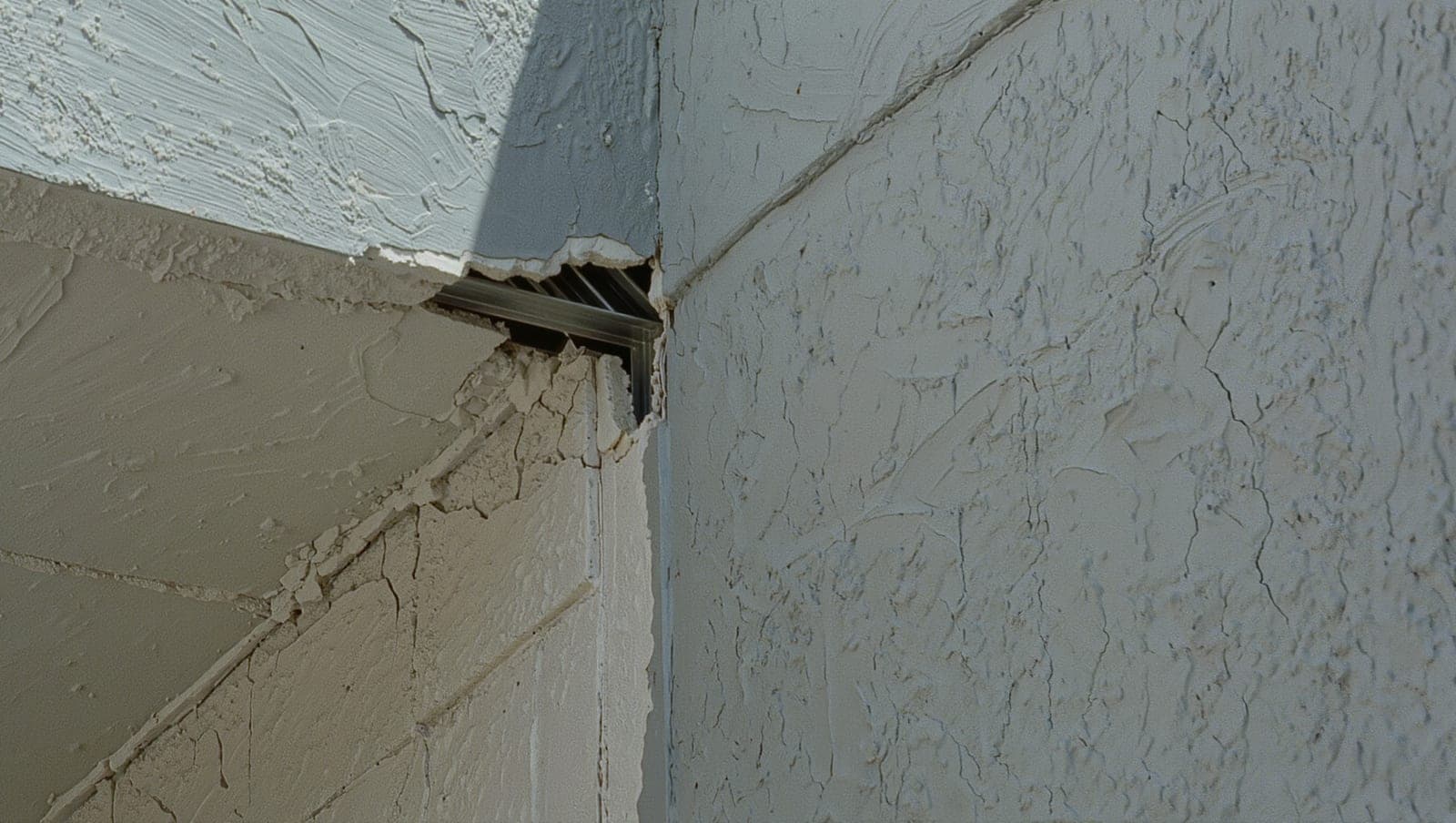
An outside corner is the most exposed inch of any wall, and drywall alone cannot hold it. Gypsum crumbles at an edge. So every outside corner in a Phoenix house is capped with corner bead, a length of galvanized steel, vinyl, or paper-faced metal that gives the corner a hard nose and a straight line for the finisher to mud against. When the bead is hit hard enough, it dents, and the compound over it cracks away in a ragged strip that no amount of spackle rebuilds. When the bead was fastened lightly, or the framing behind it dried and shrank through a few summers, the flange works loose and a crack opens along one or both edges of the corner. In bathrooms and garages the metal rusts under the paint and bleeds an orange line to the surface. Bullnose bead, the rounded profile that most Valley builders switched to in the 1990s, has its own habit: the compound feathers thin across the curve and chips in half-moons when a vacuum or a laundry basket clips it.
These are the corners that matter most in daily life. The hallway corner at the kitchen, the one at the top of the stairs, the corner beside the garage door that every move-in and every grocery run passes. Once the metal is exposed, the damage accelerates, because there is no longer any compound on the edge to take the next hit. A bare inch of steel becomes a bent inch, then a corner that snags sleeves. An outside corner is the one part of a wall that furniture, vacuums, and moving dollies seem to aim for. For property managers, outside corners are on nearly every move-out inspection, and the ones at unit entries take the worst of the dolly traffic on turnover day.
Bleuwave Handyman repairs corners according to what the bead is doing. A shallow dent in bead that is still firmly attached is straightened against a wood block and refilled with setting-type compound. A crushed or loose section is cut out with tin snips or an oscillating tool, the old compound is cleaned back, and a new piece of matching profile, square or bullnose, in the same width, is spliced in, fastened through both flanges with drywall screws or crimped tight, and mudded in three coats with the nose of the corner as the guide. Vinyl bead is set in spray adhesive and stapled, paper-faced bead is bedded in compound like tape. Rusted metal is sanded to bright, primed, and recoated, or replaced where the rust has lifted the compound. Then the texture is brought right to the nose of the corner and the paint is carried to a natural break.
The finish is what separates a corner repair from a corner that looks repaired. Compound on a corner must be pulled from the nose outward, one wall at a time, feathered four to six inches onto each face, and sanded so there is no hump where the new section meets the old. On bullnose the curve has to be continuous by eye, because the eye is very good at finding a flat spot on a curve. We take the time.
A damaged corner is small, and everyone who walks past it notices. The estimate is free, the repair is typically two short visits, and the corner comes back with a clean line that will take the next twenty years of traffic.
Signs you need corner bead
- A dent or flattened spot on an outside corner with compound cracked away around it and gray metal showing.
- A straight crack running the height of a corner along one or both edges of the bead, sometimes with the compound lifting in a strip.
- An orange or brown line bleeding through the paint at a corner in a bathroom, laundry room, or garage.
- Half-moon chips out of a bullnose corner at knee to hip height.
- A corner that is no longer straight, bowing in or out where the bead has pulled off the framing.
- A previous repair with a visible lump where filler was piled over a dent instead of the bead being straightened.
Not sure this is your problem?
Start with a diagnosis. These questions end at this repair:
How the repair is done
- 1
Assess the bead: dented, loose, or gone
We press along the full height of the corner and tap it, which tells us whether the flange is still tight to the stud or floating in cracked compound. The profile is identified, square or bullnose, and the radius measured, along with the material: galvanized steel, vinyl, or paper-faced metal. A rusty corner gets a moisture check at the base and a look at the nearest plumbing or exterior wall before anything is sealed.
- 2
Straighten or cut out the damaged section
A shallow dent in sound bead is worked back into line with a hammer against a wood block, and the flange is refastened with 1-1/4-inch drywall screws. A creased or loose section is scored along both edges with a utility knife, cut through with tin snips or an oscillating tool fitted with a metal blade, and removed, and the compound is cleaned back to bare board on each face.
- 3
Splice in new bead of the same profile
A new length of matching bead is cut with snips and set with its nose exactly in line with the old, checked with a straightedge. Metal bead is fastened every six to eight inches through both flanges with drywall screws or set with a crimping tool. Vinyl bead is set in spray adhesive and stapled. Paper-faced metal is bedded in setting-type compound like a strip of tape. The splice is butted tight so there is no step to telegraph through the finish.
- 4
Coat in three passes with setting compound
The first coat is 45-minute setting compound, pulled with a six-inch knife riding on the nose of the bead and the wall, so the corner sets the plane. The second and third coats go on with eight- and ten-inch knives, feathered farther onto each wall, and are sanded between with a fine sponge. On bullnose the coats follow the curve, and the splice is checked by sighting down the corner until no flat spot remains.
- 5
Prime the metal, texture, and paint
Any exposed steel is primed with a rust-inhibiting primer, and rust marks are sealed with shellac so they do not bleed through the finish. Texture is sprayed to match the walls and carried to the nose of the corner. The compound is primed with PVA, and both walls are painted to a corner or a natural break, because touch-up on a corner reads as a stripe from down the hall.
What it costs in Phoenix
In the Phoenix market, a single dented corner with the bead still sound, straightened, filled, textured, and painted, typically comes in at the low hundreds. Replacing a damaged section of bead or a full corner from floor to ceiling, with texture and paint on both walls, more often lands in the mid hundreds, and bullnose runs a bit higher because the curve takes more finish work. A hallway or entry with several corners in a unit turn is priced as a batch. Rusted corners that trace back to a leak are priced after the leak is understood. These are typical ranges, not a price list. The free estimate will name the profile, the length to be replaced, and how far the paint needs to go.
Do it yourself, or call someone?
Straightening a small dent and filling it is within reach of a handy homeowner: a block of wood, a few taps, a screw through the flange, and setting-type compound, not lightweight spackle, which will crack out of a corner within a season. Replacing bead is a bigger step. The old section has to come out clean, the new piece has to sit dead straight with its nose exactly in line, and the compound has to be pulled from the nose out without rounding the edge you just rebuilt. Bullnose is harder still, because a splice that is slightly out of round shows from the end of the hall. If the corner is at an entry, in a room you are trying to rent or sell, or is rounded, the difference between an attempt and a repair is worth the call.
Can a handyman repair drywall? The honest answerWhat is included
- Dented metal corner bead straightened, refastened, and refilled
- Damaged sections cut out and spliced with matching square or bullnose bead
- Full-height bead replacement on crushed or loose corners
- Vinyl, galvanized steel, and paper-faced bead, matched to the original
- Rusted bead in bathrooms, laundry rooms, and garages primed or replaced
- Setting-type compound in three coats, feathered onto both walls
- Texture carried to the nose of the corner and paint to a natural break
- Entry and hallway corner sweeps for turns and work orders
Why Phoenix calls Bleuwave
- We fix the bead, not just the compound over it. Filler piled on a bent corner is a lump waiting for the next dolly.
- The profile is matched exactly, including three-quarter-inch bullnose, so the repaired section and the original read as one edge.
- Setting compound on every coat over metal, which cures hard and stays bonded through Phoenix summers.
- Rust is treated as a symptom. If a corner is bleeding orange in a bathroom, we find the moisture before we paint over it.
- Turn-ready scheduling for property managers, with several corners in one visit and one invoice.
- Licensed, insured, and bonded, Veteran Owned & Operated since 2022, with free estimates and next-day availability within 35 miles of Phoenix.
Questions Phoenix homeowners ask
Can a dented corner bead be fixed without replacing it?
Often, yes. If the flange is still tight to the framing and the dent is shallow, the metal can be tapped straight against a block, refastened, and recoated. Once the bead is creased, crushed, or pulling loose along its length, a new section is the honest repair, because metal that has been folded never holds a true line again.
Why is there a crack running down the corner of my wall?
The bead's flange has separated from the compound over it. That happens when the bead was fastened lightly or only with compound, when the stud behind it dried and shrank, or when the corner took an impact that flexed the metal. It is a bonding failure, not a structural one. The repair is to refasten or replace the bead and recoat with setting compound.
What is bullnose corner bead, and can you match it?
Bullnose is a rounded corner profile, usually with a three-quarter-inch radius, that most Valley builders adopted in the 1990s and 2000s. It comes in metal and vinyl and in a few radii, and yes, we match it. The trick is not the bead but the compound, which has to follow the curve without a flat spot at the splice.
Why is my corner bead rusting?
Galvanized steel bead resists rust until the coating is scratched or the paint over it lets moisture in. Bathrooms with weak exhaust fans, laundry rooms, garages, and any corner near a slab that wicks moisture are the usual places. Light rust is sanded and sealed with a stain-blocking primer. Rust that has lifted the compound means the bead is replaced, and the moisture source gets a look.
Do you have to repaint the whole wall after fixing a corner?
Usually one or both walls to a natural break, because touch-up paint on a corner shows as a stripe from down the hall. If the paint is recent and the color is on hand, a blend can work. We will tell you which on the estimate.
Can you protect a corner from getting hit again?
Yes. Clear or paintable corner guards in vinyl or metal can be added at hallway corners and entries where dollies and carts pass, and heavier-gauge bead can be used on the replacement. For rentals, a guard at the entry corner is a small cost next to repairing the same corner every turn.
Related repairs
Guides worth ten minutes
Guide · 7 min read
How Long Does Drywall Patching Take?
A small patch is a same-day job. A proper mid-size repair is two visits, and the gap between them is not idleness. Here is the realistic timeline, and what Phoenix heat does to it.
Guide · 8 min read
How Much Does Drywall Repair Cost in Phoenix?
The same doorknob hole can draw three different prices from three honest people. Here is what each of them counted, what the Phoenix ballparks look like, and how to get a number you can hold someone to.
Elsewhere on the site
Related services, nearby city pages, and reading that pairs with this repair.
Looking for the service page? See how we handle this as a scheduled service, or browse all services.
Give the corner its edge back. Get a free estimate.
Licensed, insured & bonded · Veteran Owned & Operated since 2022 · Serving 35 miles around Phoenix.