
Repair Hub · Phoenix Metro
Smooth Wall and Skim Coat Repair for Finishes That Hide Nothing
Level-five skim coats, seam and patch repairs on smooth walls, and textured walls made smooth, finished for the raking light that fills Phoenix rooms.
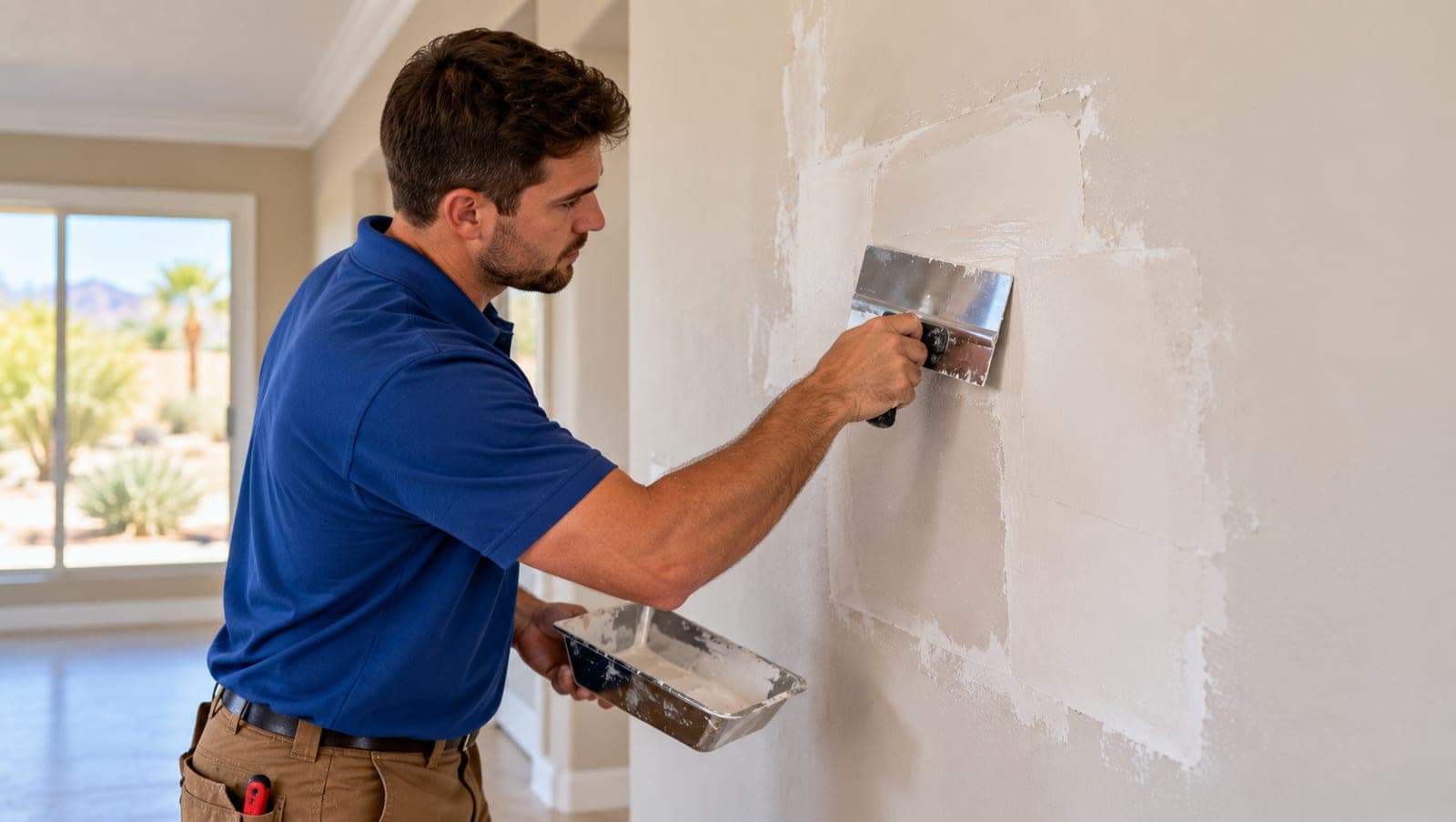
A smooth wall is a wall with no alibi. There is no texture to break up the light, so a seam that stands a hair proud, a screw dimple that was filled once instead of three times, or a patch feathered eight inches wide instead of twenty casts a shadow the moment the sun comes in low. Phoenix is hard on smooth walls. The light here is bright and arrives at a low angle for more of the day than in most of the country, and the houses that have smooth walls tend to have the biggest windows: custom homes in Paradise Valley and north Scottsdale, mid-century houses in Arcadia and central Phoenix, and remodels where the owner scraped or skimmed the builder's texture to get the modern look. In those rooms, a wall that would pass anywhere else fails at four in the afternoon.
The trade has a name for the finish smooth walls require: level five. A standard drywall finish, level four, tapes and coats the seams and fasteners and leaves the paper face bare between them. Level five adds a thin skim of compound over the entire surface, so the wall is one continuous plane of the same material with the same porosity. Without it, primer and paint dry differently over paper than over compound, and every seam ghosts through as a slightly different sheen, a problem finishers call flashing. It is common in Valley homes where a builder sold smooth walls and delivered level four. Repairing a smooth wall means honoring that standard in the patch, and often means bringing the wall up to it for the first time.
Bleuwave Handyman repairs and skim coats smooth walls with the tools the finish demands: 12- and 14-inch knives, setting-type compound for the build, topping compound for the skim, a raking work light instead of optimism, and sanding with fine sponges and vacuum-assisted sanders so the dust stays out of the house. A patch on a smooth wall is feathered far wider than one on a textured wall, often two feet or more, and checked with a straightedge and a low light from two directions before anything is primed. Where a whole wall is going smooth, we skim in thin coats, sand between them, prime with a high-build or sealing primer, and paint corner to corner, because on a smooth wall the paint is the last place a repair can be seen.
Commercial spaces and higher-end rentals carry the same problem into work orders. Offices with smooth partition walls under LED ceiling lights show every previous patch, and a downlight raking down a smooth wall is less forgiving than the sun. We repair smooth walls in occupied suites with dust containment, skim and repaint in sections after hours where needed, and bring the same standard to a conference room as to a great room.
If your smooth wall shows its seams at certain hours, or a repair on it is visible from the doorway, the fix is a wider feather and a full skim, not more paint. We can tell you which your wall needs in one visit. Estimates are free.
Signs you need smooth walls
- Seams and screw lines that appear on a smooth wall only at certain hours, when sunlight or a downlight rakes across the surface.
- A patch that is invisible under the room's ceiling light and plainly visible from the side with a flashlight held against the wall.
- A difference in sheen between the seams and the field of the wall, which means the wall was painted over bare paper and compound without a skim coat.
- Sanding scratches, pinholes, or knife ridges showing through the paint on a previous repair.
- A wall where the builder's texture was scraped or sanded off and the surface still shows a faint ghost of the old pattern.
- Remnants of popcorn or knockdown around fixtures and corners on a ceiling that was supposed to be made smooth.
Not sure this is your problem?
Start with a diagnosis. These questions end at this repair:
How the repair is done
- 1
Find every flaw with a raking light
An LED work light is held almost flat against the wall from the left, then from the right, and every ridge, dip, pinhole, and proud seam is circled in pencil. A straightedge confirms what the light suggests. The wall is never judged under the ceiling fixture, because that is the one light under which a smooth wall looks fine.
- 2
Build the low spots with setting-type compound
Dents, dips, and wide feathers are filled with 45-minute setting-type compound, which cures hard, does not shrink, and can be recoated within the hour. Ridges and proud seams are shaved with a scraper or knocked down with a sanding sponge. Corners that were rounded over by old paint are re-set square. The goal of this step is flat, not pretty.
- 3
Skim in thin coats with wide knives
Topping or all-purpose compound is thinned slightly and laid on with a 12-inch knife, then pulled tight with a 14-inch knife so what remains is a film rather than a layer. Two or three coats go on, each in a different direction from the last. Thin coats matter in Phoenix, because a heavy skim dries too fast on the surface in this air and cracks. On a full-wall skim, a roller lays the compound on and the wide knife takes most of it off.
- 4
Sand with dust control
Sanding is done with 150- to 220-grit sponges on details and a pole sander or sanding head connected to a vacuum with HEPA filtration on the field. Doorways are sealed with plastic, returns are covered, and floors are protected. After sanding, the raking light comes back out for a second inspection and any pinholes are touched up before primer.
- 5
Prime with a sealing primer and paint to the corners
A high-build or drywall sealing primer goes on first to equalize porosity between compound and any remaining paper, which is what stops seams from flashing through the finish. Then the whole wall is painted corner to corner, and ceilings end to end. We recommend flat or matte on smooth walls; eggshell and anything shinier will find flaws that no finish can remove.
What it costs in Phoenix
Smooth walls are the most expensive finish to repair well, because the feather is wider, the sanding more careful, and the paint always goes to the corners. In the Phoenix market a single patch on a smooth wall usually runs somewhat more than the same patch on textured drywall, still generally in the low hundreds before whole-wall paint. Skim coating a textured wall smooth is priced by the square foot and lands in the high hundreds to low thousands for a typical bedroom wall, more for a room and considerably more for a great room with tall ceilings. Those are honest ballparks. The specific figure is a free written estimate after we have put a light on your wall.
Do it yourself, or call someone?
A small nail hole or dent on a smooth wall is a fair homeowner job if you fill it with setting-type compound, feather it far wider than feels necessary, sand it with a fine sponge, and then prime and paint the whole wall. Beyond that, smooth wall work punishes shortcuts more than any other finish. A patch feathered six inches on a textured wall disappears; the same patch on a smooth wall is a low hill with a shadow on one side. Skim coating an entire room is a real trade skill, hard on the shoulders, and it produces a remarkable amount of dust without the right sanding equipment. If the wall gets afternoon sun, if the paint is anything shinier than flat, or if the goal is to take a textured room to smooth, get a professional light on it first. The estimate costs nothing and can save a weekend and a repaint.
Can a handyman repair drywall? The honest answerWhat is included
- Level-five skim coating on new and existing walls and ceilings
- Wide-feather patch and seam repair on smooth walls, checked under raking light
- Textured walls and ceilings converted to smooth, including popcorn and knockdown removal
- Setting-type compound for the build, topping compound for the skim, 12- and 14-inch knives
- Vacuum-assisted sanding with fine sponges, plastic containment, and floor protection
- High-build or sealing primer to stop flashing between paper and compound
- Corner-to-corner paint in a sheen that suits a smooth wall
- After-hours and sectioned work in occupied offices and suites
Why Phoenix calls Bleuwave
- Every smooth wall is inspected under a raking light from two directions, before and after. Ceiling light is where flaws hide; side light is where your guests find them.
- Patches on smooth walls are feathered two feet or more. The wide feather is the difference between flat and flat-looking.
- Skim coats go on in thin passes with wide knives, because thick compound cracks and shrinks in Phoenix air, and a cracked skim is a wall done twice.
- Sanding runs through vacuum extraction. Skim dust does not belong in the ductwork or on the kitchen counters.
- Primer is chosen to seal porosity, not just to cover, so seams do not flash through the final coat in a west-facing room.
- Licensed, insured, and bonded, Veteran Owned & Operated since 2022, with free estimates on every wall.
Questions Phoenix homeowners ask
What is a level-five drywall finish, and do I need it?
Level five is a standard level-four finish, taped seams and coated fasteners, plus a thin skim coat of compound over the entire surface so the wall is one uniform material. You need it whenever walls are smooth and the paint is anything but dead flat, or whenever a room gets strong side light from windows or downlights. Textured walls do not need it, because the texture does the same job of hiding differences.
Why can I see the seams on my smooth walls at certain times of day?
Two reasons, often together. The seams may be slightly proud or the feather too narrow, so low-angle light casts a shadow along them. Or the wall was painted without a skim coat, so the compound over the seams and the bare paper between them absorbed primer and paint differently and dried to two sheens. The first is fixed by widening the feather. The second is fixed by skimming and priming the whole wall.
Can you repair one spot on a smooth wall without repainting the whole wall?
The spot can be repaired and feathered so it is flat, but on a smooth wall a spot paint almost always shows as a sheen or color difference, even with paint from the same can, because the old paint has aged and the new paint is over primer. Flat paint in a dim room is the one exception. For anything else, plan on corner to corner. It is the less expensive part of the job.
Can textured walls be made smooth, and how is it done?
Yes. Heavy texture is knocked down with a scraper or sanded, then the wall is skim coated in two or three thin coats of compound applied with wide knives, sanded flat with vacuum extraction, primed with a sealing primer, and painted. Popcorn ceilings are wetted and scraped first. It is priced by the square foot and it is real work, but it is the only way to get a genuinely smooth wall from a textured one.
What paint sheen is best on smooth walls?
Flat or matte. Every step up in sheen, from eggshell to satin to semi-gloss, reflects more light and reveals more of the surface beneath it. Modern matte paints are washable enough for most rooms, which removes the old reason for eggshell. If a client wants sheen on a smooth wall, the wall has to be at a true level five first, and we say so before quoting.
How much dust does skim coating make?
A great deal if it is sanded with a pole sander and nothing else, and very little when sanding runs through a vacuum with HEPA filtration. We seal the room with plastic, cover the returns so dust does not enter the air handler, and clean as we go. Setting-type compound also produces less sanding dust than lightweight compound, because it is applied closer to flat and needs less taking down.
Related repairs
Guides worth ten minutes
Guide · 8 min read
How Much Does Drywall Repair Cost in Phoenix?
The same doorknob hole can draw three different prices from three honest people. Here is what each of them counted, what the Phoenix ballparks look like, and how to get a number you can hold someone to.
Guide · 7 min read
How Long Does Drywall Patching Take?
A small patch is a same-day job. A proper mid-size repair is two visits, and the gap between them is not idleness. Here is the realistic timeline, and what Phoenix heat does to it.
Elsewhere on the site
Related services, nearby city pages, and reading that pairs with this repair.
Looking for the service page? See how we handle this as a scheduled service, or browse all services.
Walls with nothing to hide, in the light that shows everything. Get a free estimate.
Licensed, insured & bonded · Veteran Owned & Operated since 2022 · Serving 35 miles around Phoenix.