
Repair Hub · Phoenix Metro
Drywall Patches That Vanish Under Texture and Paint
Small and mid-size patches across the Phoenix metro, backed, taped, feathered, and textured so the wall forgets it was ever hurt.
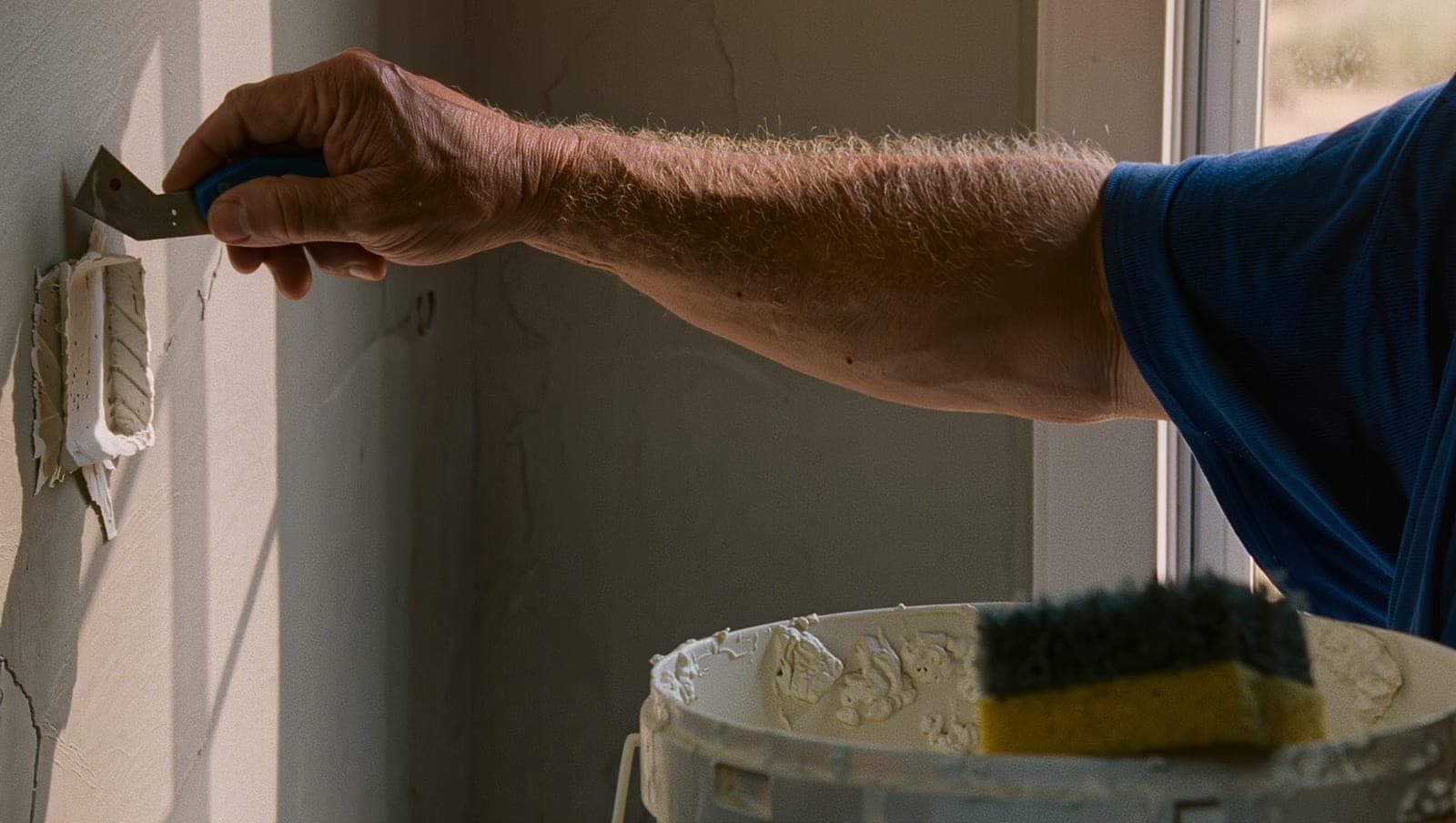
A drywall patch is a small piece of new material set into an old wall and finished until the two are indistinguishable. That last part is the whole trade. Setting the piece takes ten minutes; making it vanish takes technique, patience, and a working knowledge of what the rest of the wall looks like under raking light. In Phoenix that knowledge starts with texture. Most homes built in the Valley since the 1970s wear orange peel or knockdown over their drywall, and many older ceilings still carry popcorn. A patch that is flat and smooth in a room full of texture is not a repair. It is a label. The patches we do most are the ordinary wounds of living in a house: doorknob strikes, anchors pulled from a wall when the TV moved, the ragged hole left when a cable installer or plumber cut an access opening and left it for someone else.
Patches fail for three reasons, and all three are visible from the doorway. The first is a hump: compound built up over the patch and not feathered far enough, so the repair reads as a raised square when the afternoon sun crosses the wall. The second is texture that almost matches, which is worse than texture that does not, because the eye lingers on almost. The third is flashing, where paint went onto raw compound without primer and now shows as a dull rectangle in a sheen wall. A stick-on mesh patch, three coats of spackle, and a rattle can of texture manage to commit all three at once. The wall then carries that patch, visibly, until someone does it again.
Bleuwave Handyman patches drywall the slower way, which is the only way that disappears. Small openings get a California patch, a piece of new board with its paper face left long so the paper becomes the tape. Anything larger than a hand gets wood backing screwed behind the opening and a plug cut to match the wall thickness. Seams are taped and bedded in setting compound, then built out in two or three thin coats with wide knives and sanded to nothing. Texture is tested off the wall before it goes on the wall, feathered past the patch edges, and knocked down on the same timing the original was. Then primer, then paint, blended or taken to a corner. When we are done, you should have to point to where the hole was, and you should be wrong the first time.
Most of our patch work is a single small job in a single home, and it is treated as though it mattered, because to the person who looks at that wall every evening it does. A good share of it is volume: property managers clearing a unit between tenants, an office with a dozen anchor holes after a reconfiguration, a landlord's list with four patches in three rooms. We batch those into one set of visits where drying time allows, invoice cleanly, and finish with paint so the space shows the day the compound is dry. We are licensed, insured, and bonded, Veteran Owned & Operated since 2022, and same-day and next-day appointments are usually available across a 35-mile radius of Phoenix.
If there is a hole in your wall that has been hiding behind a picture frame, or a patch someone else made that has been hiding in plain sight, get a free estimate. We will tell you what the wall needs, how many visits it takes, and what it costs, in plain numbers.
Signs you need patch repair
- A hole between the size of a quarter and a dinner plate, with torn paper and exposed gypsum around the edge.
- Old anchor and screw holes clustered where a TV, shelf, or curtain rod used to hang.
- A rectangular opening left by a plumber, electrician, or cable technician who needed access and did not close the wall.
- A previous patch that reads as a raised square, a smooth spot in the texture, or a flat patch of paint at a different sheen.
- Dents and gouges from furniture moves, with crushed gypsum under paper that is still mostly intact.
- A doorknob strike behind a door with a missing or broken stop, often with a matching dent from the last time.
How the repair is done
- 1
Size the damage and pick the patch
Under about two inches across, a dent can be filled after the crushed paper is cut out. From two to roughly six inches, a California patch, cut from a scrap of the same half-inch board with two inches of paper face left on every side, is the fastest invisible fix. Above that, or anywhere the wall gets touched, we cut the opening square and install backing. A flashlight and inspection mirror check for wires, pipes, and the condensate line that has a habit of running through Phoenix walls right where the hole is.
- 2
Cut square, back it, and set the plug
A utility knife and jab saw square the opening to clean edges. Two furring strips or a strip of half-inch plywood go inside the wall on each side, held with 1-1/4 inch coarse-thread drywall screws set just below the paper. The plug is cut to the opening, checked for thickness against the existing wall, and screwed to the backing. A plug that sits proud is a hump before the first coat goes on.
- 3
Tape and bed in setting compound
Seams get paper tape bedded in 20- or 45-minute setting-type compound, mixed from powder on site, which cures by chemical reaction rather than evaporation and does not shrink. On small, stable patches fiberglass mesh is acceptable under setting compound; under premixed compound alone it cracks. The bed coat is pulled tight with a six-inch knife and left rough for the next coat to grip.
- 4
Build out in thin coats and feather wide
Two or three coats of lightweight all-purpose or topping compound follow, each with a wider knife, ten then twelve inches, feathered eight to twelve inches past the seam so the transition is invisible to the hand. Each coat dries fully; Phoenix air helps, but overnight is honest. Sanding is done with a fine sponge and a vacuum-attached sander so the dust stays in the room and out of the return-air grille.
- 5
Texture, prime, and paint
Texture is matched with a hopper gun or an adjustable aerosol, tested first on cardboard to match spatter size and coverage. Knockdown is troweled with a wide knife after the same flash time the original had. Once dry, the patch is primed with PVA or a stain-blocking primer so paint does not flash, then painted with the wall color, blended into the field or carried to the nearest corner where the existing paint has faded.
What it costs in Phoenix
A single small patch in the Phoenix market generally lands in the low hundreds, and much of that is the trip and the return visit rather than the material. Several patches in one home, done together, cost less per patch than the same patches done a month apart. Mid-size patches through knockdown or orange peel, with texture and paint, typically run in the mid hundreds, and a patch that turns out to be water damage or a sizeable access opening moves the estimate upward once backing, drying, and a wider paint area come into it. Smooth walls cost more than textured ones to hide work on, because there is nothing for the eye to lose the seam in. These are ballparks, not quotes. Your free estimate is specific to the wall, the texture, and how many patches we can finish in one set of visits.
Do it yourself, or call someone?
A pinhole from a picture hanger is a fingertip of spackle and a wipe. A nail pop is a screw set an inch above it and a skim coat. Those are yours to do. The turning point is the doorknob hole. The kits at the home center sell a stick-on mesh disc that sits on the wall surface, and finishing it flat requires feathering compound eight inches in every direction, which is exactly the skill the kit assumes you have. Most first attempts leave a hump. Texture is the second wall to hit. The aerosol cans get close, but the spatter size and density on a thirty-year-old orange peel wall are hard to dial in, and a patch that is nearly right draws the eye more than the hole did. Then there is dust, which in a house running AC eighteen hours a day travels from the spare bedroom to the kitchen counters in an afternoon. If you enjoy the work, do the pinholes and try one patch in a closet first. If you want the wall to look untouched by Friday, that is what the estimate is for.
Can a handyman repair drywall? The honest answerWhat is included
- California patches for small holes, backed plugs for anything larger
- Anchor and screw hole clusters filled and finished as one field
- Access openings from plumbing, electrical, and cable work closed and textured
- Bad previous patches cut out and redone properly
- Texture matching on every patch: orange peel, knockdown, skip trowel, smooth
- Prime and paint, blended or taken to a natural break
- Multi-patch visits for rentals, offices, and move-outs
- Dust control with vacuum sanding and drop cloths
Why Phoenix calls Bleuwave
- We feather wide and sand between coats. The hump that gives away most patches is a shortcut we do not take.
- Texture is tested before it touches your wall, and matched by spatter size, not by the label on the can.
- Setting compound on every bed coat, so the patch does not shrink and crack in its first summer.
- Batch pricing for multiple patches in one property, which property managers and landlords notice on the invoice.
- Licensed, insured, and bonded, Veteran Owned & Operated since 2022, serving everything within 35 miles of Phoenix.
- Same-day and next-day appointments most weeks, with after-hours visits for occupied commercial space.
Questions Phoenix homeowners ask
How big a hole can be patched instead of replacing the drywall?
Anything up to roughly two feet across can be patched with backing and a plug and will be as strong as the original wall. Beyond that, or where damage runs across several studs, replacing a section from stud center to stud center is faster and finishes cleaner. Water damage changes the math: a small stain can hide a large soft area, so we size the cutout by what the moisture meter finds, not by the visible mark.
How long does a drywall patch take to dry?
Setting compound is workable in twenty to ninety minutes depending on the mix. The finish coats of premixed compound need to dry fully before sanding, usually overnight in Phoenix air, longer in a monsoon week. Texture needs to dry before primer and primer before paint. A small patch typically takes two short visits over two days. A same-day patch is possible with setting compound throughout, and we will tell you when that is a good idea and when it is a compromise.
Can you patch a textured wall so it does not show?
Yes, and orange peel and knockdown are the easiest to hide work in, because the texture breaks up the surface. Popcorn and heavy hand textures take more care and are matched by hand. Smooth walls are the hardest, since every ripple shows; those get skim-coated wider and sanded under a work light.
Why does my old patch show through the paint?
Usually flashing. Fresh compound absorbs paint differently from the painted wall around it, so an unprimed patch dries to a different sheen and shows as a dull rectangle in daylight. Sometimes it is a hump from poor feathering. Either way, the fix is to skim and sand the patch flat, prime it, and repaint to a break in the wall.
Can you patch over a previous bad patch?
Sometimes, if it is flat and well adhered; we skim it, re-texture, and paint. If it is a mesh sticker with a hump or a plug that flexes, it comes out and is done properly. Building over a bad patch mostly produces a bigger bad patch.
Do you patch multiple units or offices in one visit?
Yes. We batch patches by drying stage, so one crew can bed-coat six rooms, then return once for finish, texture, and paint. For property managers that means one work order, one invoice, and the unit ready to show on a known date.
Related repairs
Guides worth ten minutes
Guide · 7 min read
How Long Does Drywall Patching Take?
A small patch is a same-day job. A proper mid-size repair is two visits, and the gap between them is not idleness. Here is the realistic timeline, and what Phoenix heat does to it.
Guide · 8 min read
How Much Does Drywall Repair Cost in Phoenix?
The same doorknob hole can draw three different prices from three honest people. Here is what each of them counted, what the Phoenix ballparks look like, and how to get a number you can hold someone to.
Elsewhere on the site
Related services, nearby city pages, and reading that pairs with this repair.
Looking for the service page? See how we handle this as a scheduled service, or browse all services.
The wall will forget. So will you. Get a free estimate.
Licensed, insured & bonded · Veteran Owned & Operated since 2022 · Serving 35 miles around Phoenix.