
Repair Hub · Phoenix Metro
Knockdown Texture Repair Timed to the Minute, Blended to the Edge
Sprayed, waited, and flattened to the same island size and height as the original, so the repair has no border to find.
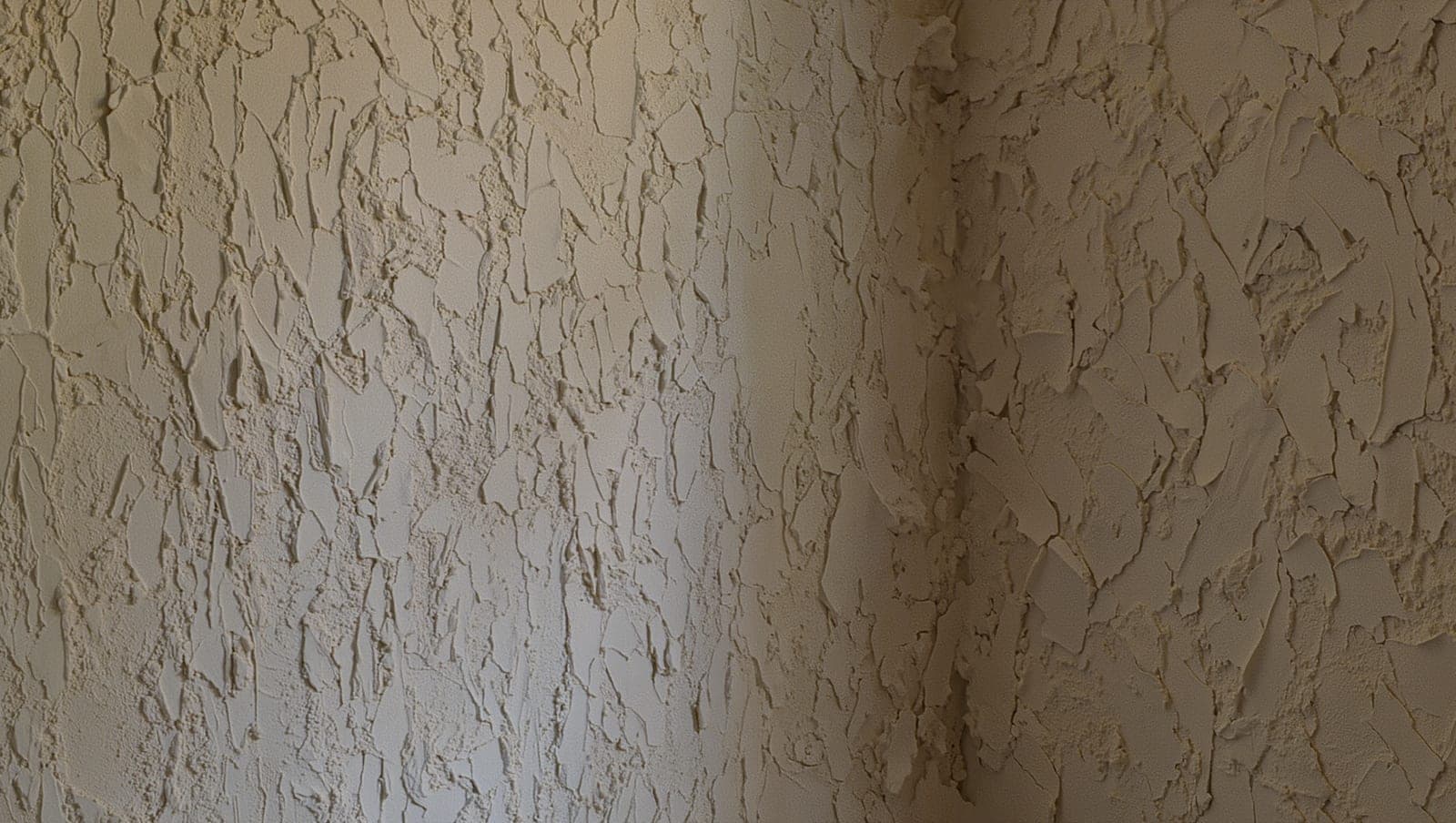
Knockdown is the texture of the Valley's building booms. Walk into a house in Gilbert, Peoria, or Ahwatukee built between the early 1990s and the late 2000s and the walls are almost certainly knockdown: a heavy spatter of joint compound, sprayed from a hopper and left to set for a handful of minutes, then flattened with a wide knife so each blob becomes a low plateau with soft edges. The result reads as a mottled, hand-finished surface from across the room and hides framing waves, seams, and screws under it. Builders liked it because it is only slightly slower than orange peel and looks more expensive. It is the one common wall finish with a clock in the recipe, and that clock is what makes repairing it hard.
The window between spraying and knocking down is where a knockdown match is won or lost. Flatten the spatter too early and the knife smears it into streaks and ridges. Wait too long and the blobs have skinned over and will not flatten, leaving a patch of stubby orange peel in a field of plateaus. The window is set by the compound, the humidity, the temperature, and the air moving through the room. In a Phoenix house in June, with the air conditioning running and the relative humidity in the single digits, the window can be half what it would be in a coastal city, and it closes without warning. A previous repair that looks busy, streaky, or too tall almost always came down to timing.
Bleuwave Handyman repairs knockdown as a two-step texture with its own clock. The patch is finished flat with setting-type compound and primed. Compound is mixed to the heavier, less thinned consistency knockdown needs and sprayed through a larger orifice at lower pressure onto a test board, then flattened with a wide, flexible knockdown knife at a shallow angle after a timed wait, and compared with the wall under raking light. Once the island size, spacing, and plateau height match, the wall is sprayed with the pattern feathered past the patch, knocked down in one direction at the same interval, primed, and painted to the corners.
Property managers in the East and West Valley live with knockdown across entire portfolios, and a unit turn can mean a dozen patches on walls that all have to knock down the same way. We hold the same mix, orifice, and timing across a unit, correct old repairs that were flattened too early or too late, and re-texture whole walls when a wall's history has become its most visible feature. We also texture new walls and closed doorways to match the house, where the challenge is not a patch but a full plane that has to look sprayed by the same hand on the same day.
If your knockdown patch is technically done and visibly there, it is a texture problem, not a drywall problem, and it is solvable in a visit. The estimate is free.
Signs you need knockdown
- A repaired area where the islands are taller, smaller, or more crowded than the rest of the wall, giving it a busy look from across the room.
- Streaks and drag marks in the texture where a knife flattened compound that had not yet set.
- Stubby, unflattened bumps like a coarse orange peel where the compound set before it was knocked down.
- A hard line at the edge of a repair where the new texture was not feathered into the old.
- A closed-in doorway, new wall, or drywall infill that is smooth or lightly textured in an otherwise knockdown room.
- Ceiling knockdown around a replaced fan or can light that is visibly different in scale from the rest of the ceiling.
How the repair is done
- 1
Read the pattern and finish the patch flat
We study the original in an unpainted spot and note three things: how large the islands are, how much flat wall shows between them, and how high the plateaus stand under a raking light. The patch itself is set with setting-type compound, feathered with a 12-inch knife, sanded, and primed, because knockdown plateaus sit on the surface and any hump underneath lifts them into the light.
- 2
Mix heavier and spray coarser
Knockdown compound is thinned less than orange peel so the spatter lands as distinct blobs with some body. It goes through a larger hopper orifice at lower pressure, often in the low twenties of pounds per square inch, and onto a test board first. Spatter size sets the island size; compound thickness sets the plateau height. Both are adjusted on cardboard, not on the wall.
- 3
Time the knockdown on the test board
After spraying, we wait and watch. The compound is ready when it has lost its wet shine but still moves under a fingertip, which might be fifteen minutes in a cool room and five in a Phoenix summer with the AC running. Then an 18- or 24-inch flexible knockdown knife is drawn across at a low angle with almost no pressure, in one direction, wiped clean between passes. The test board tells us the interval for this room today.
- 4
Spray the wall, feather, and knock down
The area is masked and the patch is sprayed with the pattern thinning outward past the repair edges. We note the time. At the interval the test board gave us, the knife flattens the new spatter in the same direction as the original strokes, riding out onto the old texture at the edges so the new plateaus and the old ones merge. One pass. A second pass is how a repair gets that smeared look.
- 5
Prime, paint, and match the sheen
Once dry, the new texture is primed so it absorbs paint like the surrounding wall, and the wall is painted corner to corner. Knockdown ceilings are painted end to end in flat. Where the wall is eggshell or satin, whole-wall paint is not optional, because the sheen difference over a spot paint shows before the texture does.
What it costs in Phoenix
Knockdown repair in the Phoenix market runs a little above orange peel for the same size patch, because the second step and the timing add labor, but a single patch textured and painted still usually lands in the low hundreds. A wall with several old mistimed repairs corrected at once costs little more than one, since the setup is shared. Re-texturing a full wall, or a new wall or closed doorway, is priced by the square foot and lands in the hundreds, more for tall or vaulted ceilings. Ballparks only. The real figure is a written estimate for your wall, and ours is free.
Do it yourself, or call someone?
Knockdown from an aerosol can is possible for a spot the size of a playing card, and the results are uneven even for people who do it often, because the can's spatter is finer than a hopper's and the knockdown window in a Phoenix room is short and hard to predict. The first attempt usually gets flattened too early and smears, the second too late and stays bumpy, and the wall gets painted anyway. A rented hopper improves the spatter but not the clock. If the patch is larger than your hand, on a ceiling, near a window, or one of several, or if you have already tried once, this is a repair to hand off. It costs less than the third try.
Can a handyman repair drywall? The honest answerWhat is included
- Knockdown texture matching on walls and ceilings
- Hopper gun spatter sized on a test board to the original island scale
- Knockdown timed against the room's actual temperature and humidity that day
- Wide flexible knockdown knife, low angle, one direction, matched to the original stroke
- Correction of previous repairs knocked down too early, too late, or too heavily
- New walls, infills, and closed doorways textured to match the house
- Feathered edges so the patch has no border in raking light
- Primer over new texture and corner-to-corner paint
Why Phoenix calls Bleuwave
- The knockdown is timed on a test board in your room, with your air, before the wall is touched. The window in a Phoenix summer is too short to guess.
- Compound is mixed for knockdown, not repurposed. A thin mix makes short islands that vanish under the knife.
- The knife runs one direction, once, at the original stroke angle. Second passes are how a repair gets that smeared look.
- The patch is flat and primed before texture. Knockdown plateaus sit on the surface, and a hump underneath lifts them into the light.
- Consistent mix, orifice, and timing across whole units and portfolios for property managers within 35 miles of Phoenix.
- Licensed, insured, and bonded, Veteran Owned & Operated since 2022, with free estimates on every repair.
Questions Phoenix homeowners ask
What is the difference between knockdown and skip trowel texture?
Knockdown is sprayed from a hopper and then flattened with a knife, so its islands are roundish, evenly scattered, and about the same size. Skip trowel is applied by hand, with a trowel skipping thinned compound across the wall, so its shapes are longer, sweeping, and irregular. Most Phoenix tract homes from the 1990s onward are knockdown. Skip trowel shows up in custom and Southwest-style homes and is matched by hand, not by hopper.
How long do you wait before knocking down the texture?
Until the spatter has lost its wet sheen but still yields to a fingertip. In a cool, closed room that is often ten to fifteen minutes. In a Phoenix house in summer, with dry air and the AC moving it, it can be five. That is why we spray a test board first and time it in the room rather than following a number from a label.
Why does my knockdown repair look smeared or streaky?
The knife went across before the compound had set, so instead of flattening the tops of the blobs it dragged them. Too much pressure or a second pass does the same thing. The remedy is to sand or lightly skim the smeared area, re-spray it at the right mix, and knock it down once at the right minute with a light hand.
Can you texture a new wall or a closed-in doorway to match my knockdown?
Yes. A full plane is in some ways easier than a patch, because there is no blend zone in the middle of it, but the edges where it meets the existing walls still have to feather, and the island size and height have to match the room. We set the hopper on a test board against the adjoining wall and knock the new wall down at the same interval, then prime and paint the whole thing.
Can a knockdown ceiling patch be done in one visit?
Often, yes. The patch is set with fast-setting compound, primed, sprayed, knocked down, and left to dry, then primed and painted in the afternoon or the following morning depending on the size and the humidity. A whole ceiling re-texture takes longer because of the drying time between steps and the ceiling paint at the end.
Should I switch from knockdown to smooth walls when I repaint?
You can, and many remodels do, but it is not a paint job. Going smooth means skim coating the entire wall in several thin coats, sanding, priming, and painting, and it is priced by the square foot. Smooth walls also show every future flaw. If you love the look, budget for a room at a time. If you simply want the old repairs to disappear, re-texturing the wall in knockdown is the shorter road.
Related repairs
Guides worth ten minutes
Guide · 8 min read
Can a Handyman Repair Drywall?
Drywall repair is the job handymen do most and do best. The better question is where the line falls, and how to know whether the person you hired is on the right side of it.
Guide · 8 min read
How Much Does Drywall Repair Cost in Phoenix?
The same doorknob hole can draw three different prices from three honest people. Here is what each of them counted, what the Phoenix ballparks look like, and how to get a number you can hold someone to.
Elsewhere on the site
Related services, nearby city pages, and reading that pairs with this repair.
Looking for the service page? See how we handle this as a scheduled service, or browse all services.
Right mix, right minute, no border. Get a free estimate on your knockdown repair.
Licensed, insured & bonded · Veteran Owned & Operated since 2022 · Serving 35 miles around Phoenix.