
Diagnosis · Phoenix Metro
Why is my wall soft?
Short answer
A wall goes soft because water has soaked the gypsum core and broken its bond with the paper face. In Phoenix the water usually comes from a plumbing leak inside the wall, a slab leak wicking up from the floor, or a roof or air conditioner leak running down from above. Soft drywall does not firm up again when it dries. The wet section is cut out and replaced once the leak is fixed.
High urgencySoft drywall is wet drywall, and wet drywall inside a warm Phoenix wall cavity can start growing mold within a day or two. The leak that caused it is usually still running. If you can find the shutoff for the nearest fixture, close it. Then get the wall opened this week, not after the next billing cycle.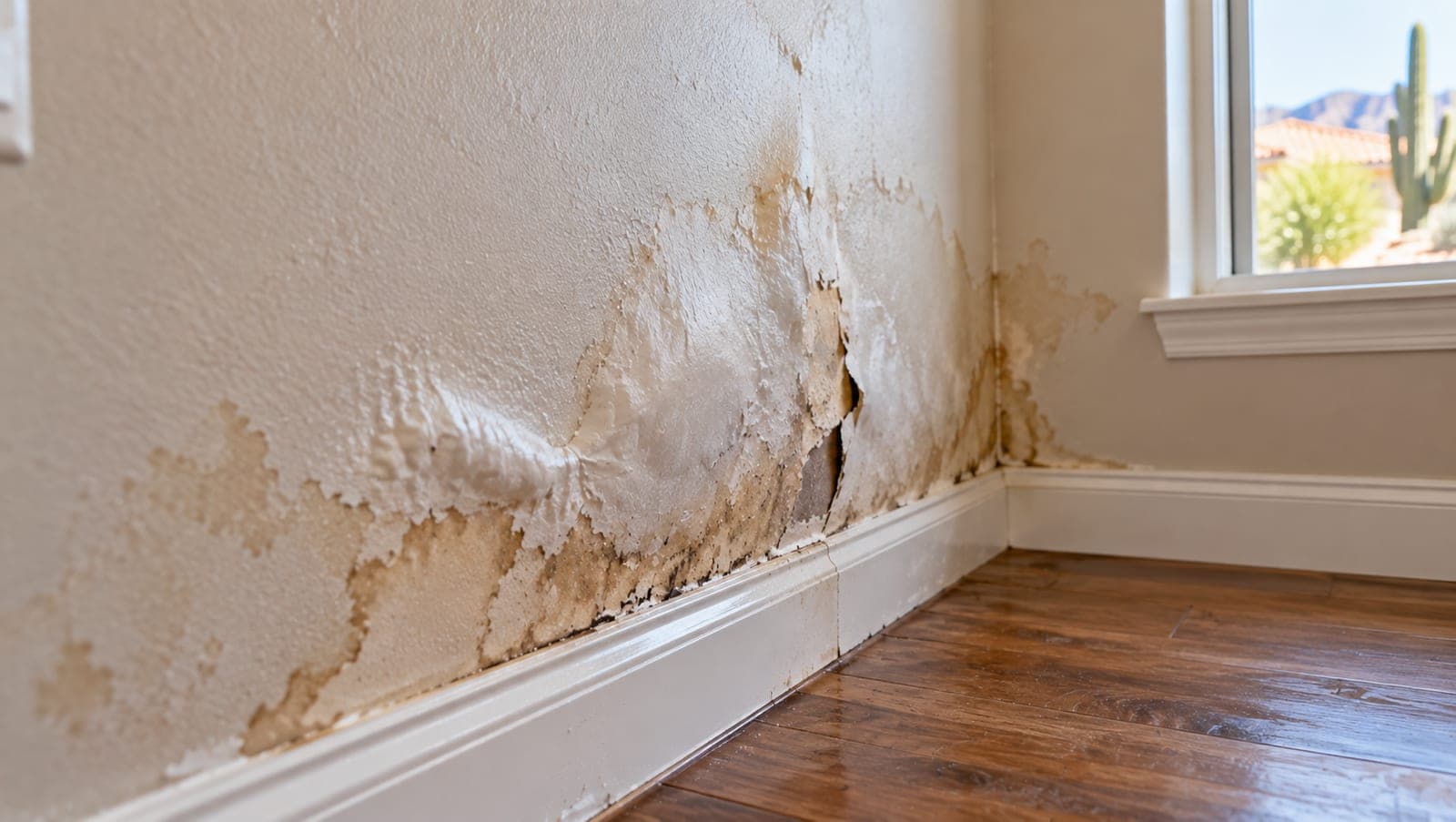
Drywall has one job, and it does that job only while it is dry. The gypsum core is a pressed mineral slab. The paper on each face gives it stiffness the way the skin of a drum gives it tone. Add water and the paper lets go of the core, the core turns to damp chalk, and the wall that used to stop your thumb now yields to it. A wall should feel like a wall. When it feels like a loaf of bread, something upstream has been leaking for a while.
In a Phoenix house the water rarely announces itself. Supply lines run through walls and attics. Most houses sit on a slab, so a pinhole in a hot-water line under the floor shows up first as a warm tile and a soft baseboard, not as a puddle. Overhead, the air handler in the attic drips into a pan when its drain clogs with summer dust, and the pan drips onto the ceiling and down the nearest wall. Monsoon storms push water under tile and around parapets from June through September. Swamp coolers overflow. Hard water eats fittings from the inside. The soft spot is where all of that finally reaches the paint.
The good news is that a soft wall is a precise instrument. Where it is soft, how high it is soft, and what is on the other side of it will usually name the source within ten minutes. This page walks through that reading, then hands you to the repair that fits.
Likely causes, ranked
- 1
A supply or drain leak inside the wall
most commonThe soft area sits within a few feet of a sink, toilet, shower, washer, or refrigerator line, often on the wall that shares plumbing with the room next door. It may be at any height. A hot-water leak sometimes leaves the drywall warm to the touch. Listen at the wall with the house quiet: a faint hiss with every fixture off is a pressurized line venting into the cavity. A water bill that climbed without explanation is the other tell.
- 2
A failed shower or tub surround
commonThe wall behind or beside a shower goes soft in a band at splash height, or at the floor where the tub meets the wall. Grout has cracked or caulk has pulled away, and water has been running behind the tile for months. Look for hairline gaps at the tub lip, a tile that sounds hollow when tapped, and softness that gets worse a day or two after heavy shower use.
- 3
A slab leak or water wicking up from the floor
commonSoftness that runs along the bottom six to twelve inches of a wall, with a swollen baseboard and a tide line above it, is water coming up rather than down. On a slab house the sources are a leaking under-slab line, a shower pan, or a drain. A warm patch of floor near the wall points to the hot side. Shut off every fixture and watch the water meter for five minutes. If the low-flow indicator moves, the leak is on your side of the meter and it is running now.
- 4
Water from above: roof, AC condensate, or swamp cooler
commonThe soft area is high on the wall or starts at the ceiling line and fades downward, sometimes with a brown stain above it. It appears or worsens after a storm, or during a hot stretch when the air conditioner runs all day and its drain pan overflows. Rooms under the air handler closet, under a roof valley, or beside a rooftop cooler are the usual suspects.
- 5
Irrigation, grading, or a planter against the house
less commonSoft drywall on an exterior wall, low, often behind furniture, with white mineral crust on the stucco outside. A drip emitter aimed at the stem wall, a hose bib that seeps, or a raised planter holding wet soil against the house keeps the wall damp from the outside in. It is slow, and it is the one cause on this list that a licensed plumber will not find.
Check it yourself in ten minutes
- 1Press the wall with your palm in a grid around the soft spot and mark the edge of the softness with painter's tape. If the marked area is larger than your open hand, you are looking at a section replacement, not a patch.
- 2Look at the baseboard. Swelling, a dark line along the top edge, paint lifting at the bottom of the wall, or a baseboard that has pulled away from the drywall all mean water has been standing at the floor.
- 3Shut off every faucet, appliance, and irrigation zone and watch the water meter for five minutes. Any movement means a leak on your side of the meter.
- 4Open the cabinet on the other side of the wall. Feel the supply lines, the trap, the shutoff valves, and the cabinet floor. Look for warped particleboard and a chalky white ring where a drip has dried.
- 5Look up and out. A stain on the ceiling above the soft spot, the attic access nearby, or the air handler closet on the other side changes the source from plumbing to condensate or roof.
- 6Smell the wall at the baseboard and near the soft spot. A musty, earthy odor means the cavity has been damp long enough to grow something, which changes the urgency and the scope.
The fix
Cut out, dry, and rebuild the wet section
The standard fix for a soft wall. After licensed plumbing or HVAC stops the water, the wet drywall is cut back to dry board and to the nearest studs, wet insulation comes out, the cavity is dried with air movement, and new board goes in.
Water-Damaged Drywall Repair
Replace the wall when the softness runs its length
When the bottom course is soft from corner to corner, or a shower wall is spongy across its whole width, a row of patches is slower and uglier than new board. The wall comes off, the framing is inspected and dried, and a fresh sheet goes up.
Drywall Replacement
Match the texture so the repair disappears
New board is only half the job. The seam between old orange peel or knockdown and the repair is where cheap water-damage work shows. Texture is matched from a test board and blended past the repair edge before paint.
Texture Matching
When to stop diagnosing and call
Stop diagnosing the moment the meter moves, the wall smells musty, or the soft area is bigger than your hand. Those three facts mean the leak is live, the cavity has been wet for a while, or the repair is beyond a patch, and all three get more expensive with each week. Bleuwave Handyman is licensed, insured, and bonded, Veteran Owned & Operated since 2022, and the Bleuwave family includes licensed plumbing and HVAC, so the leak and the wall are one call rather than two vendors pointing at each other. We serve everything within 35 miles of Phoenix with same-day, next-day, and after-hours availability. Estimates are free, and a soft wall is the kind of estimate we move to the front of the week.
More questions on this one
Can soft drywall dry out and become hard again?
No. Once the gypsum has been saturated and the paper has separated from the core, drying leaves you with a stiff-looking board that crumbles under a screw and will not hold compound. Board that was only lightly damp and dried within a day may still be firm. If it is firm now, it can stay. If it is soft now, it is done.
Is a soft wall dangerous?
Drywall carries no structural load in a normal house, so a soft wall is not going to bring anything down. The risks are the ones behind it: water near wiring and outlets, mold in a closed cavity, and framing that has been wet long enough to matter. Treat the wall as a warning about the cavity, not as the hazard itself.
Why is only the bottom of my wall soft?
Water travels down and wicks up. Softness confined to the lowest foot of a wall, with a swollen baseboard, almost always means water arrived at floor level: a slab leak, a shower pan, a drain, an appliance overflow, or water from outside. Softness that starts high and fades downward came from above.
How much of the wall will be replaced?
The cut goes past the soft boundary to dry board, usually a foot or so beyond what you can feel, and out to the nearest studs so the new piece has framing to screw to. On a wall that is soft along the whole bottom, the practical cut is often a horizontal band two feet up from the floor, which is the height of a standard drywall sheet turned lengthwise.
Who fixes the leak?
The licensed trade that owns that kind of leak. Within the Bleuwave family, licensed plumbing handles supply lines, drains, shower valves, and slab leaks, and licensed HVAC handles condensate lines and drain pans. If the source is the roof or the irrigation, we tell you what we found and where. The handyman crew rebuilds the wall after the water stops.
Related questions and reading
Elsewhere on the site
Services and reading that follow naturally from this diagnosis.
Still not sure what you are looking at?
Browse every question in the Repair Hub, or skip the reading and have a licensed pro look.