
Repair Hub · Phoenix Metro
Interior Wall Repair for Drywall, Plaster, Stucco, and the Seams Between Them
Stucco-to-drywall transitions, interior plaster over block, and the wall repairs older Arizona houses actually need.
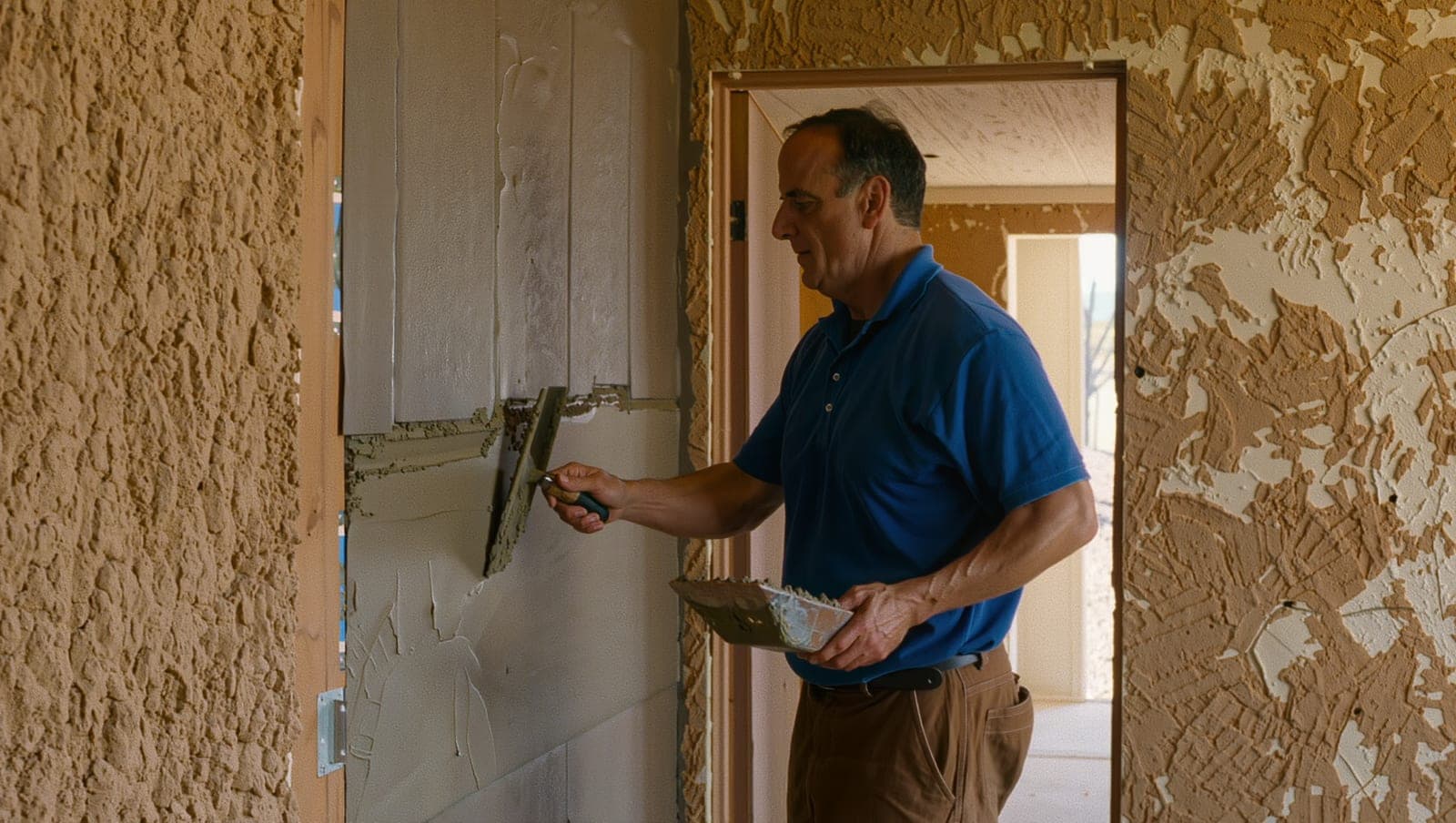
Not every interior wall in Phoenix is drywall. The ranch houses built across central Phoenix, Tempe, Scottsdale, Glendale, and Mesa from the 1950s through the 1970s were often raised in concrete block, and their interior walls were finished in plaster or a sand-finish stucco troweled directly onto the block, or in drywall screwed to furring strips nailed against it. Later, when somebody added a bedroom, enclosed a patio, or converted the garage, new wood-framed drywall walls were joined to those old masonry walls. Two materials that move differently now share a corner. Block and plaster hardly move at all. Wood framing and drywall move with heat, humidity, and settling. The seam between them cracks, and it keeps cracking, no matter how many times it is caulked.
Beyond transitions, older interior walls fail in their own ways. Plaster loses its key to the block and sounds hollow when tapped. A sand-finish stucco wall gets patched with lightweight spackle that cannot bond to it and falls out in a season. Drywall on furring strips is only as solid as the furring, and a doorknob through it exposes a block wall an inch or two behind with no way to back a normal patch. Nail pops appear in rows where furring strips have dried and shrunk. And every one of these walls carries a texture, whether a fine sand finish, a hand trowel, or a later coat of orange peel, that has to be matched on a substrate that does not take texture the way drywall does.
Bleuwave Handyman repairs interior walls according to what they are actually made of. We tap and inspect before we quote, and on block walls we check for moisture where efflorescence or a tide line suggests it. Plaster is repaired with a bonding agent, fiberglass mesh, and setting-type compound that cures hard enough to belong. Interior stucco gets a proper base and finish coat and the sand texture matched by hand. Furred drywall gets new furring where the old has failed and 1/2-inch board fastened to it. Transitions between stucco or plaster and drywall are rebuilt with a real joint, either a trim bead and a flexible sealant that can absorb movement, or a reinforced taped joint where the two sides have proven stable. Then the surface is textured, primed, and painted so the repair reads as wall.
Property managers with older buildings know this problem well. Block-built fourplexes, mid-century office suites, and converted houses carry mixed walls, and a tenant's damage in a furred hallway or a cracked addition seam is not a job for a standard drywall patch kit. We handle these on turns and work orders, scope the substrate before we arrive with materials, and finish so the next tenant sees a wall, not a history.
A crack that returns every year is not a paint problem. It is a joint problem, and it is solvable once. Estimates are free, and a photo of the crack with a coin next to it for scale is a good place to start.
Signs you need interior walls
- A crack that runs the full height of a wall exactly where an addition, enclosed patio, or converted garage meets the original house.
- A drywall corner pulling away from a stucco or plaster wall, leaving a gap that caulk fills for a season and then reopens.
- Plaster or interior stucco that sounds hollow when tapped, or that bulges slightly away from the block behind it.
- A previous patch that has fallen out or shrunk back, leaving a ring of failed spackle around a hole.
- A hole punched through drywall that reveals concrete block an inch or two behind it, with nothing to anchor a normal patch to.
- Nail pops or screw dimples appearing in straight vertical rows, the sign of furring strips behind the drywall.
How the repair is done
- 1
Find out what the wall is made of
We tap the wall to map hollow plaster, probe a hole to see whether there is block, furring, or a stud cavity behind, and read block walls with a moisture meter where a stain or white efflorescence suggests water has been moving through the masonry. On a transition crack we look at both sides to judge whether the movement is ongoing or has settled, because that determines the kind of joint we build.
- 2
Cut back to sound material and prepare the substrate
Loose plaster and failed stucco are removed to a firm edge with an oscillating tool and a cold chisel, and the block or lath behind is wire-brushed clean. Failed furring is pulled and replaced with new strips anchored to the block. Old caulk and paint are cut out of a transition joint so the new joint bonds to clean material. A bonding agent is applied wherever new compound or stucco will meet old masonry.
- 3
Repair each material with what suits it
Plaster gets fiberglass mesh embedded in setting-type compound, built up in coats to the original plane. Interior stucco gets a base coat and a finish coat, with the sand finish matched by hand before it sets. Drywall on furring is replaced with 1/2-inch board fastened to the new strips and taped into the surrounding wall. Where a patch has to span open block with no backing, we set backing strips or furring first so the repair is supported, not floating.
- 4
Build a transition joint that can move
Where drywall meets stucco or plaster and the two are still moving, we finish the drywall edge with a J-bead or L-bead and leave a narrow, clean joint filled with a high-quality flexible sealant that can stretch through the seasons. Where the movement has stopped, we bridge the joint with mesh or paper tape set in setting-type compound and feather it wide. The wrong joint is why the crack came back three times already.
- 5
Texture, prime, and paint across the whole surface
Sand-finish and hand textures are recreated by hand. Orange peel and knockdown are sprayed from a texture hopper after a test board. Masonry and patched plaster are sealed with the appropriate primer so the finish coat holds its sheen evenly, and the wall is painted corner to corner so nothing outlines the repair.
What it costs in Phoenix
In the Phoenix market, a small interior plaster or stucco patch typically lands in the low to mid hundreds, more than a comparable drywall patch because the materials and the hand texture take longer. Rebuilding a cracked stucco-to-drywall transition along a full wall height is usually a mid-hundreds job, and refurring and re-drywalling a block wall is priced by the square foot of new wall. Access, ceiling height, and how much of the room must be repainted move the number. These are ballparks for orientation, not a price list. A written estimate after we have tapped the wall is free.
Do it yourself, or call someone?
Small drywall dents and nail pops on a furred wall are fair homeowner work if you use setting-type compound rather than lightweight spackle and accept that you will paint the wall afterward. Plaster and interior stucco are less forgiving. Patching compound that does not bond to masonry falls out, and a patch built up too thick in one coat cracks as it dries. Transition cracks are where most homeowner attempts fail, because the instinct is to fill the crack rather than rebuild the joint, and the crack simply returns after the first summer. If you have caulked the same seam twice, the third time is a call.
Can a handyman repair drywall? The honest answerWhat is included
- Stucco-to-drywall transition repair at additions, enclosed patios, and garage conversions
- Interior plaster repair over concrete block, including hollow and delaminated sections
- Interior sand-finish stucco patching with hand-matched texture
- Furring strip replacement and 1/2-inch drywall on block walls
- Recurring crack repair with movement joints or reinforced taped seams
- Nail pop and screw dimple repair in furred drywall
- Corner bead, J-bead, and L-bead installation at material transitions
- Texture matching, primer, and paint to a finished wall
Why Phoenix calls Bleuwave
- We repair the wall you have, not the wall a patch kit assumes. Plaster, block, furring, and stucco each get the material that bonds to them.
- Transition cracks get a joint designed for movement, because caulk over a moving seam is a subscription, not a repair.
- Setting-type compound and a bonding agent on masonry repairs, so the patch cures hard and stays put through the summer.
- Hand-matched sand and trowel textures where a hopper would give the repair away.
- Older buildings, fourplexes, and mixed-wall properties handled on work-order timelines within 35 miles of Phoenix, after hours when a tenant is in place.
- Licensed, insured, and bonded, Veteran Owned & Operated since 2022, with free estimates on every wall.
Questions Phoenix homeowners ask
Why does the crack where my addition meets the house keep coming back?
Because the two walls move differently. The original block or plaster wall barely moves. The newer wood-framed drywall wall expands, contracts, and settles with the seasons. Any rigid filler in that seam, whether spackle, compound, or paint, cracks as soon as the framing moves. The fix is a joint that can flex, or a properly reinforced taped joint once the movement has stopped, not another bead of caulk.
Can you patch a hole in drywall that has concrete block behind it?
Yes. The drywall is sitting on furring strips against the block, usually with an inch or two of air behind it, so a standard patch has nothing to attach to. We install backing strips or new furring anchored to the block, fasten a new piece of 1/2-inch drywall to it, and tape and texture it into the wall like any other patch.
How do you repair interior plaster in an older Phoenix home?
Loose plaster is removed back to a firm edge, the surface behind it is cleaned and coated with a bonding agent, and the repair is built up with fiberglass mesh and setting-type compound in coats until it meets the original plane. The texture, often a fine sand finish or a light trowel, is matched by hand. It is more work than a drywall patch, and it lasts when done that way.
Can a handyman repair interior stucco walls?
Yes. Interior stucco is finished the same way as exterior stucco, with a base coat and a finish coat over masonry or lath, and the repair uses stucco patching materials rather than joint compound. Bleuwave Handyman handles interior stucco patches, cracks, and transitions as part of interior wall repair, and matches the sand finish by hand so the repair does not show.
Is a crack in an interior wall a structural problem?
Most are not. Hairline cracks above doors and windows, along transitions, and at ceiling corners are the normal movement of slab-on-grade homes in desert soil. Cracks wide enough to fit a coin, that step diagonally through block, that come with doors that no longer latch, or that grow visibly month to month deserve a look from a structural engineer, and we will tell you when we see one. Everything else, we repair.
Can you match the texture between a stucco wall and a drywall wall?
Within reason, yes. A sand-finish stucco wall and an orange peel drywall wall are different textures, and most homes accept a clean line between them at the corner or the trim bead. Where a repair spans the two, we hand-blend the transition so the change reads as intentional rather than as a patch. If you want one texture throughout, the drywall side can be re-textured to a sand finish or the stucco side skimmed, and we will price both.
Related repairs
Guides worth ten minutes
Guide · 8 min read
Can a Handyman Repair Drywall?
Drywall repair is the job handymen do most and do best. The better question is where the line falls, and how to know whether the person you hired is on the right side of it.
Guide · 8 min read
Repair vs. Replace Damaged Drywall
Most drywall damage can be patched. Some of it should not be. Here is a framework, a decision table, and the water-damage rule of thumb that settles most arguments.
Elsewhere on the site
Related services, nearby city pages, and reading that pairs with this repair.
Looking for the service page? See how we handle this as a scheduled service, or browse all services.
The crack has come back for the last time. Get a free estimate on your interior walls.
Licensed, insured & bonded · Veteran Owned & Operated since 2022 · Serving 35 miles around Phoenix.