
Repair Hub · Phoenix Metro
Popcorn Ceiling Repair and Removal Done the Safe Way
Damaged acoustic texture patched to match, or tested, scraped, skimmed, and refinished smooth or knockdown, in homes across the Phoenix metro.
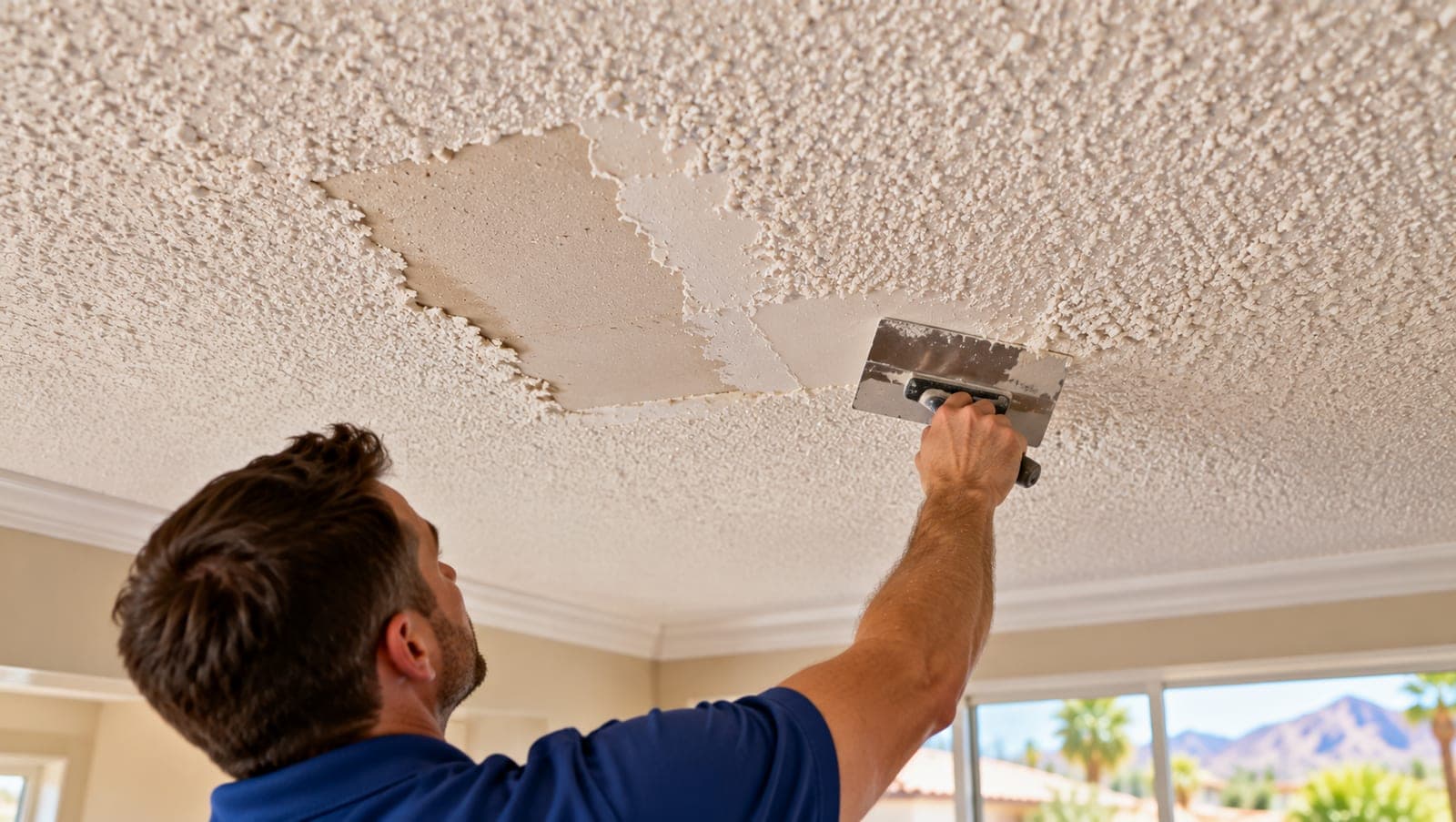
Popcorn ceiling is a sprayed acoustic texture made of joint compound or a similar binder loaded with lightweight aggregate, polystyrene beads or vermiculite, applied thick enough to hide a ceiling that was finished quickly. It was the standard ceiling in Phoenix tract houses from the 1950s through the 1980s and lingered in some builders' lines into the 1990s, because it was fast, cheap, and forgiving. Nobody had to sand a ceiling that was about to be buried under a quarter inch of cottage cheese. It has two problems in the desert. The first is that it is fragile. It absorbs water from a roof or condensate leak and lets go in a wet sheet, it flakes when a ceiling fan is installed or a can light is cut, and it rubs off on anything that touches it. The second is that acoustic texture applied in homes built before the early 1980s may contain asbestos, which means the texture cannot be scraped, sanded, or drilled casually until a sample has been tested.
Repairs come in two sizes. Small damage, a flaked patch around a fixture, a water stain that has dried, a scrape from a moved bookshelf, can be patched: the loose material removed, the stain sealed, the board repaired if needed, and new acoustic texture applied to match the aggregate size and density of the original. Matching is a matter of choosing the right coarseness, a fine, medium, or coarse aggregate mix, and building the coverage in light passes until the new patch reads the same as the old in raking light. Ceilings that have been painted, which by now is most of them, are patched and then painted corner to corner, because new texture is whiter than old.
The other size is removal. A homeowner tired of the texture, a ceiling with too many patches to hide, or a buyer who wants the house to look like this decade calls for scraping. Bleuwave Handyman does this in a fixed order. In any home built before the early 1980s, a sample goes to an accredited lab first, and no scraping starts until the result is back. If the texture tests positive, we stop, refer you to a licensed asbestos abatement contractor, and return afterward to finish the ceiling; we do not do abatement and will not pretend otherwise. If it tests negative, or the house is young enough that testing is not needed, the room is sealed in plastic from floor to ceiling, the texture is wetted with a pump sprayer until it softens, and a wide popcorn scraper takes it down in sheets into a catch bag. What is left is a ceiling with a rough tape job and a hundred scraper marks, so it is skim-coated with joint compound, sanded, and either finished smooth or sprayed with knockdown or orange peel to match the walls. Then primer and paint.
For property managers with older buildings, popcorn is a recurring headache: every fixture change and every leak becomes a texture repair, and every prospective tenant looks up. We can patch to keep a unit rentable, or plan a scrape-and-refinish on a turn, with testing built into the schedule and documented for the file. Where scraping is not practical, a ceiling can be covered instead, with a new layer of quarter- or three-eighths-inch drywall screwed through the old ceiling into the trusses, taped, and finished. It is more material and less mess, and the old texture stays sealed behind it.
Popcorn is one of the few ceiling problems where the right first tool is a lab envelope, not a scraper. If yours is flaking, stained, or simply in the way of the house you want, the estimate is free, the testing is arranged, and the finish, patched or new, will look like it was always there.
Signs you need popcorn ceiling
- A bare or flattened patch in the texture around a ceiling fan, light fixture, or smoke detector.
- Texture that has dropped in a sheet after a leak, leaving brown paper or gray compound exposed.
- A yellow or brown stain that has soaked into the acoustic texture, with the aggregate discolored rather than just the surface.
- Crumbs of texture on the floor or furniture, or a gritty bare spot where something brushed the ceiling.
- Previous patches that are whiter, coarser, or finer than the surrounding ceiling.
- A house built before the early 1980s with popcorn in any room that has never been tested, which matters before any repair, fan install, or paint job.
How the repair is done
- 1
Test first in older homes
In any home built before the early 1980s, a small sample is taken with the texture misted to keep dust down, bagged, and sent to an accredited lab for analysis. Results typically take a few days. A positive result stops the job and sends you to a licensed asbestos abatement contractor, and we return when they are done. A negative result, or a house young enough not to need the test, clears the way. The report goes in your file either way, which matters at resale and on a turn.
- 2
Seal the room and remove what has failed
Floors and walls are covered in plastic sheeting, fixtures are dropped or bagged, and HVAC registers are covered so dust does not travel through the house. For a patch, loose or stained texture is scraped back to sound material. Water stains are sealed with an oil- or shellac-based stain-blocking primer, never a water-based one, which re-wets the texture and loosens what you are trying to save.
- 3
Patch the board and re-texture to match
Any damaged drywall under the patch is repaired like any ceiling patch, with backing, paper tape, and setting-type compound. Then acoustic texture goes on, from an aerosol for a small spot or a hopper gun with a popcorn nozzle for a larger field, with the aggregate coarseness chosen to match the original and tested on cardboard. Coverage is built in light passes and feathered past the edge so the patch has no border.
- 4
Full removal: wet, scrape, and skim
A pump sprayer soaks the texture one section at a time until it softens, and a ten- to twelve-inch popcorn scraper with a bag attachment takes it down. Painted popcorn resists the water and takes longer soaking or light scoring first. The bare ceiling is then skim-coated with all-purpose compound in one or two coats to bury the tape lines, gouges, and rough finish that the popcorn was hiding, and sanded flat with a pole sander and a vacuum.
- 5
Refinish, prime, and paint
The ceiling gets the finish you chose: smooth, with a final skim and sanding under a raking light, or knockdown or orange peel from a hopper gun to match the walls. It is primed with PVA and painted corner to corner with a flat ceiling paint. Where the cover-over route was chosen instead, the new board is hung, taped, and finished the same way. Plastic comes down, and the room is vacuumed and returned.
What it costs in Phoenix
In the Phoenix market, a small popcorn patch around a fixture or a dried stain, sealed, re-textured, and the ceiling repainted, typically lands in the low to mid hundreds, and most of that is the repaint. Removing popcorn from a single room and refinishing it, once testing has cleared the material, usually runs from the high hundreds into the low thousands depending on square footage, whether the ceiling has been painted, and whether the new finish is knockdown or smooth. Lab testing is a modest separate cost, and a positive result moves the removal to a licensed abatement contractor at their pricing before we return to finish. Covering a ceiling with new board is priced by the room. These are ranges to plan by, not a menu. The free estimate will say which path fits your ceiling and what each one costs.
Do it yourself, or call someone?
Patching a palm-sized spot of popcorn with an aerosol acoustic texture is homeowner-possible, if the house is young enough or the texture has tested clean, and if you accept that you will be repainting the ceiling. Scraping a room is a different weekend. It is wet, heavy, and everything below the ceiling ends up under the plastic or under the mud. What a homeowner cannot do at all is know whether pre-1980s popcorn contains asbestos by looking at it, and scraping first and testing later is exactly backward. The skim coat afterward is where the ceiling is won or lost; a scraped ceiling that is primed without skimming shows every joint and scraper track the moment the paint dries. If the goal is a ceiling that looks like it was never popcorn, the test, the scrape, and the skim are worth handing off.
Can a handyman repair drywall? The honest answerWhat is included
- Popcorn texture patched to match aggregate size around fixtures, fans, and repairs
- Water-stained acoustic texture sealed with stain-blocking primer before re-texture
- Lab testing arranged for any pre-1980s ceiling before scraping, with results documented
- Referral to a licensed abatement contractor when a sample tests positive, and finish work afterward
- Full popcorn removal: room sealed, texture wetted and scraped, debris bagged and hauled
- Skim coat over the scraped ceiling to bury tape lines and scraper marks
- New finish in smooth, knockdown, or orange peel, primed and painted corner to corner
- Cover-over with new ceiling board where scraping is impractical
Why Phoenix calls Bleuwave
- Testing before scraping in any home old enough to need it. We arrange the sample and wait for the lab, and we will not touch a ceiling that has not been cleared.
- Straight talk about abatement. If the result is positive, we refer you to a licensed abatement contractor and come back for the finish. We do not do abatement.
- Aggregate matched on patches, so the repair is not a different grain of popcorn in the middle of the ceiling.
- Stains sealed with the right primer. Water-based sealer on popcorn loosens what you are trying to save.
- A skim coat is part of every removal, because a scraped ceiling is not a finished ceiling.
- Licensed, insured, and bonded, Veteran Owned & Operated since 2022, with free estimates and turn-friendly scheduling within 35 miles of Phoenix.
Questions Phoenix homeowners ask
How do I know if my popcorn ceiling has asbestos?
You cannot tell by looking. Acoustic textures applied in homes built before the early 1980s may contain it, and some product stock was used for years after that. The only answer is a lab test on a small sample, which we can arrange. Until the result is back, leave the texture alone: no scraping, sanding, or drilling.
Can you patch a popcorn ceiling so it matches?
Yes, within limits. The aggregate comes in several coarseness grades, and choosing the right one plus building coverage in light passes gets a patch that disappears from the floor. New texture is always whiter than old, so the ceiling gets painted corner to corner afterward. Heavily yellowed or repeatedly patched ceilings may be better candidates for removal.
Is it better to scrape popcorn or cover it with new drywall?
Scraping gives a lighter, cleaner result and keeps the ceiling height, and it is the usual choice when the texture tests clean and has not been painted. Covering with new thin drywall makes sense when the texture is painted hard, when it tested positive and you would rather encapsulate than abate, or when the ceiling underneath is in rough shape. Both end with the same finish options.
Can painted popcorn ceilings be removed?
Yes, but paint seals the texture against water, so it takes longer to soften and sometimes needs light scoring before the sprayer can reach it. Some painted ceilings are easier to skim over or cover than to scrape. We assess which on the estimate.
What do you put on the ceiling after removing popcorn?
A skim coat of joint compound first, because the ceiling under popcorn was rarely finished past a rough tape job. After that, most Phoenix homeowners choose a knockdown or orange peel finish to match their walls, and some choose smooth. Either way it is primed and painted with a flat ceiling paint.
How long does popcorn ceiling removal take for one room?
Once testing has cleared the material, a bedroom is usually two to three working days: one to seal, wet, and scrape, one to skim and sand, and one to texture, prime, and paint, with drying time between. Testing adds a few days on the front end while the lab works.
Related repairs
Guides worth ten minutes
Guide · 8 min read
How Much Does Drywall Repair Cost in Phoenix?
The same doorknob hole can draw three different prices from three honest people. Here is what each of them counted, what the Phoenix ballparks look like, and how to get a number you can hold someone to.
Guide · 7 min read
How Long Does Drywall Patching Take?
A small patch is a same-day job. A proper mid-size repair is two visits, and the gap between them is not idleness. Here is the realistic timeline, and what Phoenix heat does to it.
Elsewhere on the site
Related services, nearby city pages, and reading that pairs with this repair.
Looking for the service page? See how we handle this as a scheduled service, or browse all services.
Patch it, or test it and take it down. Get a free estimate on your popcorn ceiling.
Licensed, insured & bonded · Veteran Owned & Operated since 2022 · Serving 35 miles around Phoenix.