
Diagnosis · Phoenix Metro
What causes nail pops in drywall?
Short answer
Nail pops happen when the framing lumber behind the drywall dries and shrinks, pulling the wall away from the fastener head so the compound over it breaks and the head shows as a small bump or crater. In Phoenix, new houses dry through their first two summers and pops appear in neat rows along studs and trusses. They are cosmetic, unless a row of ceiling pops sits beside a sag or a pop comes with a stain, which is a different question.
Low urgencyNail pops are cosmetic. They can be repaired on any convenient schedule, and in a new home they are best repaired in a batch after the second summer, when most of the shrinkage has happened. The two exceptions are a row of ceiling pops beside a visible sag, which should be refastened soon, and a pop with a stain around it, which is a leak question rather than a drywall one.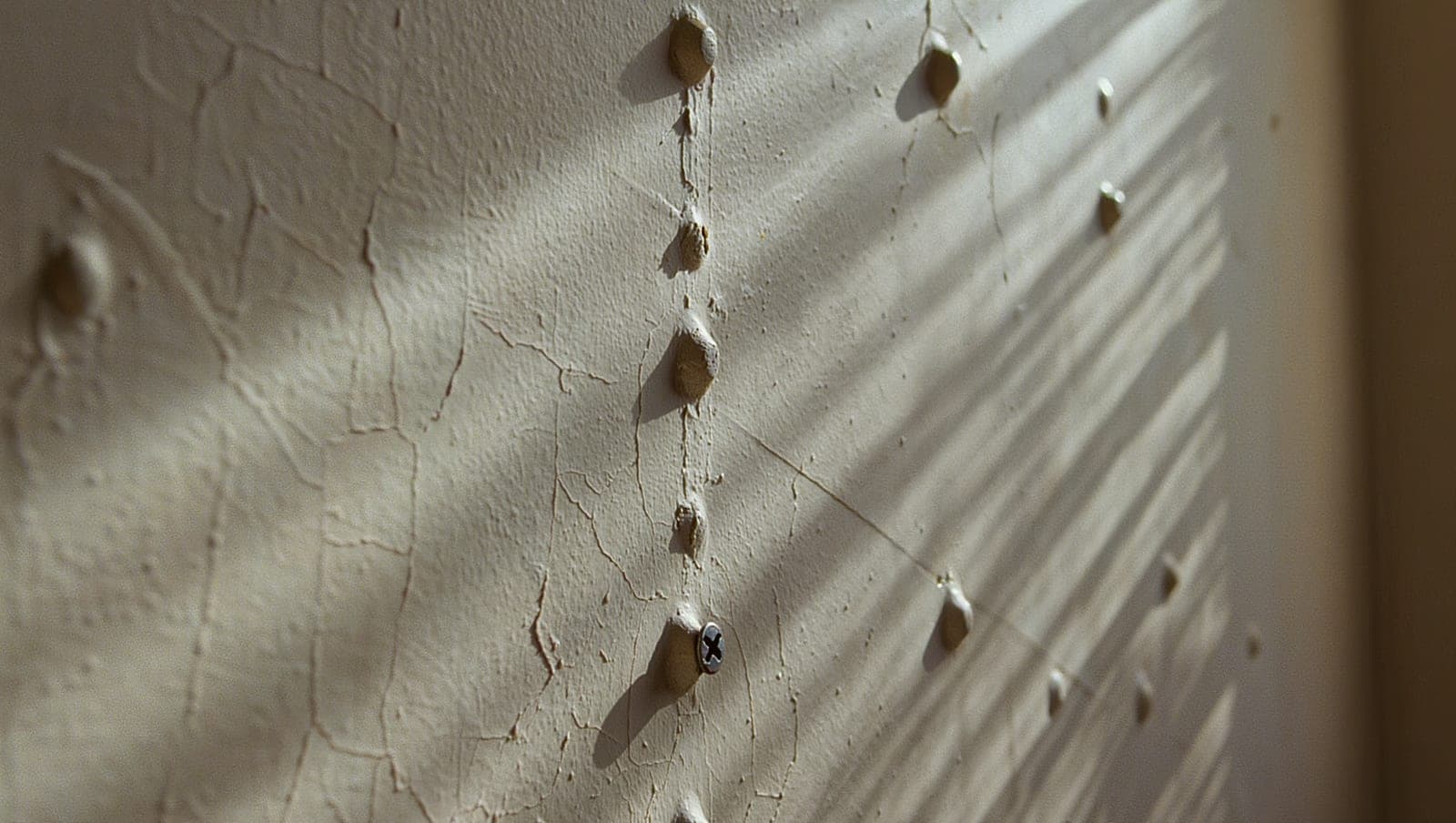
A nail pop is a small physics lesson. When a house is framed, the lumber carries moisture from the mill, and the drywall is fastened to it tight. Then the house is closed up, the air conditioning runs, the attic bakes, and the wood gives up its water and shrinks. The nail or screw does not shrink. The board, no longer held tight against the stud, drifts a hair away from it, and the fastener head, which stayed put, is now proud of the surface. The compound over the head is the only thing that gives, and it gives as a round bump, a small crater, or a crescent crack.
Phoenix accelerates every step of that process. Framing lumber that would dry over four or five years in a mild climate dries in two summers here, sometimes one, in an attic that runs past 120 degrees and a house whose indoor air stays dry all year. That is why new homeowners in the Valley find a row of pops along the hallway ceiling by the second August and why the builder's touch-up visit is a rite of passage. It is also why pops keep appearing in older homes each time the trusses flex through a heat cycle, particularly on ceilings that were nailed rather than screwed.
A nail pop is the least alarming thing on this list, and it should be treated that way. It is also the most misdiagnosed, because a row of pops along a truss line is sometimes the first visible sign that the ceiling has begun to loosen, and a pop with a stain around it is a leak reporting through the nearest weak point. The checks below sort the ordinary pops from the few that are pointing at something else.
Likely causes, ranked
- 1
Framing lumber drying and shrinking
most commonThis is the cause behind nearly every pop in a house under three years old and many in older ones. As a stud or truss chord loses moisture it shrinks across its width, the drywall relaxes away from it, and the fastener head prints through. You recognize it by the pattern. Pops appear in vertical lines on walls at 16-inch intervals and in parallel rows on ceilings at 24-inch intervals, because that is where the framing is. They show up in clusters over the second summer, they are dry, and the wall around them is flat and sound. Pushing gently on the wall beside a pop often makes the pop move, which confirms the board has drifted off the stud.
- 2
Nails instead of screws, or fasteners that missed
commonA nail holds by friction and a screw holds by thread, and when the lumber shrinks the nail loses more of its grip. Homes from before screw guns were universal have nailed drywall, and the pops return every few years along the same lines as the trusses flex. A fastener that missed the stud or caught only its edge has nothing to hold and will pop on its own, without a pattern. Look for a pop that sits alone, off the stud line, or one that can be pushed back in with a thumb and stays; that fastener is holding air.
- 3
Truss movement on ceilings
commonCeiling fasteners take the worst of the truss uplift cycle. As the truss arches in the dry months and settles in the fall, each fastener works in its hole a little, and over enough seasons the compound over the head cracks. These pops are on the ceiling, in rows along the trusses, often heaviest near the center of the house where the uplift is greatest, and they tend to appear or worsen in early summer. A row of ceiling pops with a slight pillow of the board between rows is the early sign of a ceiling that is loosening and should be refastened while it is still a small job.
- 4
Board that was never tight to the framing
less commonIf the drywall was hung with a gap between board and stud, because of a bowed stud, a proud nail from the framing crew, or a hurried install, the fastener was countersunk through the board without pulling it tight. The board later flexes, and the head pops. These pops do not follow a clean pattern; they cluster around one stud or one section of a wall, often near a corner or an opening, and the wall beside them flexes noticeably when pressed. The fix is the same, with an extra screw or two to pull the board home.
- 5
Moisture swelling the board
less commonDrywall that has been wet swells, then shrinks as it dries, and the fastener head prints through as it does. This pop comes with a stain, a faint ring, or blistered paint, and it appears near a source: below a bathroom, beside a shower wall, on the ceiling near the air handler, or on an exterior wall where a stucco crack let the monsoon in. A pop with a stain is a leak first. Resetting the fastener before the source is found is a way to fix it twice.
Check it yourself in ten minutes
- 1Hold a flashlight flat against the wall or ceiling and shine it across the area. Raking light shows every pop, including the ones the paint is still hiding, and reveals whether they line up.
- 2Measure the spacing. Pops 16 inches apart on a wall or 24 inches apart on a ceiling are on the framing and are shrinkage. A single pop off the pattern is a fastener that missed or was never tight.
- 3Press the wall gently a few inches from a pop. If the pop moves or the board flexes, the drywall has drifted off the stud and the repair should include a new screw beside the old fastener, not just a skim.
- 4Look at the pop itself. A round bump is a head that has pushed outward. A small crater with a crescent crack is compound that broke away. Either way, check for any discoloration around it.
- 5On a ceiling, step back and look along the rows for a pillow between them. Pops with a belly are a loosening ceiling. Pops on a flat ceiling are just pops.
- 6Check the age of the house and the season. Pops arriving in clusters during the first two summers of a new home are expected. Pops arriving in a twenty-year-old home after a storm or a plumbing issue deserve a look at what changed.
The fix
Set a screw beside the pop and finish it
The loose fastener is driven below the surface or removed, a drywall screw is set an inch or two away to pull the board tight to the framing, and both dimples are filled, feathered, textured, and painted. A pop that is only skimmed over without a new screw is a pop on a schedule.
Nail Pop Repair
Refasten a ceiling that has begun to loosen
When the rows of ceiling pops come with a pillow between the trusses, the board is drawn back to the framing with a full screw pattern before any pop is finished. Fixing the pops on a loose ceiling one at a time is a subscription.
Ceiling Drywall Repair
Retape seams that opened with the pops
Framing shrinkage that pops the fasteners often opens the seams in the same room. The seam cracks are opened, taped, and finished in the same visit, so the room is done once.
Drywall Seam & Tape Repair
Blend the repairs into the texture
A dozen finished pops leave a dozen smooth dots on an orange peel wall. The texture is matched and feathered over each repair and the wall or ceiling is painted to a natural break, so the repair is invisible rather than merely flat.
Texture Matching
When to stop diagnosing and call
For a handful of pops on a wall, a patient homeowner with a screw gun and a small tub of compound can manage the repair, and there is no urgency. Call when the pops number in the dozens, when they are on a ceiling and require ladder work overhead, when the texture is knockdown or popcorn that has to be matched, or when you are a property manager looking at the same pattern in every unit of a floor plan. Call sooner if the pops sit beside a sag or a stain, because those are not pop problems. Bleuwave Handyman handles nail pops as a batch, resets the fasteners properly, matches the texture, and paints to a break, and the estimate is free inside a 35-mile radius of Phoenix.
More questions on this one
Do nail pops mean the house is settling?
No. Nail pops come from the framing drying and shrinking, from nails losing their grip over years of heat cycles, or from truss movement on ceilings. They appear in orderly rows along the studs and trusses and they do not indicate that the house is moving. Foundation movement announces itself with wide or offset cracks, sticking doors, and sloping floors, not with small round bumps.
Why does my new house have so many nail pops?
Because the lumber arrived with moisture in it and Phoenix removed that moisture in a hurry. A house here dries through its first two summers, the studs and trusses shrink, and the fasteners print through in rows. This is normal and expected, and most builders include a drywall touch-up visit for it. Ask for that visit after the second summer, when most of the shrinkage is done, rather than after the first.
Can I just fill a nail pop with spackle?
You can, and it will be back. The fastener is still loose and the board is still off the stud, so the next flex of the framing pushes the head through the new spackle. The durable repair sets a screw beside the pop to pull the board tight, sets or removes the old fastener, and then fills both. It takes five more minutes and it lasts.
Do nail pops mean the ceiling is going to fall?
By themselves, no. A row of pops on a flat ceiling is the fasteners working in their holes as the trusses move, and the board is still held. The signal to act is pops together with a visible pillow between the trusses, which means the board has begun to hang from fewer fasteners than it should. That ceiling should be refastened while it is still a straightforward job.
Will the nail pops keep coming back?
New pops may appear for a couple of years in a new house as the lumber finishes drying, and a nailed ceiling in an older home may produce a few each decade as the trusses flex. A pop that has been properly repaired, with a screw beside it pulling the board tight, does not itself return. Repair them after the second summer and most homeowners never think about them again.
Related questions and reading
Elsewhere on the site
Services and reading that follow naturally from this diagnosis.
Still not sure what you are looking at?
Browse every question in the Repair Hub, or skip the reading and have a licensed pro look.