
Diagnosis · Phoenix Metro
Why is my drywall cracking?
Short answer
Drywall cracks when the framing behind it moves more than the board and its taped joints can absorb. In Phoenix the usual movers are slab settling on desert soil, lumber drying through a house's first two summers, and roof trusses lifting in a hot attic. Most cracks are cosmetic, but one that is wide, offset, or growing month to month deserves a structural look before it is repaired.
Low urgencyA hairline crack that is not growing is a cosmetic repair and can wait for a convenient week. Move it up the list if it is wider than a credit card edge, if one side stands proud of the other, if doors nearby have started to stick, or if there is a matching stair-step crack on the stucco outside. That combination is worth a structural opinion before anyone opens a bucket of compound.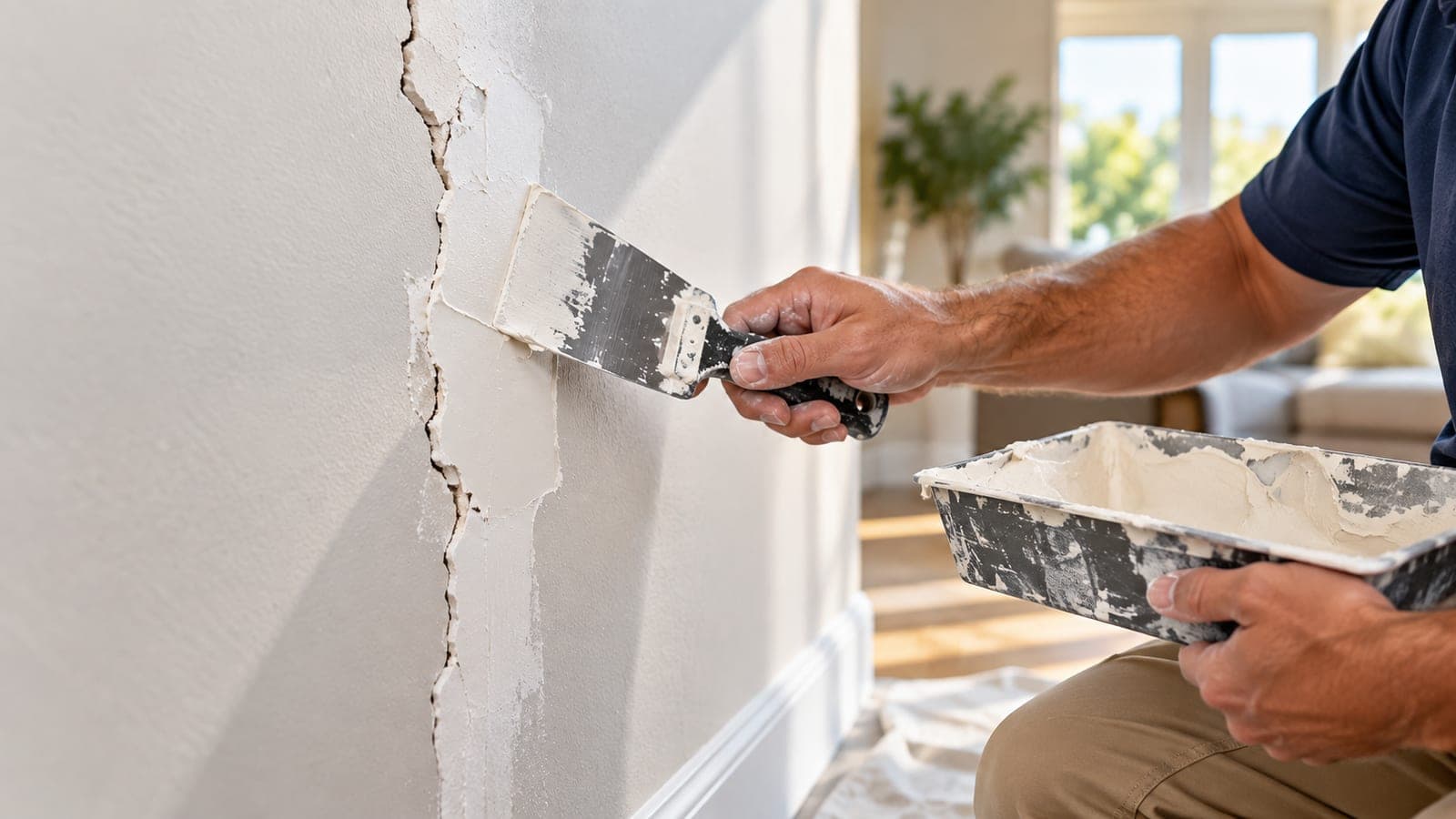
A crack is a message from the framing, delivered through the one material in the house that cannot stretch. Gypsum board is stiff and its paper face has no give, so every fraction of an inch that the studs, plates, or trusses move has to show up somewhere. It shows up along the line of least resistance, which is a taped seam, the corner of a door or window, or the joint where wall meets ceiling. Reading which line the crack chose tells you most of what you need to know about why it is there.
Phoenix supplies more movement than most homeowners expect from a city with no frost. Nearly every house sits on a concrete slab poured directly on native soil, and that soil changes volume with water. It swells after a wet monsoon and shrinks through a dry spring. New builds add a second cycle. Framing lumber arrives from the mill with moisture in it and gives that moisture up across the first two summers, and as the wood shrinks the drywall fastened to it is pulled out of plane. Overhead, roof trusses bow upward when the attic runs dry and hot and relax when it does not, which opens and closes the joint at the top of the wall on a calendar.
None of that is a defect in the house. It is how houses here behave, and the question a homeowner should be asking is not whether the wall will crack but which kind of crack this one is. The diagnosis below is built around that question. Ten minutes with a flashlight and a credit card will sort the ordinary cracks from the handful that need someone other than a drywall repair.
Likely causes, ranked
- 1
Settling and seasonal soil movement
most commonThe slab moves a little, the framing on top of it moves with it, and the wall breaks at its weakest point, which is the corner of an opening. You recognize this cause by the geometry. The crack starts at the upper corner of a door or window and runs diagonally toward the ceiling, usually hairline, usually on one side of the frame more than the other. It often appears in a home's first few years or shows up after an unusually wet August. Doors in the room still latch and the floor still reads level. If several openings in the house show the same diagonal in the same direction, the slab has tilted slightly and evenly, which is common and rarely serious.
- 2
Framing shrinkage in a newer house
commonLumber shrinks across its width as it dries, and in a Phoenix attic it dries fast. The studs and top plates lose a little dimension, the drywall stays where it was screwed, and the seams open. Look for this in a home under about three years old. The cracks follow the drywall seams in straight lines rather than running diagonally, they often come with a scattering of nail pops, and they tend to appear in the second summer, after the first one has done its work. Builder warranties typically cover one round of these; the second round is on the owner.
- 3
Truss uplift at the ceiling line
commonRoof trusses are built from lumber that dries unevenly, with the top chords in a hot attic and the bottom chords buried in insulation. The truss arches upward in the dry months and pulls the ceiling drywall up with it, and the joint where ceiling meets wall opens. You recognize it by where it is and when it moves. The crack sits at the very top of the wall or in the ceiling corner, often on interior walls near the center of the house, and it is wider in May and June than in December. A rigid patch here reopens on schedule because the movement is seasonal and the patch is not.
- 4
Joint tape that let go
commonA taped seam holds only as well as the compound it was bedded in. Tape bedded thin, or over dust, or over a coat that had already skinned, sits on the wall rather than in it and will release under normal movement. This crack is dead straight, follows a seam four feet or so from a corner or eight feet up a wall, and if you look at a raking angle you can sometimes see the edge of the tape itself as a slight ridge or a thin blister beside the crack. A fingernail dragged across it catches. This is the cause behind most cracks that have been painted more than once.
- 5
Moisture or heat stress
less commonDrywall that has taken on water swells, and when it dries it does not return to exactly the same size, which cracks the compound around it. Watch for cracks below a window that leaks in a monsoon, beside a shower wall, under an upstairs bathroom, or on a west-facing wall behind which a wet stucco patch dried in the afternoon sun. The tell is company. A moisture crack comes with a faint stain, a soft spot, a bubble in the paint, or a chalky texture in the compound nearby. A crack with company is a leak question first and a drywall question second.
Check it yourself in ten minutes
- 1Slide a credit card edge into the crack. If the edge fits, the crack is past hairline and worth measuring; mark the ends with pencil and the date, then check it in a month.
- 2Hold a flashlight flat against the wall and shine it along the crack. A raking beam shows whether the crack follows a straight seam, angles from a door or window corner, or wanders, and whether one side of it is raised.
- 3Run a fingertip across the crack at three points. A ridge or a step means the board has moved, not just the paint. A step is the one finding on this list that changes the plan.
- 4Look at the same crack from the other side of the wall and from outside. A crack that mirrors on the exterior stucco, or that lines up with a crack in the slab or the garage floor, is talking about the foundation.
- 5Press gently beside the crack with your palm. Sound board feels like a wall. Give, a hollow sound, or a papery crackle means the tape has released or the board has been wet.
- 6Walk the room and count. One crack at one opening is settling. The same crack at every opening in one direction is a slab that has moved evenly. Straight cracks at every seam in a newer house are lumber shrinkage.
The fix
Tape it, do not fill it
A settling or stress crack is repaired by opening it, bedding tape in setting compound, and feathering the joint wide. The tape gives the joint strength across the movement. Filling it with spackle or caulk is the reason it will be back by next summer.
Drywall Crack Repair
Replace the failed seam
When the crack follows a seam and the old tape has lifted, the loose length is cut out and re-embedded, not patched over. Compound on top of loose tape is compound on top of a hinge.
Drywall Seam & Tape Repair
Reset a cracked outside corner
A crack running down an outside corner is the metal or vinyl bead separating from the framing. The bead is refastened or a section is replaced, then the corner is refinished. Filling the crack alone leaves the bead loose underneath.
Corner Bead Repair
Make the repair disappear
A closed crack that shows as a smooth stripe on an orange peel wall is still a crack to the eye. The texture is matched and feathered past the repair so the wall reads as one surface under afternoon light.
Texture Matching
When to stop diagnosing and call
Stop diagnosing and call when a crack is wider than a credit card edge, when one side is offset from the other, when it has grown since you marked it, or when it comes with sticking doors, a sloping floor, or a stair-step crack in the exterior stucco. That set of findings belongs to a structural engineer or foundation specialist first, and Bleuwave Handyman will say so plainly at a free estimate rather than repair the symptom. For everything else, which is most cracks, call when you are tired of repainting the same line. The repair is a modest one when it is done as a taping job, and the estimate is free across a 35-mile radius of Phoenix.
More questions on this one
Are hairline drywall cracks normal in a new Phoenix house?
Yes. A new house dries out through its first two summers, the lumber shrinks, and the slab settles into the soil. Straight seam cracks, diagonal cracks at door corners, and a few nail pops are expected in that window. Most builders include one drywall touch-up visit for exactly this reason. Ask for it before the warranty period ends.
How can I tell a settling crack from a foundation crack?
A settling crack is hairline, runs diagonally from an opening or straight along a seam, and holds still once it appears. A foundation crack is wider, keeps growing, often shows a step where one side sits proud of the other, and usually brings friends: doors that suddenly rub, a floor that slopes, or a matching crack in the stucco or slab outside. One finding is a drywall repair; the cluster is an engineering question.
Why did a crack appear after the monsoon?
Because the soil under the slab took on water and swelled, and the house moved with it. Desert soils, particularly the clay pockets in parts of the East Valley, change volume with moisture more than people expect. The crack usually opens a little in the wet weeks and settles down by winter. If it keeps widening into the dry season, that is the signal to have it looked at.
Should I wait for the crack to stop moving before repairing it?
For a settling crack, no. A taped repair carries ordinary seasonal movement; that is what the tape is for. For a crack you suspect is truss uplift, the repair is designed to float regardless of season. The only crack worth waiting on is one you are actively measuring because you suspect the foundation, and in that case the wait is for an engineer, not for the crack.
Does painting over a crack ever work?
Paint has no strength across a joint. It hides a hairline for a season and then the same line prints through, now with a paint ridge on either side. Even a crack that never moves again needs compound and usually tape beneath the paint to stay invisible.
Related questions and reading
Elsewhere on the site
Services and reading that follow naturally from this diagnosis.
Still not sure what you are looking at?
Browse every question in the Repair Hub, or skip the reading and have a licensed pro look.