
Repair Hub · Phoenix Metro
Nail Pop Repair That Keeps the Bumps From Coming Back
Rows of popped fasteners in walls and ceilings across the Phoenix metro, re-secured with screws, filled, textured, and painted so the framing stops announcing itself.
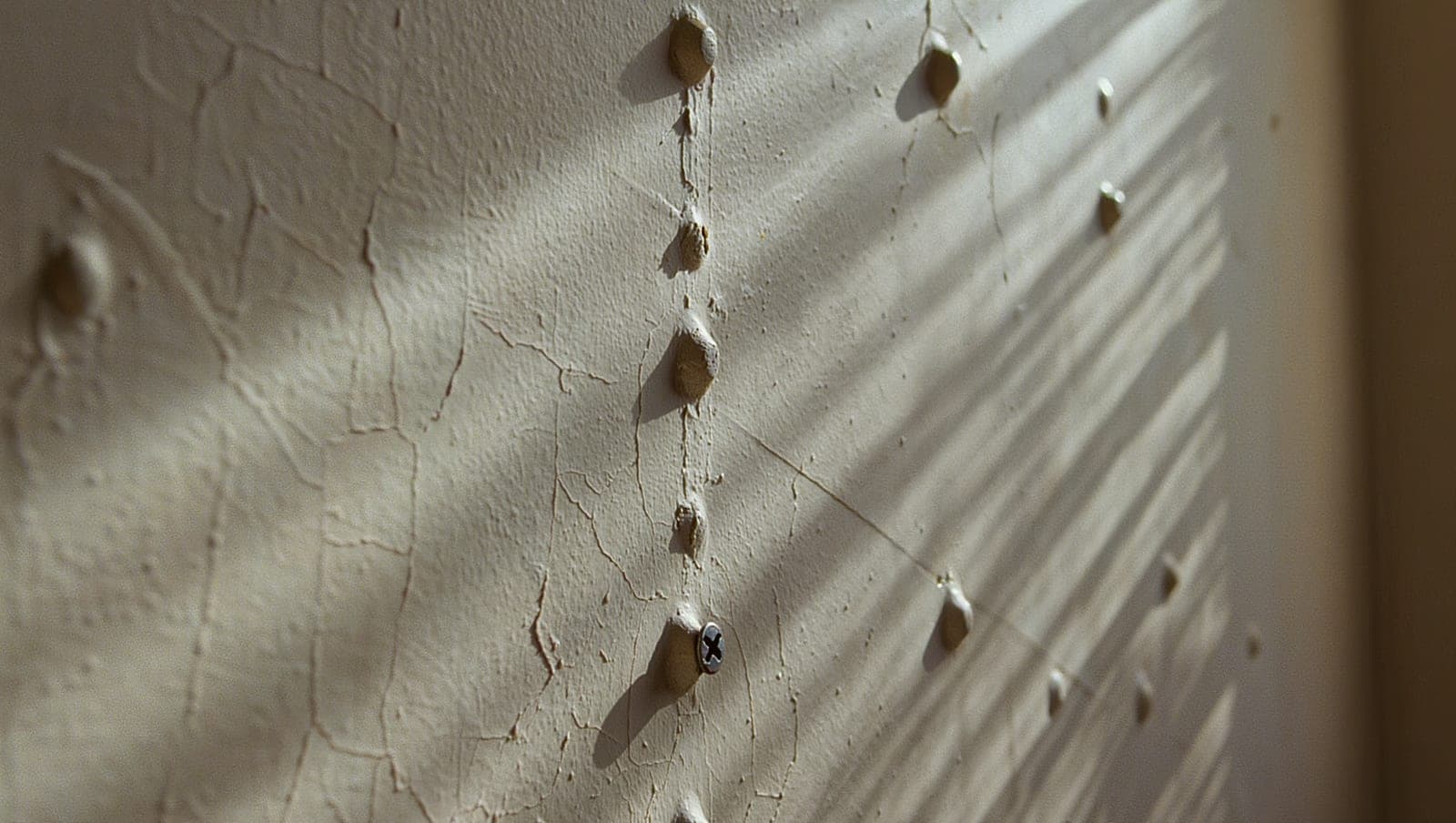
A nail pop is a fastener head that has moved relative to the drywall around it. The nail did not move; the wood did. Framing lumber arrives at a Phoenix job site carrying moisture and is nailed, textured, and painted within weeks. Then the house meets its first summer. Attic air climbs well past the outdoor high, the studs and truss chords give up water and shrink across their width, and the nail, which is steel and does not shrink, is left standing proud by a sixteenth of an inch. The compound over the head has nowhere to go but out. On a wall it looks like a small circular blister with a crack around its rim. On a ceiling it is a dimple with a shadow, and in a bedroom with an east window it is the first thing you see every morning.
The pattern tells you the cause. Pops that line up vertically every sixteen inches are studs drying. Pops that march across a ceiling in parallel lines two feet apart are trusses, and if they appear in fall and ease in spring, truss movement is part of the story. A single pop beside a door frame is usually a board that was never pulled tight to the stud when it was hung, so it has been flexing ever since. A rusty pop in a bathroom or laundry room is moisture reaching the nail head, which means the fix starts with the moisture. Screws pop too, less often, and for the same reason: the board was not tight to the wood when the screw was set.
The wrong repair is the one nearly everyone makes first. Tapping the nail back in with a hammer and dabbing spackle over it resets the clock, because the nail returns to a hole it has already loosened. Bleuwave Handyman fixes a nail pop by taking the load off the nail entirely. Two coarse-thread drywall screws go in an inch and a half above and below the pop, pulling the board hard against the framing. The original nail is driven below the surface or pulled. The blistered compound and torn paper are cut away, the dimples are filled with setting-type compound that cures without shrinking, then skimmed with a lightweight topping coat, sanded, textured, primed, and painted. Done this way the pop does not come back, because there is nothing left to push.
Property managers see nail pops in bulk: a building of new units through its first two summers, or a stack of turn sheets where every bedroom has a row of them over the closet. We handle them as a batch, room by room, with the texture matched and the paint taken to a corner so the ceiling does not end up freckled with touch-up. Homeowners in a house still under a builder warranty should photograph the pops and put them on the eleven-month list; if the builder's crew has already come and gone, or the house is older than its warranty, we are the second call.
A nail pop is the smallest repair in the drywall trade, which is exactly why it deserves to be done right the first time. Nobody wants to fix the same bump three times. The estimate is free, the visit is short, and the bumps stay gone.
Signs you need nail pops
- A round bump the size of a dime or nickel with a hairline crack circling it, usually in a vertical line on a wall.
- A dimple or shadow on the ceiling that shows in morning or evening light and disappears at noon.
- A row of bumps spaced about sixteen inches apart on walls or twenty-four inches on ceilings, tracing the framing behind.
- A pop that was painted over and has cracked or bulged through the new paint within a year.
- A rust-colored dot at the center of the bump, common in bathrooms, laundry rooms, and garages.
- A cluster of pops near a door, window, or ceiling fan where the drywall flexes every time the opening is used.
Not sure this is your problem?
Start with a diagnosis. These questions end at this repair:
How the repair is done
- 1
Map the pops and read the pattern
We walk each room with a low-angle work light, which turns every pop into a shadow, and mark them with painter's tape. Vertical rows mean studs, parallel rows overhead mean trusses, and a lone pop near an opening means a loose board. Any pop with a rust dot gets a moisture-meter reading around it, and a ceiling row is checked with a straightedge for sag, because a row of pops on a bowing panel is a fastening problem, not a cosmetic one.
- 2
Re-fasten with screws, not the same nail
A 1-1/4-inch coarse-thread drywall screw goes in an inch and a half above the pop and another below it, driven with a dimpler bit so the head sits just under the paper without tearing it. On 5/8-inch ceiling board we use 1-5/8-inch screws and set them along the truss on either side. The screws pull the drywall tight to the wood. The original nail is then driven below the surface with a nail set, or pulled outright if it is loose in its hole.
- 3
Cut out the blister and fill with setting compound
A utility knife removes the raised compound and any torn paper around the old head. The nail dimple and the two new screw dimples are filled with 45-minute setting-type compound, the powdered kind that cures by chemical reaction, does not shrink, and can be recoated within the hour. A second, wider coat of lightweight all-purpose compound follows with a six-inch knife, feathered four to six inches out so there is no ring.
- 4
Sand, texture, and prime each spot
A fine sanding sponge takes the fill flush. Texture is matched to the wall: orange peel or knockdown from an adjustable aerosol for a few spots, or from a hopper gun when a whole ceiling has a field of them, tested on cardboard first. Every spot is primed with PVA primer-sealer so the paint does not flash, and any rusty head is spot-primed with a shellac-based stain blocker before the PVA.
- 5
Paint to a natural break
Where the paint is fresh and the color is on hand, the spots are blended. Where it has faded, the wall or ceiling is painted to a corner so there are no touch-up circles. Tape comes down, floors are vacuumed, and the pops are gone rather than hidden.
What it costs in Phoenix
In the Phoenix market, a handful of nail pops in one room, re-fastened, filled, textured, and painted, typically lands in the low hundreds, and most of that is the two short visits the compound and paint require rather than the material. A whole house of first-summer pops, twenty or thirty spread across bedrooms and hallways with ceilings repainted corner to corner, can run into the mid hundreds and beyond depending on how much painting the finish requires. Pops that turn out to be a loose ceiling panel or a moisture problem are a different repair and are priced as one. These are ballparks, not a menu. The number that counts is on the free estimate, which lists every pop we found and what it takes to make each one disappear.
Do it yourself, or call someone?
This is the one drywall repair we will tell you to try yourself, provided you do the part that matters. Buy a box of 1-1/4-inch coarse-thread drywall screws, drive one an inch and a half above the pop and one below, set the nail, and fill with setting-type compound rather than lightweight spackle, which shrinks into a fresh dimple. Where it gets away from people is what comes after: the spot of texture that does not match, the dab of paint that flashes at a different sheen, the ceiling that ends up with eleven slightly different white circles. If the pops are on a ceiling, in a row, or more than a few, or if the paint is more than a couple of years old, the finish work is where the job is, and that is the part worth paying for.
Can a handyman repair drywall? The honest answerWhat is included
- Wall and ceiling nail pops re-fastened with drywall screws, not re-driven nails
- Screw pops and loose-board flex fixed at the framing
- Setting-type compound fill so the repair does not shrink
- Rusty fasteners spot-primed and moisture checked before closing
- Orange peel, knockdown, and smooth finishes matched at each spot
- Primer on every repair, paint to a blend or a corner
- Whole-house first-summer pop sweeps for new builds and turns
- Truss-line ceiling pops assessed for uplift and sag before repair
Why Phoenix calls Bleuwave
- Every pop gets two screws and a set nail. Pushing the nail back in is a repair that expires with the next heat wave.
- Setting compound in the dimples, because a shrunken fill under fresh paint is just a smaller pop.
- We read the pattern first. A row of pops on a ceiling can be trusses drying or a panel letting go, and the two are not the same repair.
- Texture and sheen matched spot by spot, so the ceiling is not left with a constellation of touch-ups.
- Batch pricing for new-build sweeps, unit turns, and work orders across the metro.
- Licensed, insured, and bonded, Veteran Owned & Operated since 2022, with free estimates and next-day scheduling within 35 miles of Phoenix.
Questions Phoenix homeowners ask
Are nail pops a sign of foundation problems?
Almost never. Nail pops come from lumber shrinking and boards flexing, and they show up in the tightest new houses in the Valley during the first two summers. Foundation movement announces itself with diagonal cracks at door and window corners, doors that stop latching, and gaps at the slab, not with a scattered row of bumps. If pops arrive with those companions, we will say so and recommend an inspection. On their own, they are cosmetic.
Why do nail pops appear in a new house?
Because the framing was wetter on the day the drywall went up than it is a year later. Kiln-dried lumber still carries moisture, and a Phoenix attic pulls it out fast. The studs and truss chords shrink across their width, the nail does not, and the head ends up proud of the board. The first summer produces most of them and the second summer most of the rest. After that the wood has given up what it is going to give.
Can I just hammer the nail back in and paint over it?
You can, and it will pop again, usually within a season. The nail returns to a hole it has already enlarged, with no more grip than it had before. The fix that lasts puts screws above and below the pop so the board is held by threads rather than friction, then sets or removes the nail.
Will the builder fix nail pops under warranty?
Many builder warranties treat nail pops as a cosmetic item covered through the first year, often handled at the eleven-month walkthrough, and some limit it to one visit. Read your warranty booklet, photograph every pop with a piece of tape beside it, and submit the list before the deadline. If the builder repairs them and they return, or if the warranty has lapsed, that is where we come in.
How many nail pops is too many?
There is no number, but there is a pattern. A dozen scattered pops in a new house is normal. Pops concentrated on one ceiling, especially with a visible bow between them or a crack running through the row, mean the panel may be pulling away from the trusses, and that ceiling should be refastened as a whole rather than spot by spot.
Do nail pops come back after repair?
Not when the board has been screwed tight and the fill cured properly. A pop returns when the nail was simply re-driven, when lightweight spackle shrank in the dimple, or when the real problem was a loose panel that was never re-secured. If a pop we repaired reappears, call us and we will look at why.
Related repairs
Guides worth ten minutes
Guide · 7 min read
How Long Does Drywall Patching Take?
A small patch is a same-day job. A proper mid-size repair is two visits, and the gap between them is not idleness. Here is the realistic timeline, and what Phoenix heat does to it.
Guide · 8 min read
Can a Handyman Repair Drywall?
Drywall repair is the job handymen do most and do best. The better question is where the line falls, and how to know whether the person you hired is on the right side of it.
Elsewhere on the site
Related services, nearby city pages, and reading that pairs with this repair.
Looking for the service page? See how we handle this as a scheduled service, or browse all services.
Fix the bumps once. Get a free estimate or call (480) 863-5975.
Licensed, insured & bonded · Veteran Owned & Operated since 2022 · Serving 35 miles around Phoenix.