
Repair Hub · Phoenix Metro
Sagging Ceiling Repair Before the Panel Lets Go
Pillowing drywall, popped fasteners, and bellied ceilings across the Phoenix metro, re-secured to the trusses or replaced outright, then textured and painted so the room is flat again.
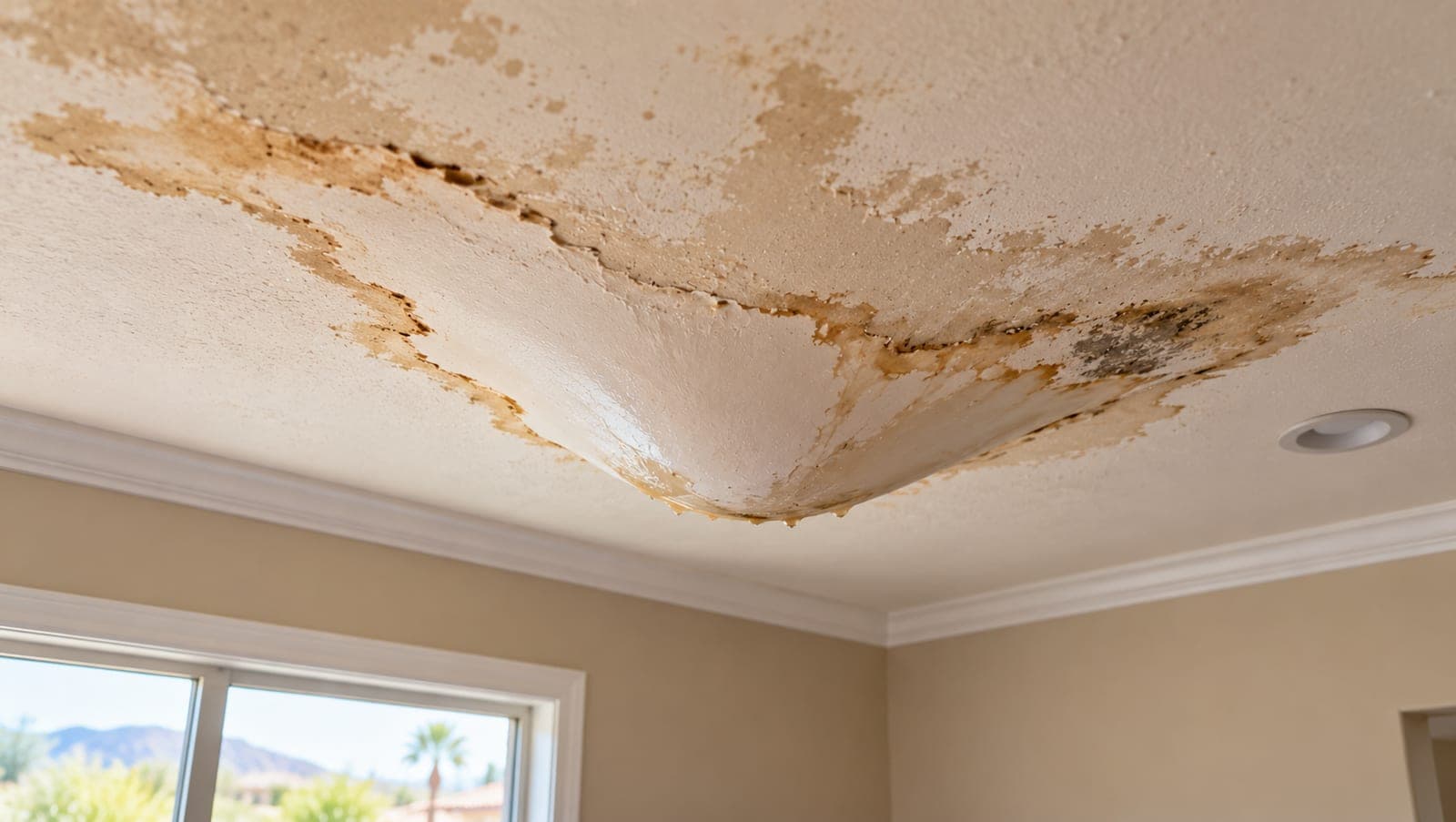
A sagging ceiling is drywall losing a long argument with gravity. Ceiling board hangs from the underside of roof trusses spaced twenty-four inches apart, held by nails or screws every twelve inches or so, and it stays flat only as long as the board is stiff and the fasteners hold. Three things in Phoenix undo that. Water, from a roof leak in a monsoon storm or an AC condensate line that backs up in July, soaks into the gypsum and turns a rigid panel into a wet blanket that bellies between trusses within hours. Heat, in an attic that spends every summer far above the outdoor high, bakes the board and its paper face for decades until half-inch panels on two-foot centers begin to droop between supports on their own. And fasteners, especially nails in older homes, work loose as the trusses dry and move, until the board is hanging on compound rather than steel. Add the weight of blown-in insulation topped up over the years, or a heavy popcorn texture, and a ceiling that was marginal on the day it was hung becomes a ceiling with a visible wave.
The shape of the sag says what is happening. A smooth, even belly between every truss across a room, with no stains, is usually undersized or heat-tired board. A single tight bulge with a stain or a wet-looking patch is water, and if it is holding liquid the paint will look stretched and glossy over it. A panel that has dropped along one edge with a row of fastener heads showing is a fastener failure, and the next thing that happens is the edge lets go. A sag beside a light fixture or ceiling fan is often a fixture that was screwed to the drywall rather than to a box on the framing. A sag under an attic hatch or along the HVAC platform is people, and where they knelt.
Bleuwave Handyman fixes sagging ceilings in the order that keeps them up. First the cause: a moisture meter tells us whether the board is wet, and if so the water gets stopped and the board dries or comes out. For dry ceilings sagging from loose fasteners or tired board, we lift the panel back to the truss with a T-brace or a drywall lift and drive 1-5/8-inch coarse-thread drywall screws into every truss across the sagged area, on a tighter pattern than the original, adding drywall washers where the paper has weakened. For board that will not lie flat, or that crumbles under the screw, the section comes out and goes back as new 5/8-inch or sag-resistant half-inch panel, with backing along every cut edge. Where trusses are on two-foot centers and the original board was too light, 1x3 strapping at sixteen inches gives the new panel closer to the support it needs. Then tape, setting compound, texture, primer, and paint to the walls.
A ceiling that is holding water or sagging visibly within a day is not a monitoring situation. Property managers know the version of this that starts in a second-floor bathroom and lands in the living room below. We take those calls same day, and after hours when that is when the ceiling decides. The immediate step is to get people and furniture out from under it and to relieve a water-filled bulge with a bucket and a small hole at its lowest point, before the panel picks its own moment.
A sagging ceiling does not reverse itself. The only question is whether it comes down onto a drop cloth on our schedule or onto the dining table on its own. The estimate is free, the visit is fast, and the ceiling will be flat and fastened when we leave.
Signs you need sagging ceiling
- A visible wave or belly between trusses, most obvious when you sight along the ceiling from a doorway.
- A tight, rounded bulge with a stain or a glossy look to the paint, which usually means water sitting above the board.
- Rows of nail or screw heads showing along a truss line, with the board dropped slightly below them.
- A gap opening where the ceiling meets the wall, with the ceiling edge lower than it used to be.
- Cracks radiating from a light fixture or ceiling fan that has begun to droop.
- Popcorn or knockdown texture sagging or falling in sheets, or a soft spot when pressed gently with a broom handle.
Not sure this is your problem?
Start with a diagnosis. These questions end at this repair:
How the repair is done
- 1
Measure the sag and find the cause
A moisture meter reads a grid across the sag and two feet past it in every direction, since the wet area is always larger than the stain. A straightedge measures how far the board has dropped. Then we go into the attic and look: wet insulation, the path of any leak, the condensate line, the fastener pattern, the board thickness, and the truss spacing. That ten minutes overhead decides whether the ceiling is refastened or replaced.
- 2
Relieve water and stabilize the room
If the bulge is holding water, a drop cloth and bucket go under it and a small hole at the lowest point lets it drain in a controlled way. Wet insulation is bagged and removed so it stops loading the board, and air movers dry the cavity. The leak itself is handled by the licensed plumbing or HVAC company in the Bleuwave family, or by your roofer, before any board is closed.
- 3
Refasten sound board to the trusses
A T-brace cut from 2x4s or a drywall lift pushes the panel up until it touches the truss. Then 1-5/8-inch coarse-thread drywall screws go in every eight inches along each truss across the sag and one truss beyond it, with drywall washers under the heads where the paper is too weak to hold a screw on its own. Old nails are set or pulled. Any fixture or fan hanging from drywall is moved to a box fastened to the framing.
- 4
Replace board that will not hold
Board that has been soaked, has taken a permanent set, or crumbles around a screw is cut back to the centers of the nearest trusses. Two-by blocking is added along every cut edge, and where the trusses are two feet apart and the original panel was light, 1x3 strapping goes on at sixteen inches. New 5/8-inch or sag-resistant half-inch ceiling board is hung, and every joint gets paper tape bedded in setting-type compound.
- 5
Fill, texture, prime, and paint
Screw dimples and rows are filled with setting compound and skimmed flat. Texture is matched from a hopper gun, knockdown or orange peel or acoustic, after a test pass. Any water mark is sealed with a shellac- or oil-based stain-blocking primer, the rest is primed with PVA, and the ceiling is painted corner to corner. Plastic comes down, floors are vacuumed, and the room is handed back.
What it costs in Phoenix
In the Phoenix market, refastening a dry ceiling that has loosened from its trusses, with the screw rows filled, textured, and the ceiling repainted, typically runs in the mid hundreds for a bedroom-sized room. Cutting out and replacing a sagged section after a leak, with backing, new board, texture, and paint, usually reaches into the low thousands once drying time and return trips are counted, and a whole ceiling replaced with 5/8-inch board is more. Wet insulation removal and the leak itself are separate line items. Treat these as orientation rather than quotes. The free estimate will show what is holding the ceiling up now, what it takes to hold it up for good, and the cost of each piece.
Do it yourself, or call someone?
If the ceiling is dry, the sag is slight, and you are comfortable on a ladder with a screw gun, refastening a panel is possible: a T-brace cut from 2x4s to push the board up, screws into every truss, fill, sand. Most people find the difficulty is not the screws but what comes after, which is a room-sized ceiling that now needs texture and paint. If the ceiling is wet, sagging more than half an inch, cracking, or dropping texture, do not push on it and do not work under it. Wet gypsum has almost no strength, and a soaked four-by-eight sheet with insulation on top is heavier than it looks. Get people and belongings out from under it, put a bucket under the low point, and call. After-hours visits exist for exactly this.
Can a handyman repair drywall? The honest answerWhat is included
- Dry, sagging ceiling panels lifted and refastened with screws to every truss
- Water-filled bulges relieved safely, wet insulation removed, and the leak addressed
- Failed sections cut out and replaced with 5/8-inch or sag-resistant board
- Strapping and backing added where trusses on two-foot centers need it
- Loose light fixtures and fans secured to boxes on the framing
- Paper tape and setting-type compound on every seam
- Knockdown, orange peel, and popcorn texture matched overhead
- Stain-blocking primer and full ceiling paint, with floor protection and cleanup
Why Phoenix calls Bleuwave
- Cause before cosmetics. We meter the board and look in the attic before a single screw goes in, because refastening a wet ceiling is a collapse on a delay.
- Same-day and after-hours response for ceilings that are holding water or visibly dropping.
- Screws to every truss on a tight pattern, and drywall washers where the paper cannot hold a head. Refastened means refastened.
- The right board goes back: 5/8-inch or sag-resistant panel where the original was too light for the span.
- The Bleuwave family includes licensed plumbing and HVAC companies, so the condensate line or the supply leak that caused the sag is handled without a second contractor.
- Licensed, insured, and bonded, Veteran Owned & Operated since 2022, with free estimates within 35 miles of Phoenix.
Questions Phoenix homeowners ask
How urgent is a sagging ceiling?
It depends on why it sags. A slight, even droop between trusses that has been there for years is not an emergency, though it will not improve. A bulge that is new, stained, glossy, or growing is water and should be handled today, because wet drywall can drop without further warning. Keep people out from under it and call.
Can a sagging ceiling be pushed back up and screwed?
Yes, if the board is dry and still sound. A brace lifts the panel to the truss and screws every few inches along each truss hold it there. If the board has been wet, crumbles around the screw, or has taken a permanent set in its sag, it will not go back flat and needs to be replaced.
Why is my ceiling sagging if there is no leak?
Usually because half-inch board was hung on trusses two feet apart and has spent decades under a hot attic, or because the fasteners have worked loose as the trusses moved. Heavy texture, added insulation, and years of humidity from an old swamp cooler all contribute. Refastening handles the loose case; replacement with 5/8-inch or sag-resistant board handles the tired case.
How much ceiling has to be replaced after a leak?
Everything that got wet, plus a margin to sound board and out to the centers of the nearest trusses so the new panel has something to fasten to. A moisture meter draws that line, and it is almost always larger than the visible stain. The insulation above it is replaced too.
What should I do about a ceiling bulge that is holding water?
Move furniture and people out from under it, put a bucket and a drop cloth below the lowest point of the bulge, and make a small hole there with a screwdriver to let the water drain in a controlled way. Do not press on the bulge from the side, which spreads the water and the damage. Then call. If it is after hours, call anyway.
Should the new ceiling be 5/8-inch drywall?
On trusses two feet apart, yes, or a half-inch sag-resistant ceiling board designed for that span. Standard half-inch is fine at sixteen-inch spacing, and it is what many Valley builders used at twenty-four, which is why so many of those ceilings droop. Going to 5/8-inch adds weight, so the fastener pattern and the framing get checked, but it stays flat.
Related repairs
Guides worth ten minutes
Guide · 8 min read
Repair vs. Replace Damaged Drywall
Most drywall damage can be patched. Some of it should not be. Here is a framework, a decision table, and the water-damage rule of thumb that settles most arguments.
Guide · 8 min read
Can a Handyman Repair Drywall?
Drywall repair is the job handymen do most and do best. The better question is where the line falls, and how to know whether the person you hired is on the right side of it.
Elsewhere on the site
Related services, nearby city pages, and reading that pairs with this repair.
Looking for the service page? See how we handle this as a scheduled service, or browse all services.
Do not wait for it to come down. Get a free estimate or call (480) 863-5975.
Licensed, insured & bonded · Veteran Owned & Operated since 2022 · Serving 35 miles around Phoenix.