
Repair Hub · Phoenix Metro
Drywall Repair That Disappears Into the Wall
Holes, cracks, water damage, and tired ceilings across the Phoenix metro, repaired, textured, and painted so no one can find where the damage was.
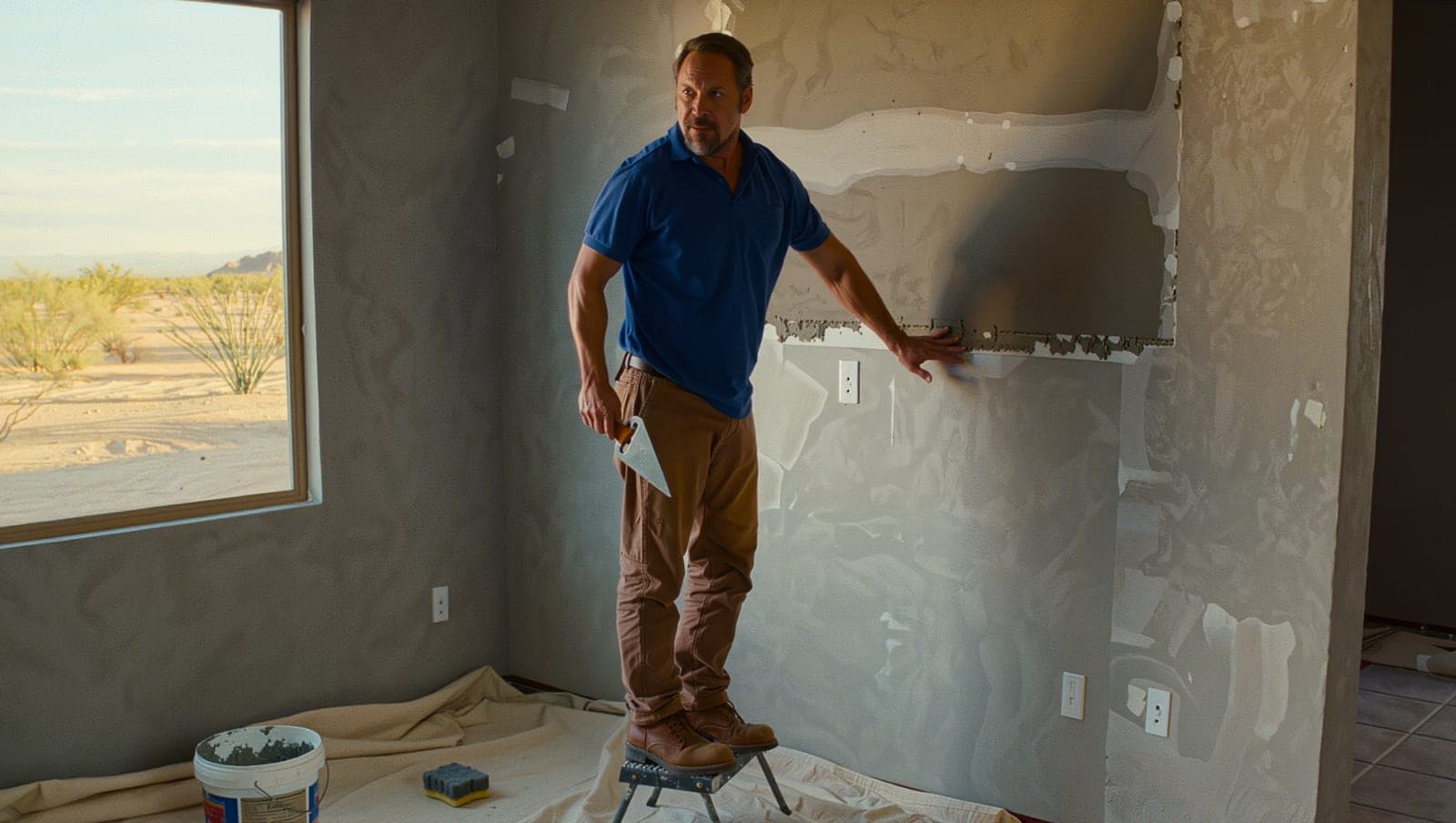
Drywall is a sheet of gypsum pressed between two faces of heavy paper. It is cheap, fast to hang, and fire resistant, which is why nearly every wall and ceiling built in the Valley in the last seventy years is made of it. It is also soft. Gypsum crumbles under a doorknob, dissolves under standing water, and cracks wherever the framing behind it moves. In Phoenix the framing moves more than most. Slab-on-grade stucco houses sit on desert soils that swell in the monsoon and shrink through the dry months, framing lumber gives up moisture through a hundred days above 100 degrees, and roofs and attic air handlers send water down through ceilings every summer. The result is a steady, predictable supply of damaged drywall in houses of every age and price.
Most of that damage starts small and stays small only if someone attends to it. A doorknob hole is cosmetic on the day it happens. Six months later it is a highway for dust and a soft spot the next impact will widen. A hairline crack over a bedroom door is settling. A crack that keeps opening after three coats of paint is settling that has never been taped. A faint brown ring on a ceiling is old water, or it is water from this morning, and the drywall does not care which; it only knows that it is wet. The honest rule is that drywall damage is cheapest on the day you notice it and gets more expensive on a schedule nobody publishes.
Bleuwave Handyman repairs the full range: patches, holes, cracks, water-damaged sections, sagging ceilings, texture that no longer matches, and complete replacement when a patch would be a bandage. Every repair gets the fundamentals that make it disappear. Damage is cut back to sound material. Openings get real backing, not a mesh sticker and hope. Joints get tape, because compound without tape is a crack on layaway. Coats go on thin and wide, sanded between, and texture is feathered past the edges so there is no ridge for the afternoon light to find. Then we prime and paint, because a perfect patch under a mismatched square of paint is not finished. It is just quieter.
We are licensed, insured, and bonded, Veteran Owned & Operated since 2022, and we work everything within 35 miles of Phoenix, from Peoria to Gilbert. Property managers and maintenance teams use us for unit turns, tenant damage, and standing work orders, where a crew that can patch, texture, and paint in one visit shortens a vacancy by days. Same-day and next-day appointments are usually available, and after-hours service exists for the ceiling that came down on a Friday night. When the drywall damage came from a leak or a failed condensate line, the Bleuwave family includes licensed plumbing, HVAC, and electrical companies, so the cause and the cosmetic repair can be handled without a second phone call.
A wall is one of the few things in a house that is supposed to be boring, and keeping it that way takes more skill than it looks. If a wall or ceiling in your house has stopped being boring, the estimate is free and specific. We will tell you what happened, what it takes to make it disappear, and what it costs, before any work begins.
Signs you need drywall repair
- A hole, dent, or gouge with crushed gypsum showing through torn paper, whether from a doorknob, a piece of furniture, or a removed TV mount.
- Cracks longer than a few inches, especially running diagonally from the corners of doors and windows, or along the line where wall meets ceiling.
- Yellow or brown rings on a ceiling, or paint that has bubbled, blistered, or peeled in one area, which almost always means water from above.
- A section of wall or ceiling that flexes, feels soft, or crumbles under thumb pressure.
- Nail or screw heads pushing through paint in a regular pattern along studs or ceiling trusses.
- A previous repair that shows as a raised square, a flat spot in the texture, or a patch of paint that flashes at a different sheen in daylight.
How the repair is done
- 1
Find the cause before touching the wall
A pin-type moisture meter reads the board around any stain or soft spot, because the wet area is always larger than the visible mark. If the readings are high, the repair waits until the roof, condensate line, or plumbing is fixed and the board is dry. We photograph the damage for your insurance file or work order before anything is removed.
- 2
Cut back to sound board and add backing
A utility knife and jab saw square the damage to clean edges, after a flashlight and inspection mirror confirm what is behind it. Furring strips or half-inch plywood scraps are screwed inside the wall along each edge with 1-1/4 inch coarse-thread drywall screws. A plug of matching thickness, half-inch on most walls and five-eighths on many ceilings, is fastened to the backing so it sits flush or a hair below the surface.
- 3
Tape every joint and build in thin coats
Seams get paper tape bedded in setting-type compound, the powdered kind that cures by chemical reaction and does not shrink. Fiberglass mesh is reserved for small, stable patches under setting compound. Two or three finish coats of lightweight all-purpose or topping compound follow, each pulled with a wider knife, ten then twelve inches, and feathered eight to twelve inches past the joint. Each coat dries fully before the next.
- 4
Sand and match the texture
A fine sanding sponge and a vacuum-attached sander take the repair flat under a low-angle work light. Then the texture: orange peel or knockdown from a hopper gun or an adjustable aerosol, tested first on cardboard to match spatter size and coverage, knocked down with a wide knife on the same timing the original had. Hand textures are matched by hand. The texture is feathered past the patch so there is no edge.
- 5
Prime, paint, and blend
Raw compound is primed with PVA so the paint does not flash at a different sheen. Water marks get a shellac or oil-based stain-blocking primer. The wall is painted to a blend where the existing color is fresh enough, or corner to corner where it has faded. Drop cloths come up, the room is vacuumed, and the dust leaves with us.
What it costs in Phoenix
Drywall repair in the Phoenix market is priced by the scope of the repair and the texture around it more than by the size of the hole. Most small patches and single-crack repairs land in the low hundreds, a cluster of holes or a mid-size section through texture and paint typically runs in the mid hundreds, and a full ceiling section after a leak, with backing, texture, and paint, runs well into four figures once drying time and return trips are counted. Trip count is the hidden variable: compound needs to dry between coats, so an invisible repair is usually two or three short visits rather than one long one. Treat all of these as ballparks. The number that matters is the one on your free estimate, which is specific to your wall, your texture, and what we find behind it.
Do it yourself, or call someone?
Nail pops, screw holes from picture hangers, and dents smaller than a quarter are honest homeowner work: a tub of lightweight spackle, a putty knife, a sanding sponge, and a dab of touch-up paint. The trouble starts a size up. A self-adhesive mesh patch over a doorknob hole leaves a raised square that no amount of paint hides, because the mesh sits on top of the wall instead of flush with it. Feathering is a learned motion; the compound has to go from full thickness to nothing across a hand's width or more, and most first attempts end in a hump. Then comes texture. Orange peel and knockdown from an aerosol can rarely match the spatter size of the original, and the gap between almost and exactly is visible from the doorway. Add ceiling work on a ladder with a mud pan overhead, and sanding dust that travels through the whole house in a week of running AC, and the case for calling someone becomes a matter of arithmetic rather than pride.
Can a handyman repair drywall? The honest answerWhat is included
- Hole and dent repair, nail pops to fist-sized openings, with real backing
- Settling and stress crack repair, taped so it stays closed
- Water-damaged drywall cut out, dried, and rebuilt, walls and ceilings
- Ceiling repairs, including sag, stains, and monsoon leak damage
- Texture matching: orange peel, knockdown, skip trowel, popcorn, and smooth
- Corner bead and tape joint repair
- Full-sheet and full-wall replacement when a patch will not hold
- Prime and paint to a finished wall, not an almost-finished one
Why Phoenix calls Bleuwave
- Texture is treated as the job, not the last step. Test passes, feathered edges, and no proud patches.
- Every opening gets backing and every seam gets tape. We do not sell repairs that crack again in a year.
- Moisture checked before anything is closed. Sealing a wet wall buys mold, and we will not do it.
- One crew from cut to paint, so the wall is finished when we leave, not waiting on a second trade.
- Licensed, insured, and bonded, Veteran Owned & Operated since 2022, with free estimates across a 35-mile radius of Phoenix.
- Same-day, next-day, and after-hours scheduling, and standing arrangements for property managers who need turns done on a calendar.
Questions Phoenix homeowners ask
Does homeowners insurance cover drywall repair?
Sometimes. Most policies cover sudden, accidental damage: a burst supply line, a roof opened by a monsoon microburst, an AC condensate overflow that soaks a ceiling in one event. They generally exclude wear, long-term seepage, settling cracks, and anything an adjuster can call deferred maintenance. Tenant damage in a rental is usually the owner's cost or the deposit's. Photograph everything before repair, keep the estimate, and ask your carrier before filing, because a small claim can cost more in premiums than it returns.
Can a handyman repair drywall, or do I need a drywall contractor?
For repairs, a skilled handyman crew is the right-sized answer, and often the better one, because we also do the texture, the paint, and whatever caused the damage. A dedicated drywall contractor earns their keep on new construction and whole-house hangs. If your job crosses into that territory, we will say so.
Will the repair show through paint?
Not if it is done right. A repair shows for three reasons: a hump from poor feathering, texture that does not match, or paint applied to raw compound without primer, which flashes at a different sheen. We address all three, and we paint to a natural break, a corner or a full wall, when the existing paint has faded enough that a spot blend would show.
How long does drywall repair take?
Compound needs to dry between coats, so most invisible repairs are two or three short visits across two to four days. Setting-type compound shortens that for small patches, and Phoenix air helps, but skipping the drying time is how a repair cracks and shrinks. A large water-damage repair may add a day or two of drying before any board goes up.
What if there is mold behind the drywall?
Small areas of surface mold on the back of a sheet come out with the damaged board and are handled with proper containment. Large or spreading growth, or mold with an active moisture source, calls for remediation before repair, and we will tell you that plainly rather than closing it up.
Do you work with property managers and businesses?
Yes. Unit turns, tenant damage, common-area walls, office and retail patching, and standing work orders. We can invoice by unit or by work order, schedule around tenants, and get in after hours where the space is occupied during the day.
Related repairs
Guides worth ten minutes
Guide · 8 min read
How Much Does Drywall Repair Cost in Phoenix?
The same doorknob hole can draw three different prices from three honest people. Here is what each of them counted, what the Phoenix ballparks look like, and how to get a number you can hold someone to.
Guide · 8 min read
Can a Handyman Repair Drywall?
Drywall repair is the job handymen do most and do best. The better question is where the line falls, and how to know whether the person you hired is on the right side of it.
Guide · 8 min read
Repair vs. Replace Damaged Drywall
Most drywall damage can be patched. Some of it should not be. Here is a framework, a decision table, and the water-damage rule of thumb that settles most arguments.
Elsewhere on the site
Related services, nearby city pages, and reading that pairs with this repair.
Looking for the service page? See how we handle this as a scheduled service, or browse all services.
Make the damage disappear. Get a free, specific estimate.
Licensed, insured & bonded · Veteran Owned & Operated since 2022 · Serving 35 miles around Phoenix.