
Diagnosis · Phoenix Metro
Is this drywall mold or water damage?
Short answer
A water stain is flat, tan to brown, shaped like a ring or a tide line, and it does not change once the drywall is dry. Mold is a growth: black, green, or gray specks or fuzz that sit on or in the surface, smell musty up close, and spread in clusters that follow the dampness rather than a ring. Both mean water reached the drywall. Mold means it stayed wet long enough to feed something.
Medium urgencyA flat, dry, unchanging stain can wait for a convenient week. Anything fuzzy, spreading, or musty behind a wall that gives under your hand moves to high, because the water feeding it has not stopped and a warm cavity does not wait. If someone in the house has asthma or allergies that flare in one room, treat that as the tiebreaker.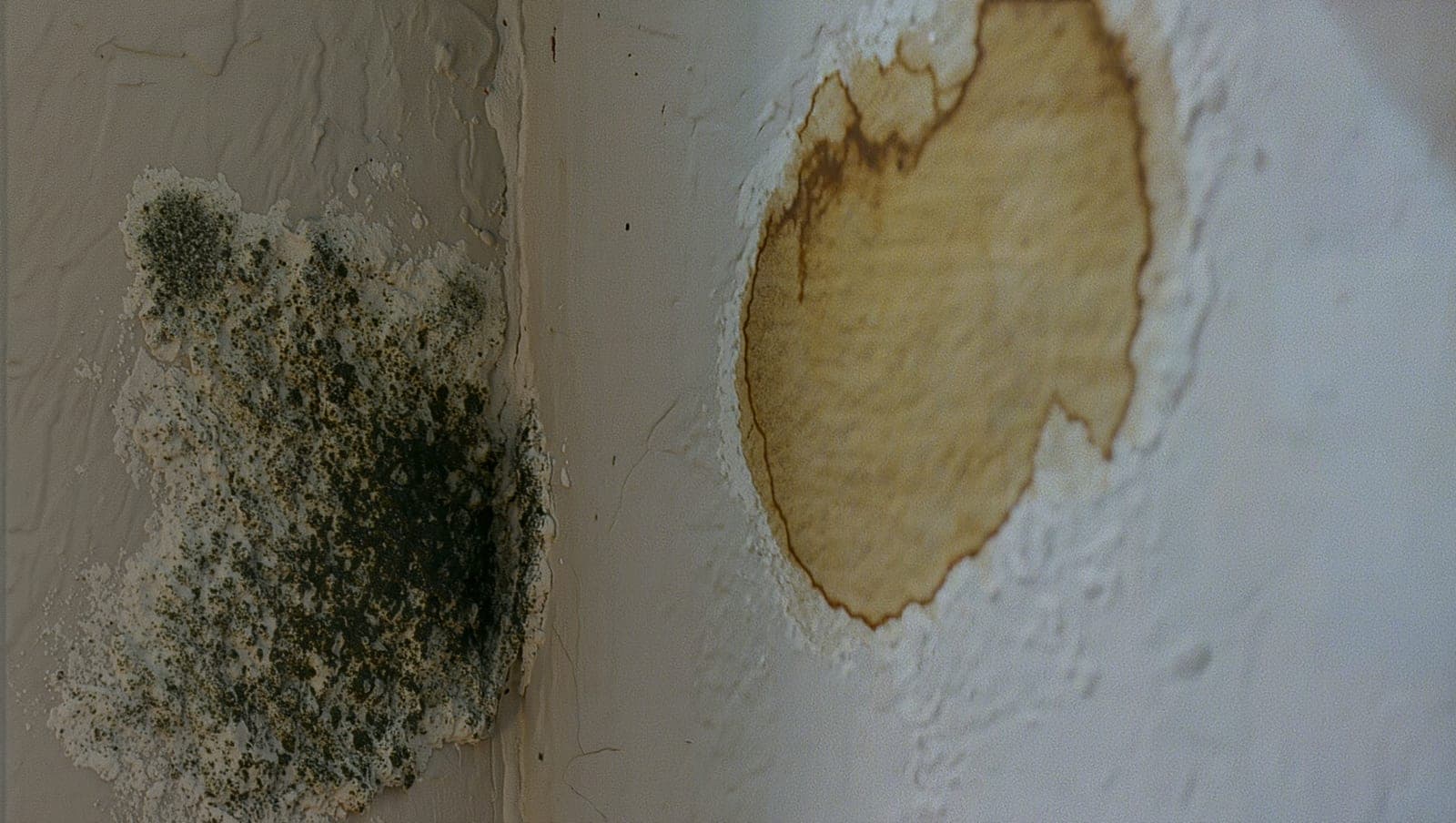
Phoenix has a dry reputation, and it earns it outdoors. Indoors the climate is whatever the nearest leak, shower, or cooler says it is. A tight modern house holds its conditioned air at 76 degrees while the attic bakes at 140, and cold supply lines sweat inside warm walls. A bathroom fan that vents into the attic instead of outside leaves the ceiling damp after every shower. A swamp cooler adds moisture to the air on purpose. Inside a closed wall cavity, humidity is local, and local is all mold needs.
The confusion runs both ways. Homeowners scrub at white crust on a garage wall that is hard-water mineral, not mold, and they paint over black speckling in a shower corner that is mold, not a stain. The two look similar from across the room and call for opposite responses. A stain is sealed and painted. Mold is removed with the board it grew on. The paint aisle has no product that turns the second case into the first, though bleach is a fine way to make a wall look innocent for a while.
The distinction takes about ten minutes, a flashlight, and your nose. Here is how to make it, what it usually turns out to be in Valley houses, and what happens next in each case.
Likely causes, ranked
- 1
A dried water stain from a one-time leak
most commonTan, yellow, or brown, with a darker rim and a lighter middle, in the shape of a ring, a drip trail, or a tide line along a baseboard. It is perfectly flat under a flashlight held at a low angle, it has no odor, and it looks the same this month as it did last month. The board around it is firm. This is the case that gets sealed and painted.
- 2
Surface mildew from humidity
commonSmall black or gray specks on a bathroom ceiling, in the corner behind a toilet, at the head of a window, or on the exterior wall of a closet packed too full to breathe. It is growth, but shallow growth on the paint film, fed by condensation rather than a leak. It wipes away with a cleaner and returns in a few weeks if the ventilation does not change. Check whether the bath fan actually moves air.
- 3
Mold fed by an ongoing hidden leak
commonFuzzy, velvety, or slimy patches, often black or dark green, sometimes with a white or gray fringe, spreading from a point rather than sitting in a ring. The smell is musty and earthy and gets stronger close to the wall. Paint may be bubbling nearby and the drywall may be soft. This one is growing through the paper, and the water behind it is still arriving.
- 4
Mineral deposits from hard water
less commonWhite, crusty, or powdery deposits on a wall shared with a garage, an exterior wall, or the bottom of a wall on a slab. Phoenix water carries a heavy mineral load, and when it wicks through masonry or concrete and evaporates, it leaves the minerals behind. Touch a wet fingertip to it. Minerals dissolve or smear white. Mold does not dissolve.
- 5
Soot, dust, or ghosting
less commonGray or dark lines that follow the studs and ceiling joists in a regular pattern, or darkening above a candle, a lamp, or a floor register. Fine dust and soot cling to the cooler strips of wall over framing, especially in a house that runs candles or has a dusty return. It has no smell, no fuzz, and no relationship to plumbing. A dry sponge takes it off.
Check it yourself in ten minutes
- 1Look at color and shape. Tan to brown in a ring or a tide line reads as stain. Black, green, or gray in speckles, clusters, or a spreading blot reads as growth. White and crusty reads as minerals, and it dissolves under a wet fingertip where mold only smears.
- 2Hold a flashlight almost flat against the wall. A stain has no height. Mold has body: fuzz, a velvet nap, or a raised crust that casts a tiny shadow.
- 3Put your nose within a few inches. A musty, earthy, damp-basement smell means something is alive. A stain smells like the wall.
- 4Outline the edge in pencil and photograph it. Check it in a week. Stains hold their line. Mold moves.
- 5A bleach spot test is a clue, not a verdict. A dab of diluted household bleach lightens mold within a minute or two while dirt and most stains hold their color. The caveats: bleach also lightens some paints and tannin stains, a negative on the surface says nothing about the back of the board, and the test belongs on a spot the size of a coin, with the window open and no other cleaner in the room.
- 6Press the wall around the spot. Softness under suspected mold means the leak is live and the question has answered itself.
The fix
Seal and paint a confirmed stain
When the mark is a dried stain on firm, dry board and the source has been fixed, it is primed with a shellac- or oil-based stain blocker and painted. No cutting required.
Ceiling Water Stain Repair
Cut out a small area of confirmed mold
A patch of growth the size of a hand or two on the face of otherwise sound drywall is cut out generously, bagged, the cavity behind it dried and inspected, and a new piece set in, taped, textured, and painted.
Drywall Patch Repair
Remove wet, moldy drywall and rebuild after the leak is fixed
When mold rides on a live leak, the order is fixed: licensed plumbing or HVAC stops the water, the wet and moldy board comes out to dry material, the cavity is dried with air movement, and only then is it closed.
Water-Damaged Drywall Repair
Replace the wall when growth is widespread
A shower wall or a closet wall with growth across most of its face is replaced rather than patched in pieces. If growth continues into framing, insulation, or ductwork beyond what a section replacement exposes, we refer the remediation to a specialist before rebuilding.
Drywall Replacement
When to stop diagnosing and call
Call when the flashlight shows fuzz, when the smell is there, when the outline moved in a week, or when the wall is soft. Call sooner if the spot is in a bedroom or a nursery, or if anyone in the house is reacting to that room. Bleuwave Handyman removes and replaces small areas of mold-affected drywall as part of water-damage repair, dries the cavity, and rebuilds after the licensed plumbing or HVAC company in the Bleuwave family has stopped the water. We are not a remediation company and do not claim to be one. Larger growth, growth inside HVAC or insulation, or growth we cannot see the end of gets referred to a remediation specialist, and we say so at the estimate rather than after the wall is closed. Licensed, insured, and bonded, Veteran Owned & Operated since 2022, serving 35 miles around Phoenix with same-day, next-day, and after-hours availability. Estimates are free.
More questions on this one
Can I clean mold off drywall instead of replacing it?
Shallow mildew on a painted bathroom ceiling, the speckled kind that wipes off, can be cleaned, and it will stay gone if the room is ventilated. Growth that has reached the paper face cannot be cleaned, because the paper is what it is eating. Once mold is in the paper, the board is removed. Scrubbing it only makes the surface look better than the board is.
Does black mold on drywall mean toxic mold?
Color does not identify the species, and many common molds are dark. Only a lab can say what a sample is, and we do not test. The practical answer is that any growth on drywall gets removed the same way, so the species rarely changes the plan. If you want it identified, an industrial hygienist or a remediation company can sample it.
Why is there mold in my house in a dry climate like Phoenix?
Because the wall cavity is not the desert. A leak, a sweating cold line, a shower without a working fan, or a swamp cooler creates a small humid zone inside a house that is otherwise dry, and mold only needs that zone, a food source such as drywall paper, and warmth. Phoenix supplies the warmth for free.
Will mold-resistant paint fix a moldy wall?
No. Mold-resistant paint slows new growth on a clean, dry surface. Painted over active growth it seals in moisture and hides the problem while the paper behind it keeps deteriorating. It belongs on new board in a bathroom, not over an existing colony.
How much mold is too much for a handyman to handle?
We remove and replace small, visible areas on drywall, roughly what a section cutout exposes, and dry the cavity behind them. When growth covers a large area, continues into framing or insulation past the opening, is inside ductwork, or there is a health concern in the household, we refer it to a remediation specialist and return to rebuild after they are finished.
Related questions and reading
Elsewhere on the site
Services and reading that follow naturally from this diagnosis.
Still not sure what you are looking at?
Browse every question in the Repair Hub, or skip the reading and have a licensed pro look.