
Diagnosis · Phoenix Metro
Why is paint peeling from my drywall?
Short answer
Paint peels from drywall when the bond between the paint and the surface fails, and that happens for three reasons: moisture coming through the wall, paint applied over an unprimed, dusty, or glossy surface, or an older coat underneath that was never sound. Look at the back of a flake and at what it left behind. Bare brown paper or blistered compound points to water or missing primer. A smooth older coat of paint points to adhesion.
Medium urgencyPeeling paint is cosmetic. What it exposes sometimes is not. If the peel is on a bathroom ceiling, under a window, near plumbing, or comes off with paper attached, treat it as a moisture question first and a paint question second. A peel that exposes smooth old paint on a dry wall can wait for the next painting weekend.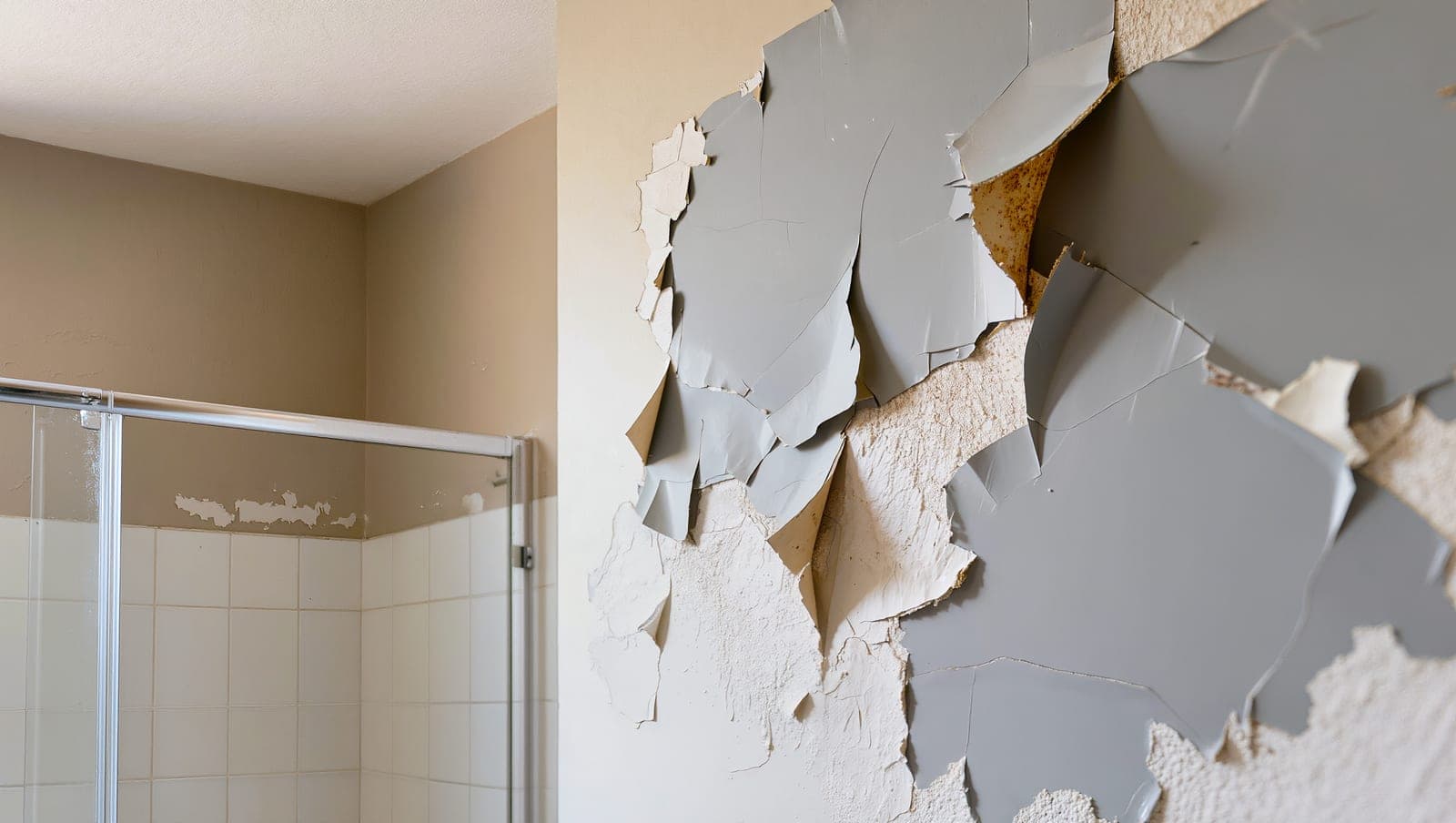
Paint is loyal to whatever it was applied to, including dust. On a clean, primed, dry wall, that loyalty lasts decades. On a wall that was damp, chalky, glossy, or coated with the fine grit of a construction site or a dust storm, the paint bonds to the layer of grit and comes away with it. Peeling is not a paint failure so much as a report on the surface underneath, delivered late.
Phoenix adds its own pressures. Bathroom ceilings in tight, well-sealed houses hold shower steam when the fan is weak or vents nowhere. Garage-side walls and rooms under a 110-degree attic cook their paint until it goes brittle and chalks. West-facing rooms take direct afternoon sun through the glass. Builders and turnover painters roll flat paint over unprimed drywall and patched compound, and the patch telegraphs and lifts a year later. Then there is the leak nobody knew about, which peels paint the way it peels everything else: by getting behind it.
The flake tells you which case you have. Its back, its thickness, and the wall it left behind sort moisture from prep from age in a couple of minutes, and each one has a different fix.
Likely causes, ranked
- 1
Moisture coming through the wall
most commonThe peel is on a bathroom ceiling, above a shower, under a window, beside an air handler closet, or on a wall that shares plumbing. The paint lifts in a sheet or a blister rather than a flake, and it brings brown paper with it or exposes a stained, sometimes soft, surface. Paint is a bandage on a wet wall. It will keep coming off until the wall is dry.
- 2
Paint over unprimed drywall or unsealed compound
commonThe peel is a clean rectangle or a feathered oval, exactly the shape of an old patch, or it runs across a new wall where the paper face and the joint compound absorbed the paint at different rates. Underneath is chalky white compound or bare paper. New drywall and fresh patches need primer before paint. Skipping it saves twenty minutes and costs a repaint.
- 3
Dust, grease, or gloss under the new coat
commonThe flake comes off thin and clean, and what it exposes is a smooth, intact older coat of paint. Latex rolled over old oil enamel in an older house does this. So does paint applied over kitchen grease, over a wall that was never wiped after a remodel, or over the fine film a dust storm leaves through an open window. The bond was never to the wall. It was to whatever was on it.
- 4
Heat and sun
less commonGarage walls, laundry rooms, ceilings under an unvented attic, and the wall a west window lights at five in the afternoon. The paint chalks when rubbed, cracks in a pattern like dried mud, and then lifts at the edges of the cracks. It has been baked past its flexibility. Unconditioned rooms in Phoenix do this to cheap paint in a few summers.
- 5
Too many coats, or a failed coat underneath
less commonThe flake is thick, and its edge shows several colors like the rings of a tree. Rentals that get a fresh coat at every turn build up a stack of paint that is only as strong as its weakest layer, and when one lets go it carries everything above it. The wall underneath may be perfectly sound. The paint stack is not.
Check it yourself in ten minutes
- 1Peel off one loose flake and look at its back. Paint only means an adhesion problem. Brown paper fibers mean water or missing primer pulled the paper face. White powder means it was painted over unsealed compound.
- 2Look at what the peel exposed. Bare tan paper, chalky gray-white compound, a stain, or a smooth older coat of paint each point to a different cause.
- 3Map where it is happening. Bathroom ceiling or shower wall points to humidity. A rectangle points to an old patch. Below a window or near a fixture points to a leak. A garage or a west room points to heat.
- 4Test the bath fan. Hold a single square of toilet paper to the grille with the fan running. If it does not hold, the fan is not clearing the steam that is lifting the paint.
- 5Press around the peel and touch it after a shower or a storm. Softness or dampness moves this from a painting problem to a water-damage problem.
- 6Rub the wall with a dark cloth. A white powder transfer means the paint has chalked from heat or age and the next coat will not stick to it without washing and a bonding primer.
The fix
Fix the water, then rebuild what it ruined
When the peel is moisture-driven, repainting is wasted money. The source is fixed by licensed plumbing or HVAC, any soft or delaminated board is cut out and replaced, and the new surface is sealed and painted once it reads dry.
Water-Damaged Drywall Repair
Patch and seal a torn or blistered area
Where peeling took the paper face with it or lifted an old patch, the loose material is removed, the torn paper is sealed so it will not bubble under new compound, the area is skimmed and primed, and the paint goes on last.
Drywall Patch Repair
Skim coat a wall that has lost its face
When a large area peeled down to paper or a paint stack failed across most of a wall, spot repairs leave a map of edges. A full skim coat gives the wall one continuous surface, primed and painted from corner to corner.
Smooth Wall & Skim Coat Repair
Re-texture where the peel took the texture
Peeling on an orange peel or knockdown wall often lifts the texture with the paint. The bare area is re-textured to match the surrounding wall before primer so the repair does not read as a smooth island.
Texture Matching
When to stop diagnosing and call
Call when the flake has paper on its back, when the wall under it is soft or damp, when the peel is on a bathroom ceiling that has already been repainted once, or when the area is bigger than a couple of square feet. Those cases are drywall work before they are paint work, and painting first means paying twice. Bleuwave Handyman is licensed, insured, and bonded, Veteran Owned & Operated since 2022, with licensed plumbing and HVAC in the family for the leak behind the peel and a crew that patches, skims, textures, and paints so one visit closes the job. Same-day, next-day, and after-hours across 35 miles of Phoenix. Estimates are free, and the estimate is where we tell you whether this is a scraper-and-primer afternoon or something more.
More questions on this one
Can I just scrape the peeling paint and repaint?
Yes, when the cause is adhesion and the wall under it is dry and firm. Scrape everything loose, sand the edges so they feather, wash the wall, prime with a bonding primer, and then paint. If the cause is moisture, the same peel will come back through the new coat within a season, and the scraping was the only useful part.
Why is paint peeling on my bathroom ceiling?
Steam. In a tight Phoenix house the ceiling above the shower gets wet with condensation every morning, and if the fan is weak, vents into the attic, or gets switched off with the light, the paint film never fully dries. Fix the ventilation, let the ceiling dry, scrape and seal, and use a bathroom-rated paint. Repainting without fixing the fan is a subscription.
Why is paint peeling off new drywall or a fresh patch?
Almost always missing primer. Bare drywall paper and joint compound absorb paint differently, and compound in particular is chalky enough that paint bonds to its dust rather than to it. The fix is to remove the loose paint, prime with a drywall primer-sealer, and repaint. A patch painted before its compound was fully dry does the same thing.
Why is paint peeling in my garage?
Heat and no primer, usually together. A Phoenix garage cycles well past 100 degrees in summer, and builder-grade paint over unprimed drywall goes brittle, chalks, and lifts. Wash off the chalk, prime with a bonding primer, and use a better-quality paint. Insulating the garage door helps the paint and everything else stored out there.
Does peeling paint always mean there is a leak?
No. Most peeling is a prep problem. But peeling that brings paper with it, sits near plumbing or under a window, appears in a blister rather than a flake, or exposes a stain should be treated as a possible leak until you have pressed the wall, touched it after rain or a shower, and found it dry and firm.
Related questions and reading
Elsewhere on the site
Services and reading that follow naturally from this diagnosis.
Still not sure what you are looking at?
Browse every question in the Repair Hub, or skip the reading and have a licensed pro look.